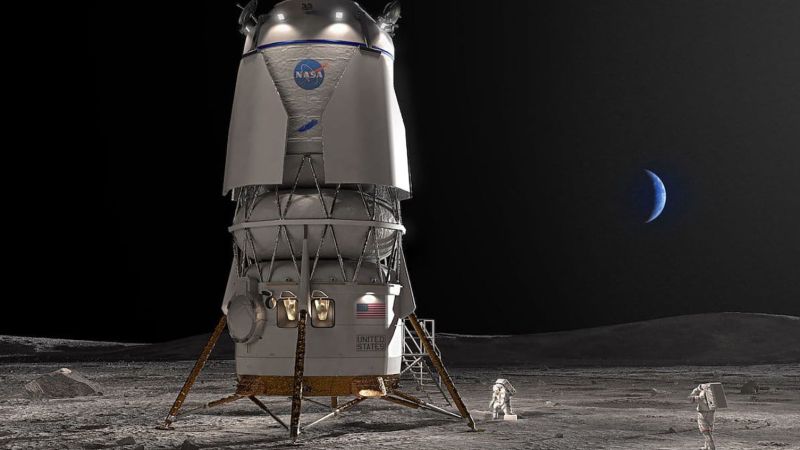
NASA on Friday offered new details about a mad race to have two lunar landers, built by competing companies Blue Origin and SpaceX, and the space agency’s own rocket and spacecraft ready for a crucial test mission next year. “We will not delude ourselves into believing that more time, more money and fewer flights will somehow make our job safer or more doable,” NASA chief Jared Isaacman said Friday at a news conference reaffirming the agency’s commitment to launching a test mission in low-Earth orbit next year ahead of a crewed moon landing in 2028. Blue Origin and SpaceX each have multimillion-dollar contracts with the U.S. space agency to develop vehicles capable of transporting astronauts from NASA’s Orion spacecraft. NASA. to the lunar surface. “All vendors and partners need to understand that when a schedule is missed, NASA staff will knock on the door, not to observe, not to write a paper or convene a committee, but to roll up their sleeves and solve problems,” Isaacman said. In February, Isaacman, then NASA’s new administrator, revolutionized the agency’s roadmap for a lunar landing by adding a test mission for 2027. Called Artemis III, this mission would see vehicles from both Blue Origin and SpaceX practice docking with Orion in low-Earth orbit, or just a few hundred miles above our planet, much closer to home than the moon which is 238,855 miles (384,400 kilometers) away. Two companies, two test landers The estimated 14-day test mission will involve the launch of three massive rockets, as well as the docking and undocking of the Orion spacecraft crewed multiple times with experimental vehicles. It is “probably the most complicated launch campaign ever undertaken,” said Jeremy Parsons, director of NASA’s Artemis Program. Artemis III is designed to help determine which lander NASA might use for Artemis IV, which is scheduled to mark the first time astronauts have landed on the moon’s surface since the agency’s Apollo program concluded in 1972. Blue Origin and SpaceX are developing very different vehicles. SpaceX, which was the first to close a lunar landing contract in 2021, intends to use its massive Starship launch vehicle, which is in development but recently completed its first orbital test flight. Starship is a two-part launch system that includes the Super Heavy rocket booster and the upper Starship spacecraft, a 171-foot-tall vehicle equipped with six rocket motors of its own. The Starship spacecraft would serve as both a lunar lander and the upper stage of the rocket itself. The vehicle is unlike anything ever flown in the history of space flight. However, Blue Origin’s Blue Moon Mark 2 comes much closer to legacy lunar lander designs. Blue Moon is expected to launch inside the cargo bay of Blue Origin’s New Glenn rocket and, at 52 feet tall, is visually reminiscent of a scaled-up version of NASA’s Apollo-era landers. Blue Moon has not yet conducted a test flight. The company had intended to launch a reduced-payload version this year, called Blue Moon Mark 1. But those plans were put on hold after a New Glenn rocket exploded in May during routine ground testing, destroying the company’s launch site in Florida. Both Blue Origin and SpaceX vehicles have a long series of technological tests and demonstrations ahead of them before Artemis III or Artemis IV. Neither vehicle has ever flown with a crew on board or docked with a spacecraft carrying astronauts. At Friday’s meeting, NASA also acknowledged a number of changes it has made to other aspects of the Artemis program, including efforts to speed up production and design changes for the agency’s Space Launch System rocket and Orion spacecraft, as well as the green light for a simplified, lighter version of the Moonwalking spacesuits designed by the Houston-based company Axiom. The simplified suits are supposed to be deployed more quickly for the first lunar landing missions, including Artemis IV, but Axiom will continue to build the more advanced version for more difficult lunar excursions later in the Artemis program. Almost across the board, NASA is “looking to simplify and eliminate difficult requirements,” Parsons said. But it’s the lunar landers, Parsons added, that are currently driving NASA’s schedule. Hardware is currently being built for the Blue Moon vehicle that will fly the Artemis III mission. Meanwhile, SpaceX will fly a relatively basic version of Starship that will essentially be “pulled” off the company’s production line next year as the company continues to tweak the vehicle’s design. Test flights have shown problems with the reliability of Starship’s Raptor rocket engines. NASA Associate Administrator Amit Kshatriya told CNN that in his opinion, “most of what you’re seeing now are issues that affect reusability.” Basically, the current engine issues could impact SpaceX’s ability to reuse the ship and therefore save costs, but that doesn’t mean Starship isn’t on track to support Artemis III, he explained. “What we want to make sure is that we can put a Starship into orbit with the amount of dwell time necessary to perform this docking test,” Kshatriya said, referring to NASA’s need to see that the Starship can maintain a stable orbit during the mission. According to a recently released schedule for the Artemis Program, in the coming months, SpaceX will need to finish building the Starship prototype that will fly the Artemis III mission and complete several demonstrations to test the vehicle’s landing legs and airlock. In the meantime, it will continue its Starship test flight campaign, including expanding operations to two new launch pads in Florida and conducting the first fuel transfer test between two Starship vehicles in orbit. Such a propellant transfer will be necessary to take the heavy Starship to the moon. Never before has supercold cryogenic propellants been transferred between two vehicles in Earth orbit. SpaceX’s first demonstration is expected in early 2027. For a moon landing, SpaceX will need to conduct multiple refueling flights. Previously, experts had estimated the number could be between 10 and 40. However, CEO Elon Musk said on social media this week that a moon landing would require six to eight launches. NASA officials confirmed Musk’s estimate on Friday, but noted that a final figure likely won’t be known until propellant transfer tests are performed. Blue Origin’s Blue Moon Mark 2 will also require some complicated prep work in low Earth orbit before heading to the moon. NASA said Friday that the lander would need to dock with at least three boost stages. The company also has a long to-do list. Blue Origin must get its New Glenn back into the air, which could happen by the end of the year, and get its delayed Blue Moon Mark 1 test flight off the ground early next year. The Blue Moon Mark 2 lander used on Artemis III will also need to be equipped with life support systems. The crew of four astronauts who will be aboard Orion during the mission are expected to board the Mark 2 vehicle while it is docked to the spacecraft. NASA does not expect to try the same with Starship. Citing SpaceX’s past experience flying crewed Dragon vehicles, the agency said it believes it can adequately examine the company’s life support systems outside of the Artemis III mission. After Artemis III, both Blue Moon Mark 2 and Starship are expected to make uncrewed trips to the moon to practice landing. NASA has not yet determined which of the two vehicles will be used for its Artemis IV mission after withdrawing its commitment to SpaceX last year and pledging to use whichever vehicle was ready first. The agency cited a desire to secure its mission schedule amid a race with China. Artemis IV is currently scheduled for early 2028, with the landing of a second astronaut, Artemis V, coming later that year. That schedule is widely expected to change. China has been working for years to have its taikonauts reach the lunar surface for the first time by 2030. Experts believe the nation will most likely meet or exceed that deadline. NASA’s intention to accelerate its schedule will require building, testing and ensuring the safety of a wide range of components, which Kshatriya acknowledged is a huge challenge. “It’s not that I don’t recognize that if you go fast, you can make mistakes. That’s obviously true in life,” Kshatriya told CNN. But “you can go fast and be careful as long as the things you look at are important.” Kshatriya added that there will be “no changes” to NASA procedures and how its engineering technology authorities oversee mission safety. EDITOR’S NOTE: This story has been updated with additional reporting. Subscribe to CNN’s Wonder Theory science newsletter. Explore the universe with news about fascinating discoveries, scientific breakthroughs and more.