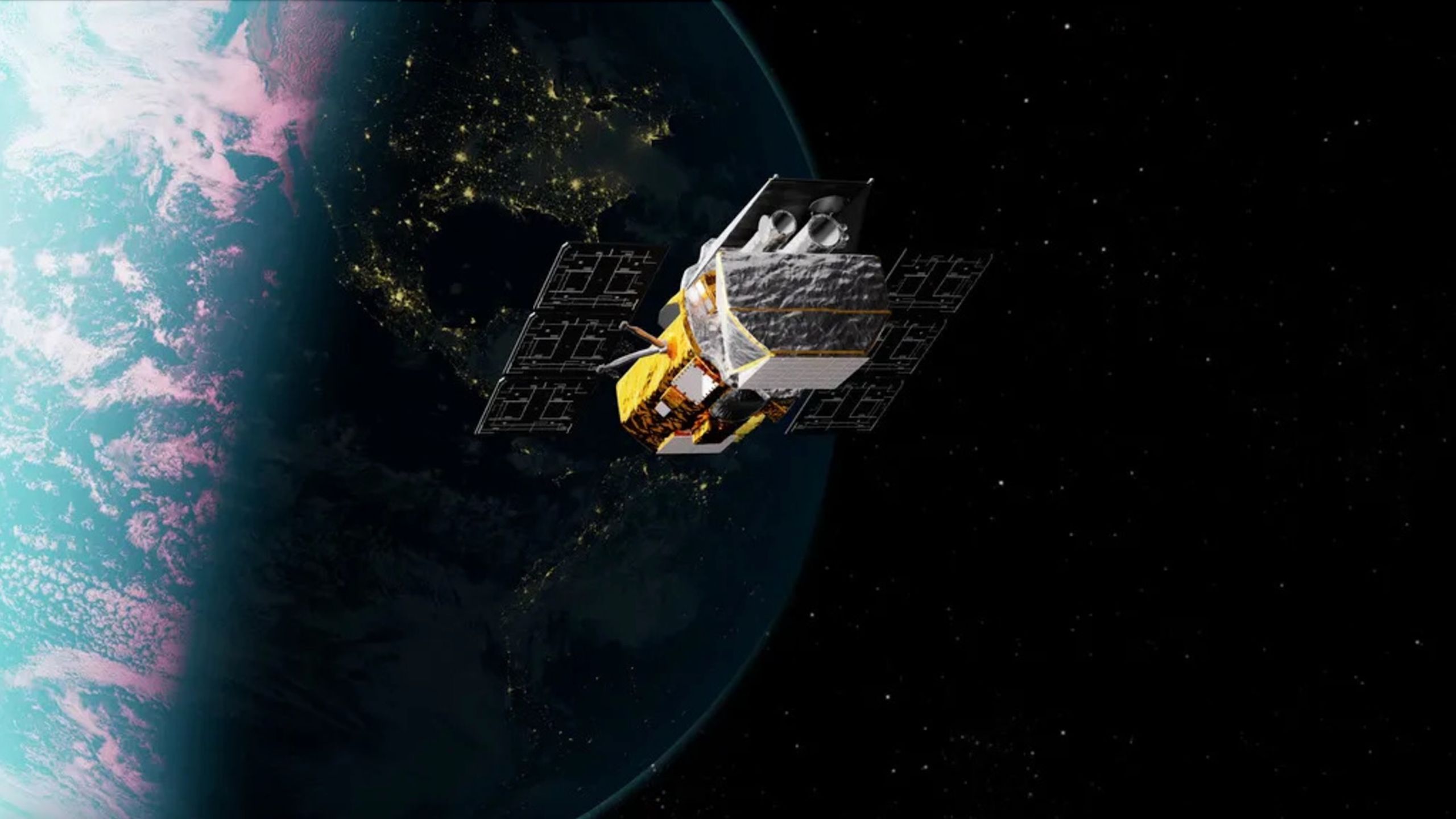
Follow Us Add us as a preferred source on Google Newsletter Subscribe to our newsletter NASA has officially ended the mission of its Swift space telescope, after a private satellite failed in its daring attempt to rescue the aging spacecraft. That rescue mission was led by Arizona company Katalyst Space Technologies, whose LINK spacecraft attempted to rendezvous with Swift this summer to boost its orbit. However, that didn’t work, so Swift continues his fall toward Earth. The telescope is expected to re-enter Earth’s atmosphere “in the coming weeks,” NASA said in a statement on Friday (Oct. 23). That statement primarily served to announce the end of the Swift mission after more than 20 very productive years. The telescope was launched into Earth’s orbit in November 2004, with the task of studying gamma ray bursts (GRBs), the most powerful explosions in the cosmos. Swift was designed to operate for two years, but continued studying the high-energy universe for more than two decades. “At that time, Swift played an important role in advancing our understanding of the changing universe and was part of a revolution in astrophysics that showed how critical fast-response observations are to the entire community,” Shawn Domagal-Goldman, director of the Astrophysics Division at NASA Headquarters in Washington, said in the statement. NASA hoped Swift would continue to operate for longer. In September 2025, the agency awarded a contract to Arizona company Katalyst Space Technologies to rescue the observatory, which was falling back to Earth due to atmospheric drag. Swift does not have thrusters capable of counteracting this resistance. So Katalyst built a refrigerator-sized spacecraft called LINK, whose goal was to rendezvous with Swift, grab it with three robotic arms, and propel it into a higher orbit, allowing the observatory to continue its scientific work. NASA and Katalyst emphasized from the beginning that success was far from guaranteed. After all, LINK’s mission was unprecedented: no private spacecraft had ever captured and boosted a satellite that wasn’t designed to be serviced in this way. And the pace of Swift’s orbital decay demanded a rapid timeline: LINK launched on July 3, just over nine months after Katalyst won NASA’s $30 million Swift rescue contract. LINK was unable to execute its very challenging mission. About three weeks after takeoff, it suffered problems with its propulsion system and the reaction wheels that maintained orientation, causing it to begin spinning at an unexpected rate. These problems prevented LINK from capturing and boosting Swift, but the private craft managed to get within 12 to 15 kilometers (7.5 to 9.3 miles) of the observatory and photograph it. What to read next “From the beginning, this was a high-risk, high-reward mission,” Domagal-Goldman said in a statement on September 25, the day LINK fell to Earth. “And while we will be sad to see Swift’s mission come to an end, we knew this momentum effort would be worth it either way: advancing American spacecraft maintenance technology, challenging us to meet unprecedented mission schedules, and testing how we operate satellites to extend their time in low-Earth orbit.” he added. Katalyst Space’s LINK robotic service spacecraft captured this view of one of its solar arrays in Earth orbit in August 2026. (Image credit: Katalyst Space)) Swift, which was officially renamed the Neil Gehrels Swift Observatory in 2018, in honor of its first principal investigator, who died a year earlier, collected its latest science data on October 20, according to NASA’s Friday update. During its long and storied career, the Space Telescope observed more than 2,000 GRBs. And he did other work, too, studying more than 1,400 supernova explosions, as well as observing asteroids, comets and black holes and conducting an all-sky study in X-ray light. Data from the mission has contributed to about 7,000 scientific papers published to date, according to NASA officials. And that number will surely continue to increase in the future. “Swift leaves us with an extraordinary archive of multi-wavelength observations that will drive new discoveries for decades to come,” Domagal-Goldman said in the Oct. 23 statement.