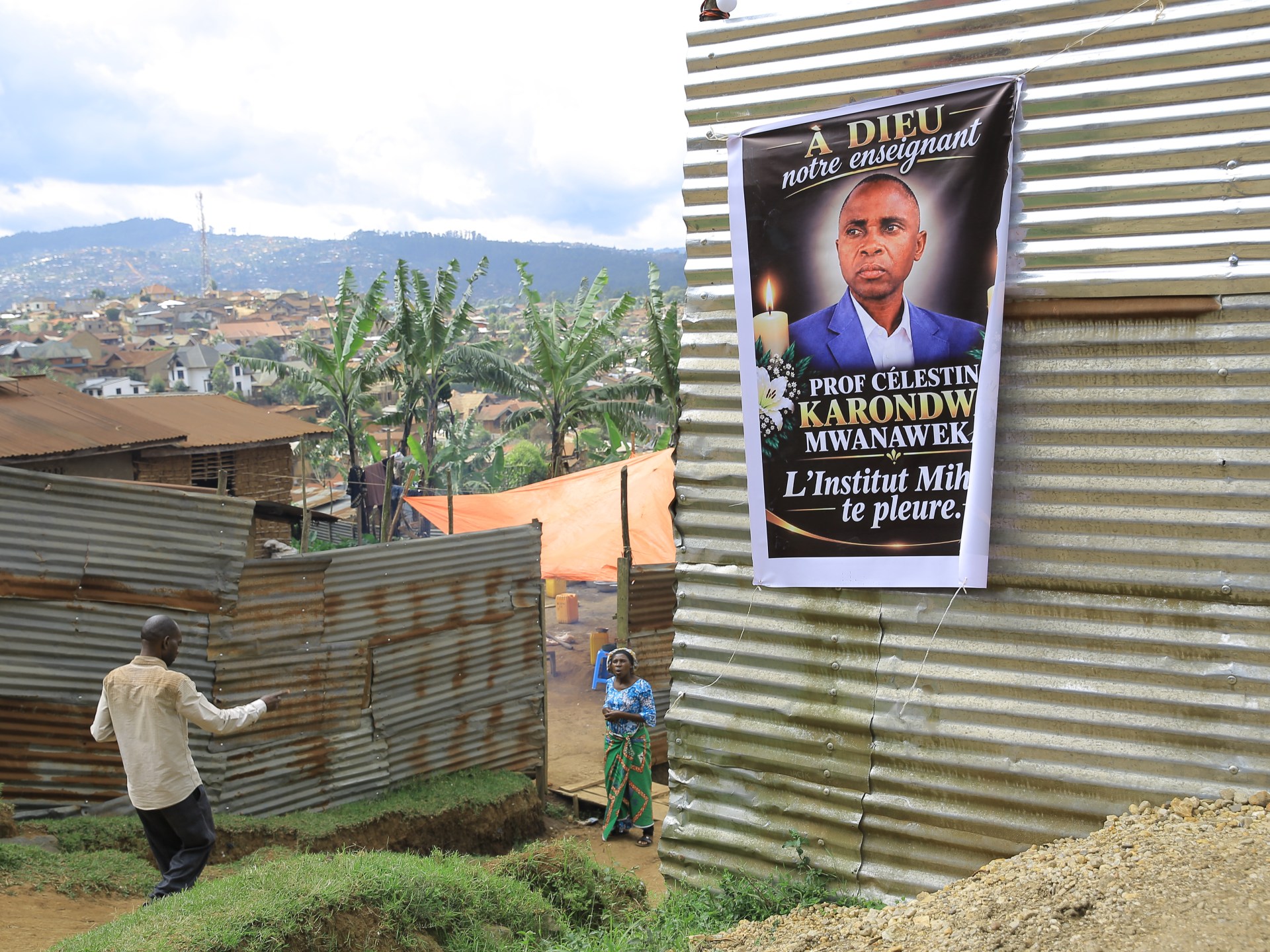
Marie-Celestin Karondwa died from her injuries after being beaten at her home in the town of Butembo, an Ebola hotspot, on Sunday. Published October 1, 2026 October 1, 2026 Mourners gathered in eastern Democratic Republic of the Congo (DRC) to bury a local politician who his party says was beaten to death after he defended the government’s response to Ebola on the radio. Marie-Celestin Karondwa’s funeral was held in the city Karondwa was attacked on Sunday in his home in Butembo, an Ebola hotspot in North Kivu province, according to his political party, the Union for Democracy and Social Progress (UDSP), which heads the Democratic Republic of Congo’s government. He died from his injuries at a local hospital. “They beat him and then set fire to the house,” his granddaughter, Sagesse Kavira, told the Associated Press news agency at the funeral. The party said Karondwa was “an innocent victim for having defended the party’s position on the existence of the Ebola virus disease… and the threat it poses to the population.” It was not immediately clear who carried out the attack, how many people were involved or what motivated it. Karondwa, a local official who was beaten to death after publicly defending the government’s response to Ebola, in Butembo, Democratic Republic of the Congo, on September 30, 2026. [Sebastien Kitsa Musayi/AP]The killing follows a series of attacks on health workers and other responders as the Central African nation battles its 17th and deadliest Ebola outbreak, which has so far recorded more than 8,000 cases, including nearly 4,000 deaths. The current outbreak is caused by the Bundibugyo strain of the virus, for which there is no vaccine or specific treatment, according to the World Health Organization (WHO). Researchers are testing potential candidates, the agency said. The WHO said Ebola was present in provinces such as Bas-Uele, Haut-Uele, Ituri, North Kivu, South Kivu, South Ubangi and Tshopo. He said Ituri remained the most affected. Officials have tried to combat the outbreak through a village-based approach, but some residents have resisted, dismissing Ebola as a hoax amid deep distrust in the government. Many believe the disease is a ruse by officials to divert money. Some refuse to report their symptoms out of disbelief or shame at being Ebola patients. Respondents say skepticism has complicated their work, even in remote communities and new emerging hotspots that lack medical supplies and health workers. Mistrust has been especially difficult to overcome in rebel-held areas of eastern DRC, where decades of conflict and human rights abuses have left many residents distrustful of outsiders and state authorities. Tedros Adhanom Ghebreyesus, WHO director-general, has said the east of the country faces “a catastrophic collision of disease and conflict” that is hampering the response.