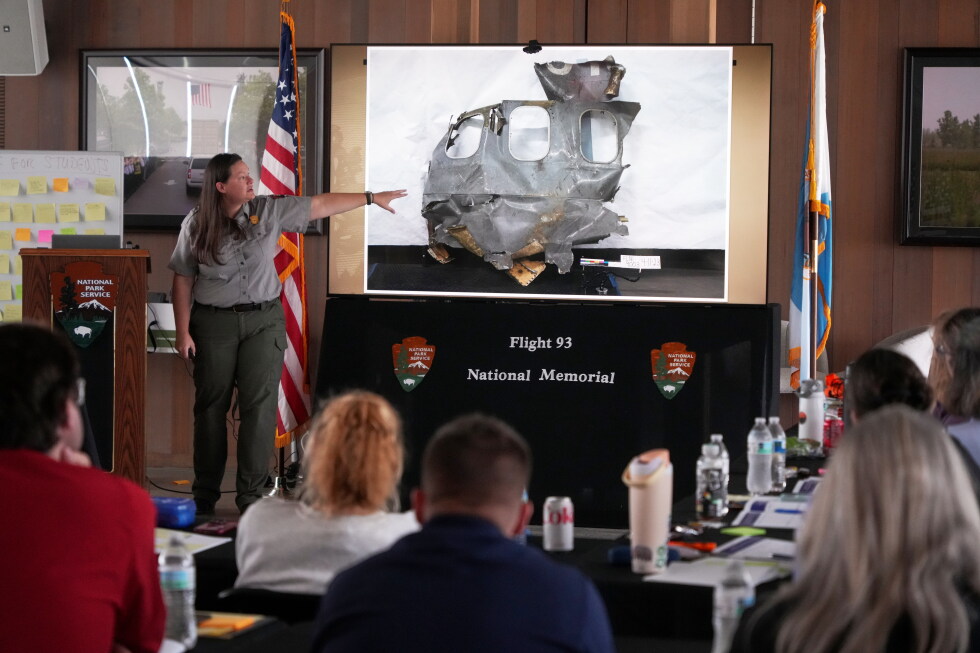
For three days this summer, teachers gathered at the National Flight 93 Memorial in remote western Pennsylvania to talk about 9/11. What’s the best way to educate a new generation about the 25-year-old attacks? What details are appropriate for young children? What do the families of the victims want students to be told about the dead? “Even worse than getting off to a bad start or using inappropriate language is the complete failure to tell the story,” Gordon Felt, whose brother Edward Felt died on United Airlines Flight 93 on Sept. 11, told teachers in one session. “That is our biggest fear.” Teaching about 9/11 in schools is more important than ever now that about a third of Americans were born after al Qaeda hijackers crashed planes and killed nearly 3,000 people in New York, the Pentagon and rural Shanksville, Pennsylvania. A growing majority of states (at least 40) expect or suggest that public schools address 9/11 in some way, but provisions vary widely in scope, specificity and framework, The Associated Press has found. State educational standards range from detailed course content to broad concepts. As a result, some do not specify what to teach about 9/11. A decade after the attacks, about 60% of states did not explicitly mention 9/11 in their education standards, but there has been more movement toward teaching as time has gone on and the attacks have been seen as “an established event,” said Jeremy Stoddard, an education professor at the University of Wisconsin. He, now-retired dean Diana Hess, and their colleagues have researched 9/11 education for decades. “For those states that include it, it appears to be going much deeper than in the past,” Stoddard said. States vary in teaching about 9/11. Twenty-five states have laws or educational standards that require or expect public schools to provide instruction specifically about the 9/11 attacks, and another 13 have optional mentions of 9/11, according to data compiled by the AP. Several other states have laws requiring or recommending compliance with school standards, bringing the number of states with some policy to at least 40. In states without specific laws or standards, schools and teachers may also choose to discuss attacks on their own. ___ Here’s how each U.S. state addresses the history of 9/11 in schools. Subscribe to Morning Wire: Our flagship newsletter breaks down the day’s biggest headlines. ___The AP compiled its data through requests to all states, reviews of standards in four states that did not respond and interviews with lawmakers and other officials. While states may share an interest in teaching about 9/11, their approaches differ. In Alabama, 9/11 fits into “U.S. military involvement in international conflicts since 1980” for students as young as fifth graders. Texas has held up 9/11 and the events surrounding it as an example of “radical Islamic terrorism” and a key piece of modern history in general. Colorado suggests high school students could discuss the aftermath of 9/11, including “discrimination in the Middle East.” New Mexico foresees debates that could include not only post-9/11 wars and legislation, but also the U.S. detention of suspected enemy combatants at the Guantanamo Bay naval base in Cuba and the Abu Ghraib prisoner abuse scandal. The class lessons of states do not always correspond clearly to their political leanings. States as politically different as California, Florida, New Jersey and North Dakota propose or expect students to discuss post-9/11 efforts to balance national security and civil liberties, for example. But reviews of social studies that reflect conservative priorities have tended to include 9/11. A 2023 Florida law even specifies that certain middle and high school courses devote 45 minutes to 9/11. Louisiana’s “Freedom Framework,” drawn up in 2022 after conservative complaints about an earlier draft, begins mentioning 9/11 in the second degree. “We came together around our belief that 9/11 needed to be included in a very real way,” Louisiana Superintendent of Education Cade Brumley said by phone this spring. He hopes students learn that “threats to our freedom are real, but I think as Americans we are pretty powerful when we stand together and face that adversity.” A 2022 Arizona law required “age-appropriate education” on 9/11 in all public schools, until lawmakers reduced it last year to seventh through 12th grades. “We have to protect young children from the true horror of 9/11 and ensure that older children never forget,” said state Sen. John Kavanagh, a Republican who sponsored the first measure and supported both. In Congress, Rep. Andrew Garbarino, R.N.Y., proposed a resolution encouraging all states to teach students about the attacks. Educating teachers, along with students About 60% of American young adults say they learned about the attacks at school, according to a recent Pew Research Center survey that included about 250 adults born after 2000. But if educators’ role in raising awareness about 9/11 is clear, it hasn’t been easy. When Megan Jones became chief of education at the National September 11 Memorial and Museum in 2014, teachers told her they were worried about bringing up traumatic memories for students. Now, students often need basic facts, and teachers reconcile their own painful memories with the reality that students view September 11, 2001, as a distant story. The key is “helping them understand how 9/11 ultimately shaped the world they live in,” Jones said. The New York Memorial has raised more than $25 million this year to enhance student field trips, teacher training and other educational programs. The Flight 93 Memorial attracted 40 Pennsylvania teachers to its site in June, hoping to generate more education about 9/11, said organizer Donna Gibson, executive director of the Friends of Flight 93 National Memorial. Fifth grade teacher Martha “Marty” Runzer went to explore a topic with personal meaning. The former United Airlines flight attendant wears her old wing pin every 9/11, telling her West Chester students about her colleagues who died and emphasizing how everyday people, like the passengers of Flight 93 and the crew members who tried to wrest control from the 9/11 hijackers, became “everyday superheroes.” John Boston Bradley, on the other hand, does not remember 9/11. The 28-year-old social studies teacher has taught his Catholic high school students in Johnstown about the attacks, but said the memorial symposium inspired him to convey more of “the human and emotional aspect.” “It will help our students understand that these difficult stories need to be told,” he said. How Children View 9/11 “Why did they want to crash into us?” Desmond Killian, 9, asked his parents as they looked around 9/11 Memorial Plaza in New York on a recent afternoon. “These are some difficult things to talk about,” Father Eric Killian responded. Desmond took that in and then asked, “What country?” “It wasn’t so much a country,” Eric Killian said. school. The state recommends that all public schools observe a moment of silence and suggests that high schools discuss the impact of the attacks on American politics and world affairs. Another visitor, 17-year-old New Jersey high school senior Ameya Williams, had learned a lot about 9/11, from the missing warning signs before the attacks to rebuilding afterward. Additionally, Williams has heard stories from family members, including his grandfather, who was on his way to work at the World Trade Center in New York when he was hit. “I feel like understanding it is understanding what they went through,” Williams said.___Associated Press writers Marc Levy in Shanksville, Pennsylvania, and David A. Lieb in Jefferson City, Missouri, contributed to this report.