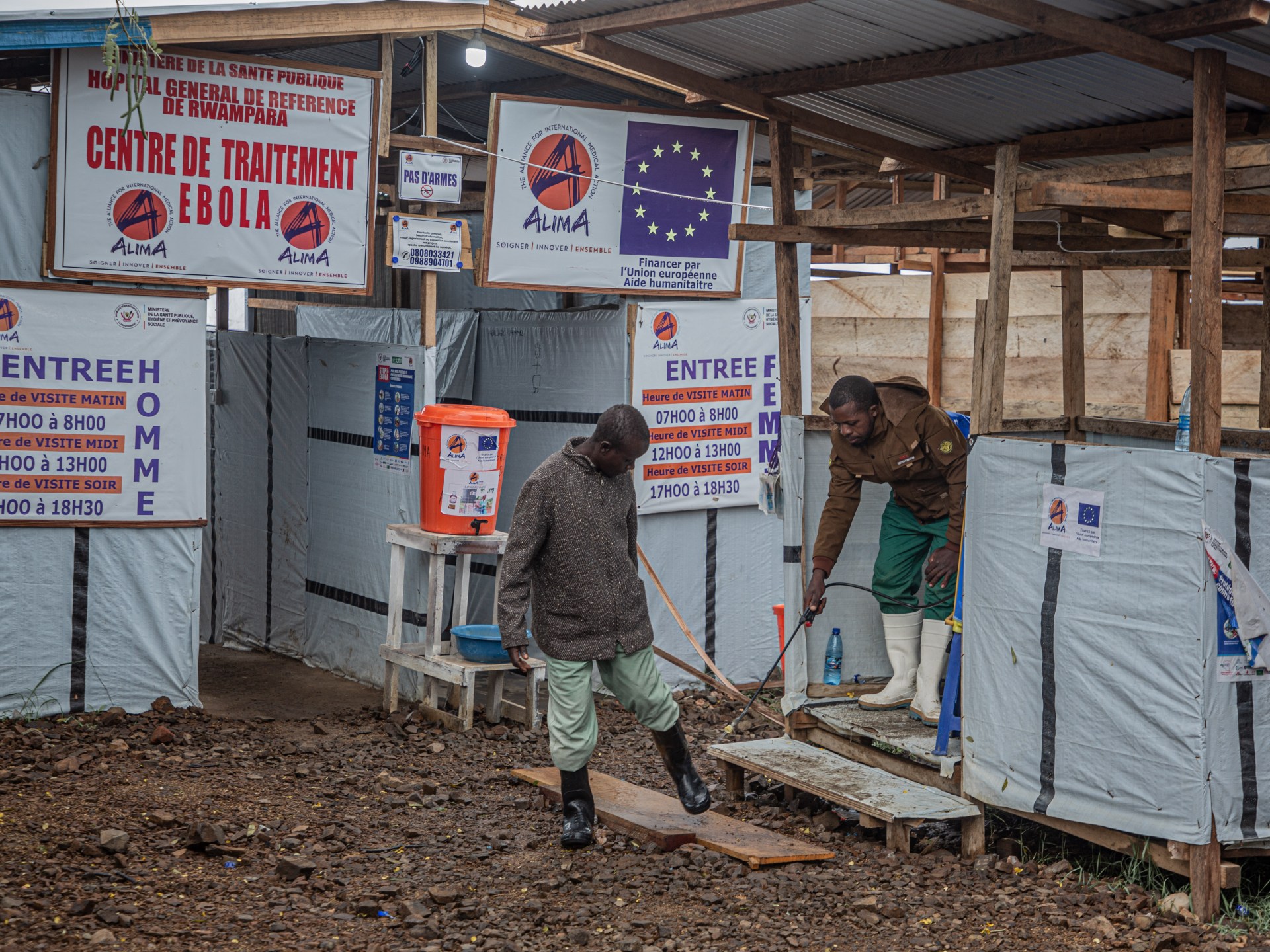
The doses are the first of 70,000 allocated for Kinshasa as experts warn of the virus’s exponential spread.Published On 22 Aug 202622 Aug 2026The Democratic Republic of the Congo (DRC) has received more than 16,000 doses of the Ervebo vaccine developed for a previous strain of Ebola, as the country faces its deadliest-ever outbreak.The 16,250 doses arrived in the capital, Kinshasa, late on Friday evening, comprising the first of 70,000 that the World Health Organization (WHO) and partners pledged to provide on Thursday.Recommended Stories list of 4 itemsend of listMore doses are set to arrive next week.Although the vaccine is approved against the Zaire strain of the virus, the Bundibugyo strain currently circulating in the country has no approved vaccine or treatment.Early data from animal trials show it may offer some protection, according to the WHO.Samuel Roger Kamba, the DRC’s health minister, told reporters Ervebo had been used several times in the past, including “on a very large scale” during the 2018 to 2020 outbreak.Of the 70,000 doses intended for the DRC, 20,000 will be part of a late-stage clinical trial to test its effect on the Bundibugyo strain, the WHO said. The remainder is allocated to front-line health workers.Ervebo ‘could have some value’“There is some evidence that this vaccine could have some value,” said Paul Hunter, an epidemiologist and a professor of medicine at the University of East Anglia.“We know from animal studies conducted 10 years ago that the vaccine for the Zaire strain, which is the one of this virus, does reduce the risk of dying,” he told Al Jazeera on Saturday.“There are also some studies on humans,” he added, “that show some cross-reaction between the Zaire vaccine and the virus.”The DRC outbreak has killed more than 2,500 people out of nearly 5,300 confirmed cases, with the United Nations warning this week that infections continue to spread “exponentially”.Hunter, who is a former WHO consultant on Ebola, said: “In animal studies, even the animals that still got the infection, they seem to have less virus, and hopefully it will be less infectious and therefore the chances of passing the virus on might even be reduced.”However, he added, “But that’s just speculation at this point.”Although the outbreak was declared in mid-May, it is believed to have started weeks beforehand. Data from the Africa Centres for Disease Control and Prevention, meanwhile, shows that transmission has not yet peaked and could reach three times its known rate.Efforts to contain the virus have been stymied by ongoing armed conflict, delays in identifying cases and a lack of infrastructure in the eastern DRC, experts say.