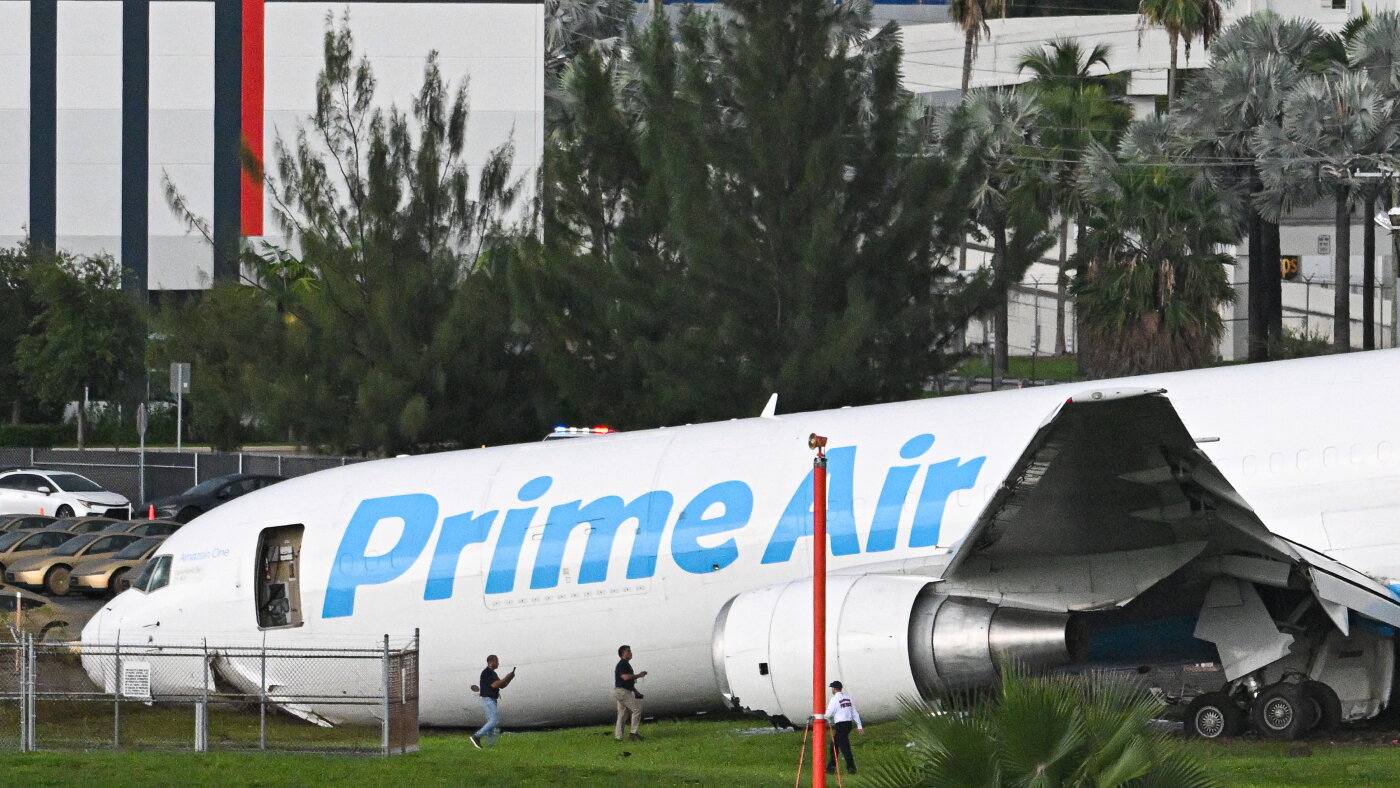
Officials investigate a Prime Air cargo plane at Miami International Airport after it overran the runway at Miami International Airport in Miami, Florida, on Sept. 6, 2026. An Amazon cargo plane skidded off the runway while landing in Miami, crashed into vehicles and caught fire, officials said. Chandan Khanna/AFP via Getty Images hide caption toggle caption Chandan Khanna/AFP via Getty Images In the moments before an Amazon cargo plane crashed at Miami International Airport on Sunday, automatic warning signals blared in the cabin. One pilot warned the other that the plane was approaching too fast, according to details from cockpit voice recordings released this week by the National Transportation Safety Board. But the flight crew went ahead with the landing anyway. “In my 60 years of flying, I have never seen such terrible performance by a crew,” said Ross Aimer, CEO of Aero Consulting Experts and a retired airline captain who worked in the industry for more than 40 years. The plane was traveling at about 180 miles per hour when it landed awkwardly on the runway, flight data logs showed. The pilots briefly attempted to take off again before the plane plummeted approximately 1,300 feet past the end of the runway and crashed into two vehicles on the ground. Five people died, all of them workers at a company that cleans airplanes. Five more were injured. “It was a very, very shaky approach from the beginning,” Aimer told NPR. In that situation, he says, pilots are trained to turn around and try to land again. “These guys should have turned around long before they even got close to that airport.” The cargo plane crash in Miami is raising concerns about the safety culture at 21 Air, the little-known airline that operated the flight for Amazon. The former pilots were raising alarms about the company’s safety practices long before Sunday’s crash, although the company disputes their claims. It is also raising questions about the retail giant’s practice of contracting with multiple smaller carriers rather than operating its own fleet of aircraft. “The main question would be,” Aimer said, “why is a major company, a very wealthy company like Amazon Prime, outsourcing its flights to a number of what I would call night-flying operations like 21 Air?” Officials investigate the scene where cars were damaged after a Prime Air cargo plane overran the runway and crashed into vehicles at Miami International Airport in Miami on Sept. 6, 2026. Chandan Khanna/AFP via Getty Images hide caption toggle caption Chandan Khanna/AFP via Getty Images Amazon strongly disputed that characterization. An Amazon spokesperson says its carrier model is standard practice across the aviation industry and that it contracts with carriers certified by Federal Aviation Administration air safety regulators. “Nothing is more important to us than safety; this includes the safety of the people who operate flights on our network, the safety of the communities around the airports we use, and the safety of the people who handle our cargo,” Amazon spokesperson Kelly Nantel said in a statement to NPR. The Miami crash is the third major accident involving a 767 flying for Amazon. In 2019, a flight operated by Atlas Air crashed into Trinity Bay during its approach to Houston, killing both crew members and one passenger on board. The NTSB found that the probable cause was pilot error. (Atlas Air remains a major cargo airline, but no longer operates flights for Amazon.) In 2024, another Boeing 767 flying for Amazon overran the runway at Vancouver International Airport in Canada. In that case, the Cargojet crew reported mechanical problems with the plane’s flaps. No one was injured during the high-speed landing. The plane was damaged but was later repaired and returned to service, Amazon said. Amazon is not the only carrier to suffer a fatal accident. In November, a UPS cargo plane exploded shortly after takeoff in Louisville, Kentucky, killing all three crew members on board and 12 people on the ground. The NTSB investigation has focused on a defective part in an engine mount on the McDonnell Douglas MD-11. Pilot experience Amazon currently has contracts with nine different airlines, with more than 100 planes in service in total, according to Cirium, an aviation analytics company. They include big names like Alaska Airlines, Allegiant Air and Cargojet, as well as lesser-known companies like 21 Air that specialize in cargo. 21 Air operates a total of eight aircraft for Amazon, according to Cirium, including the Boeing 767 involved in the Miami crash. The company, based in North Carolina, also flies for DHL. For pilots, smaller cargo airlines, like 21 Air, often serve as “a stepping stone to a bigger, better job,” said Aimer, who spent much of his career flying for United Airlines. “They attract guys who don’t have as much experience,” Aimer said. “And even if they are, they’re just looking to get a better job, like with UPS, with FedEx.” The crew of the 21 Air flight that crashed in Miami had relatively little experience with the type of plane they flew. The captain had been certified on the Boeing 767 for less than five months, while the first officer had been certified on the 767 for less than 18 months, according to the NTSB. 21 Air did not respond to NPR’s requests for comment. But in a statement to the Wall Street Journal, the company said: “Our entire organization has been focused on implementing appropriate training, protocols and procedures across all aspects of operational security.” The company said it would evaluate the NTSB’s findings. Past safety concerns Former 21 Air employees raised concerns about the safety culture at the airline long before the Miami crash. Karl Seuring, a veteran pilot and former president of the 21 Air pilots union, said that accident did not surprise him. “We anticipated it and we feared it. We knew the day would come and there was nothing we could do,” he said. Investigators continue working on September 7, 2026 to determine what caused an Amazon cargo plane to crash at Miami International Airport. Joe Raedle/Getty Images hide caption toggle caption Joe Raedle/Getty Images Seuring says he was fired in 2022 for raising concerns about 21 Air’s safety standards after being repeatedly told “it’s not going to change,” according to the federal whistleblower lawsuit he filed. His attorney, Mike Anello, shared documents from the case with NPR. “Everywhere I look there are problems,” Don Helmig, the outgoing chief security officer, wrote in an email to the company owner in 2021, in which he accused company leaders of paying “lip service” about security. “In my opinion, what they wanted (we’re missing a word here, maybe? Like ‘stop’?… Should that be read like you wanted me to do?) me to do is not say anything, but that’s not how Security is supposed to operate.” The company’s CEO at the time rejected those allegations in testimony for the lawsuit. He denied that 21 Air discouraged employees from reporting safety concerns and said the company follows “all the rules.” The company also had trouble attracting experienced pilots, Seuring said, because it paid them less than other airlines. Seuring says he presented management with a plan to change that. “If we want to bring experienced pilots here, we have to be willing to compensate them,” he said. “And then, unfortunately, when that was substandard, guys would just go elsewhere with opportunities that looked more promising.” Amazon says it is aware of reports about security concerns from former 21 Air employees. “We believe the allegations predate our relationship with the company and the current 21 Air leadership team. However, we take any safety-related allegations with the utmost seriousness,” Nantel said in a statement. Investigation ongoing Both 21 Air and Amazon say they are cooperating with the NTSB investigation into the Miami crash. NTSB Chairwoman Jennifer Homendy says investigators are seeking to understand how the two companies work together. Jennifer Homendy, chairwoman of the National Transportation Safety Board, holds a press conference regarding the Amazon Cargo plane crash investigation at Miami International Airport on September 7, 2026 in Miami, Florida. Joe Raedle/Getty Images hide caption toggle caption Joe Raedle/Getty Images “We want to see what that relationship is. Who does what? What security provisions might be in any type of contract or any type of policy? And then we’ll see from there that we might even have additional information that we’re looking for,” Homendy said during a news conference Monday. In a briefing Tuesday, Homendy said she was not familiar with complaints about the safety culture at 21 Air. But he did encourage the public to share anything that might be “relevant to this investigation.” Amazon financially supports NPR and pays to distribute some of our content.