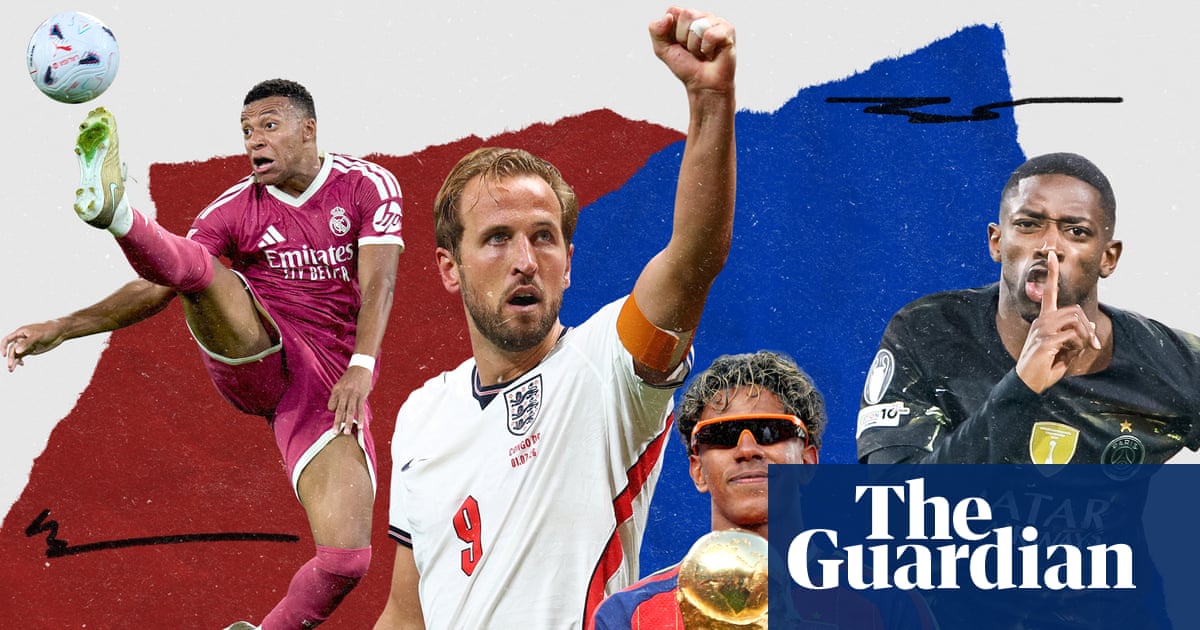
1) Harry Kane (England/Bayern Munich) Even adjusting to a goal-drunk Bundesliga, his 61 goals in 51 games for Bayern last season understates his overall impact, considering his playmaking and holding abilities. Kane was out of England’s final matches at the World Cup, but was unstoppable until the round of 16 to close out the best year of his career to date. If not now, when? 2) Rodri (Spain/Manchester City – now in Barcelona) He has a comparable case to when he won this award in 2024: Rodri remains the epicenter of an incredibly effective Spanish team. This time, there is no Premier League glory to bolster their hopes as City’s latest challenge failed and the club “only” won domestic cups in their final season at the Etihad. Back to his best en route to Spain’s second World Cup title, although only one of the four previous World Cup champions had a corresponding Ballon d’Or winner (Lionel Messi, 2023).3) Kylian Mbappé (France/Real Madrid)Mbappé and José Mourinho have launched an aggressive campaign for the Frenchman to win his first Ballon d’Or. It was even more difficult to stop him in his second Spanish season, with 40 goals in 42 games in La Liga and the Champions League; The less said about your pressure, the better. Few players captivated and dominated like Mbappé at the World Cup, where he won the Golden Boot. But the team’s lack of achievements could delay his candidacy, something even more evident given Madrid’s chronic success. 4) Lamine Yamal (Spain/Barcelona) Another member of the World Cup champions, although injuries limited his impact in North America – the master of suspense was not as involved as he would have liked. Furthermore, he achieved greater consistency in his third season as a starter for Barcelona, with 41 goals in all competitions in 45 appearances. He only turned 19 in July.5) Lionel Messi (Argentina/Inter Miami) Messi could well have qualified higher had Argentina won the World Cup this summer, as the 39-year-old was the heart and soul of their campaign. Unfortunately, a putrid final (from his teammates rather than Messi) dulls the shine of his hopes of a ninth Ballon d’Or, and is also affected by the fact that he does not play for one of Europe’s elite clubs, despite Inter Miami winning the MLS title. His remarkable 17th appearance on a list of Ballon d’Or shortlists is well deserved.6) Michael Olise (France/Bayern Munich) Who would have imagined that Bayern’s most exciting attack in recent memory would be led by signings from Tottenham and Crystal Palace? An elite secondary attacker, and one who has come to enjoy operating as a stringer in transition and on the edge of the final third. Spain masterfully closed his passing lanes and took him out of the semifinal, but a couple of assists in the third-place match placed him as the leader in that category in the World Cup. A career year, or evidence that a new standard has been set? 7) Erling Haaland (Norway/Manchester City) Even as City stumbled down the stretch, this was another season to reinforce his growing legacy as one of football’s great strikers of any era. He made the most of Norway’s return to the World Cup, finishing as the tournament’s third-highest scorer (seven) despite losing in the quarter-finals.8) Jude Bellingham (England/Real Madrid) Birmingham City’s decision to retire his number when his career had barely begun has aged well. A man for big moments, he forged an unlikely tandem with Kane at the World Cup, alternating hero swaps en route to another semi-final heartbreaker. His goals and assists plummeted in his third season with Madrid, although most of his teammates saw diminishing returns in a forgettable campaign.9) Ousmane Dembélé (France/Paris Saint-Germain) Lacking some of the bombast that characterizes his rivals, Dembélé remains a silky threat for club and country. His stats for PSG dropped from last year’s award-winning campaign, from 35 goals in 53 games to 20 in 40. His partnership with Mbappé and Olise for France was as dangerous as international football has seen. At least Dembélé has made sure it’s not a one-year wonder. 10) Khvicha Kvaratskhelia (Georgia/Paris Saint-Germain) Per minute, few players are more effective in the biggest games. Unfortunately, his club’s domestic dominance means he can take more free shifts than most of his golden peers, logging a measly 1,479 Ligue 1 minutes in 28 appearances. Georgia’s absence from this summer’s World Cup also limits the evidence available to bolster its case. However, his impressive exploits in the Champions League qualifiers saw the 25-year-old reach rare form.11) Declan Rice (England/Arsenal)The most vital cog in Mikel Arteta’s meticulous machine, and a key impact on England’s run to the World Cup semi-final, even if he sometimes looked understandably tired after a long domestic campaign.12) Bruno Fernandes (Portugal/Manchester United)One of There are few Portuguese players whose aspirations for this award were thwarted by this summer’s disappointing performance under the headstrong Roberto Martínez. Truly sensational to return the Red Devils to prouder days. 13) Pau Cubarsí (Spain/Barcelona) He looked like the leading centre-back his club and country need to play with dominant possession. On the other hand, these awards rarely skew toward defenders. 14) Fabián Ruiz (Spain/Paris Saint-Germain) Success in the Champions League and World Cup has seen this excellent facilitator get his due at 30 years old. 15) Vitinha (Portugal/Paris Saint-Germain) Involved in the best things at PSG regardless of the competition, with six of his seven goals for the club coming in the Champions League last season. Unable to shake off the stench of Portugal’s World Cup, but he’s the best deep playmaker in the world anyway. 16) Luis Díaz (Colombia/Bayern Munich) He arrived in Germany with joy, scoring 26 goals and 19 assists in 51 appearances to eclipse his production at Liverpool. However, they struggled for most of the World Cup, as Colombia fell earlier than expected. 17) Gabriel (Brazil/Arsenal) Always close to any fight, Gabriel stood his ground as ever as Arsenal enjoyed a long-awaited Premier League title. He had great summer performances at the World Cup, especially against Japan, but struggled, like the rest of his team, against Norway.18) Nuno Mendes (Portugal/Paris Saint-Germain)Few opponents have found the best way to neutralize Mendes, other than the hope that PSG will give him another day off at home between Champions League games.19) Lautaro Martínez (Argentina/Inter)Another reliable scoring campaign in Italy, and He excelled in a super substitute role during Argentina’s knockout. run. One of the great strikers of this era, and he’s already off to a good start this season. 20) William Saliba (France/Arsenal) Particularly stable in the Premier League and Champions League, he helped Arsenal achieve its most successful year in decades. His injury affected France’s chances against Spain in the World Cup semi-final, perhaps strengthening his reputation in absence. And the rest of the field…21) Achraf Hakimi (Morocco/Paris Saint-Germain)22) Vinícius Júnior (Brazil/Real Madrid)23) Dayot Upamecano (France/Bayern Munich)24) Marc Cucurella (Spain/Chelsea – now at Real Madrid)25) João Neves (Portugal/Paris Saint-Germain)26) Willian Pacho (Ecuador/Paris Saint-Germain)27) Ferran Torres (Spain/Barcelona – now in Paris Saint-Germain)28) Marquinhos (Brazil/Paris Saint-Germain)29) Julián Quiñones (Mexico/Al Qadsiah)30) Sadio Mané (Senegal/Al Nassr)