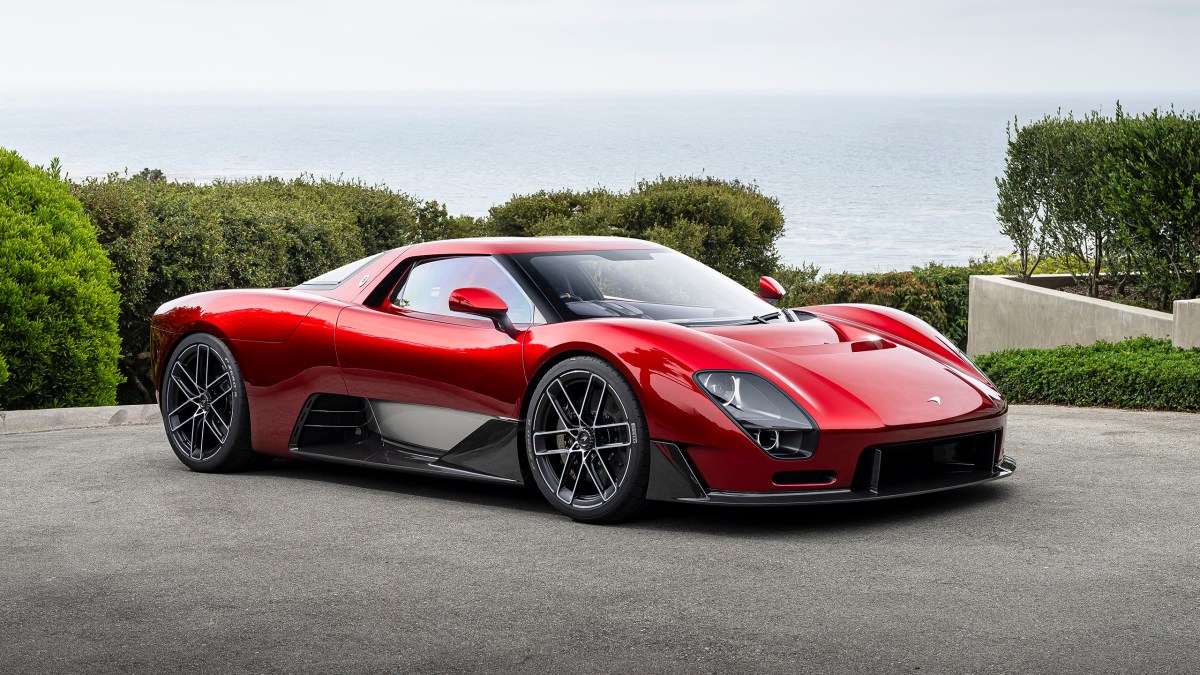
The most important car news and reviews, without the nonsense. Our free daily newsletter delivers the stories that matter to you directly to you, every weekday. If anyone really has the responsibility to keep the manual transmission alive, it’s companies like McLaren, Ferrari and Porsche, manufacturers that spare no expense to make their vehicles as excellent as possible and, frankly, can charge whatever they want for the privilege of ownership. But when even Maranello can’t seem to find a way to connect a true manual gearbox to its V12, something is very wrong. Fortunately, this year’s Monterey Car Week has brought with it a revival of the row-your-own style, and the latest to finally join the party is McLaren. It has just revealed its first manual supercar since F1 over 30 years ago, and it’s called the McL 6GT. It’s a strange name, mixing McLaren’s current Formula 1 chassis nomenclature with the spirit of its former Can-Am racing cars, such as the M6. Technically, what you see here is a concept, but the McL 6GT is promised to go into production in 2028, with its shifter and three pedals. McLaren Modern McLarens, from the MP4-12C to the Artura and even extreme examples like the Senna and W1, tend to follow some basic design principles. There is familiarity in the lines of their roofs; conical and curved noses that usually incorporate the brand logo as a motif; and exposed rear ends for cooling and airflow. However, the McL 6GT features none of these features, which could make it the company’s most exclusive design since it relaunched its road vehicle operation 15 years ago. And honestly, I think it’s perfect. There are many references to the M6 GT, from the vertical headlights and Kamm tail to the position and shape of each duct, rendered with a simplicity that we used to see in supercars of the ’90s and 2000s, but see less of today. And inside, McLaren has transformed the gearshift into a work of art in itself, its metal links drawing in natural light from all angles in a sea of black and carbon fibre. They’re clearly proud of it and, appropriately, want it to be the focal point here. McLaren At the moment, McLaren has revealed very few details about the McL 6GT under the skin. It’s powered by a V8, like many of the company’s products, although we don’t know if it’s turbocharged or naturally aspirated. There’s no hybrid assistance, as you might imagine, as the company promises a “tactile, analog and deeply mechanical” experience, and the monocoque and body are made of carbon fiber. What’s more, McLaren considers it a “new type” of supercar “beyond the core portfolio.” Based on that, it seems that manual transmissions are not going to become a standard feature of the brand; that, beyond the delimitation of “Sports, Super and Ultimate” models of the past, McLaren is diversifying towards more exclusive offerings that, at least in this particular case, pursue a more analog experience contrary to the regular line. For now, anyway. Bruce McLaren’s personal M6GT, recently restored. McLaren It’s a direction the company advanced just a few weeks ago during the Goodwood Festival of Speed, when it restored Bruce McLaren’s personal M6 GT, a Can-Am machine essentially remodeled with an enclosed cockpit for Le Mans and the like, which never actually competed and was eventually converted into a road car. That M6 GT is essentially a blueprint for what McLaren seems to want to achieve with this machine, with the benefit of another half century of technological progress and refinement to draw from. Register us. Do you have any advice? Email us at tips@thedrive.com Backed by a decade covering cars and consumer technology, Adam Ismail is a senior editor at The Drive, focused on curating and producing the site’s slate of daily stories.