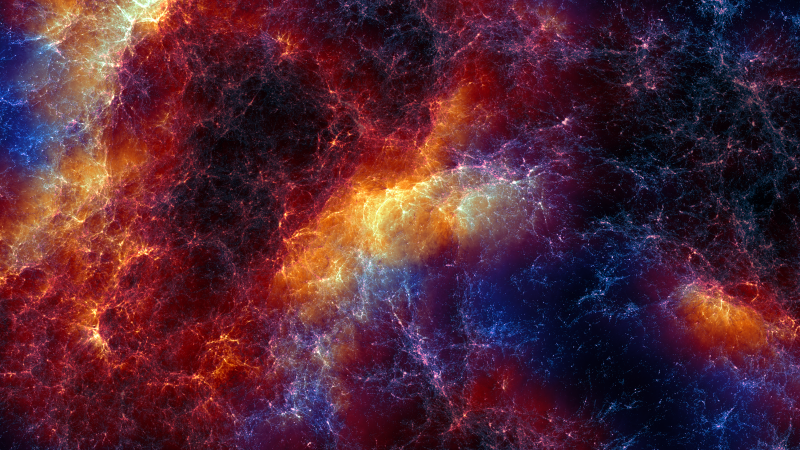
Powerful observatories like NASA’s James Webb Space Telescope offer glimpses of galaxies that formed when the universe was still young, but new supercomputer simulations are helping to fill in the gaps in the cosmos’ mysterious early history. Now, a team of international researchers has developed one of the most detailed models yet of the early universe, according to a recent study published in the scientific journal Monthly Notices of the Royal Astronomical Society. The new simulation, called Lumina, recreates how the first stars and black holes drove reionization, a fundamental but enigmatic phase that transformed the universe. After the Big Bang, ultraviolet radiation from these early light sources stripped electrons from hydrogen atoms, the most common element in space, allowing light to travel farther and changing the way galaxies formed. The early universe has become an exciting new frontier for astronomers seeking to understand how the cosmos evolved to what it is today. Because light takes time to travel through space, powerful telescopes capture distant galaxies as they appeared billions of years ago. But studying such a long stretch of cosmic history requires simulations on an equally vast scale. That’s where models like Lumina come in. One of the most promising features of Lumina is its enormous scale, covering more than 100 times more space than previous simulations, said lead author Oliver Zier, a postdoctoral researcher at the Harvard-Smithsonian Center for Astrophysics Institute for Theory and Computing, in Cambridge, Massachusetts. “We have a cosmological volume where you can see this cosmic web, how galaxies are grouped together. At the same time, we resolve individual galaxies,” Zier said, referring to the simulation’s ability to capture both the vastness of space and the intricate details. Simulation can also be used to test ideas about how the universe evolved. Scientists can compare the early universe scenario modeled in Lumina with observations from telescopes like the James Webb Space Telescope. If the results match, scientists can gain more confidence in their theories. “But it’s actually more interesting if they disagree, because that means something is missing from our model, and that could give clues to the missing physics,” Zier said. These discrepancies could offer clues about the universe that scientists have not yet fully understood. Lumina spans a region approximately 1.5 billion light years in diameter in each direction. For comparison, the Milky Way is about 100,000 light years across, according to NASA. The massive model took nearly three years to complete, using more than 15,000 graphics processing units at Frontier (a supercomputer at Oak Ridge National Laboratory in Tennessee) to provide the computing power needed for such a feat. Lumina hasn’t been made public in its entirety, but videos of the simulation highlight how vast space really is, zooming in on individual galaxies and then backing out to show how small they are compared to others across the cosmos. Earth may look giant, but it is just one of many planets in the Milky Way, which is one of countless galaxies in the universe, Zier said. “Although Lumina is very large, it is still only a very small part of the universe,” he added. For the first time, Lumina allows researchers to study how changes in both hydrogen and helium (the second most common element in space) transformed the early cosmos in a single simulation. “Lumina is a really impressive technical achievement,” said Julián Muñoz, an assistant professor of astronomy at the University of Texas at Austin, who was not involved in the new study. “Simulations of how the first galaxies form and ionize the early universe are expensive, so they typically only follow fairly small areas of the cosmos for a limited time. Lumina is larger in size and runs for a longer cosmic time than previous detailed simulations of this type,” Muñoz said in an email. The early universe did not change uniformly. Some regions evolved faster than others, and Lumina’s immense scale allows researchers to see how different regions changed over time, Muñoz said. He added that the simulation could help scientists study how ordinary matter and dark matter moved differently through space. Computer models of how the first galaxies took shape often focus on interactions between three key cosmic ingredients: ordinary matter, the stuff that makes up stars, planets and people; dark matter, an invisible substance that represents most of the matter in the universe; and radiation. Unlike dark matter, ordinary matter interacts with light, causing the two types of matter to move at different speeds. Early in the history of the universe, these differences left cosmic patterns stretching across millions of light years. Although these patterns cannot be observed directly through telescopes, the variations can be mapped in simulations like Lumina, allowing scientists to investigate how the dynamics of matter may have shaped the early cosmos, Muñoz said. The simulation could help researchers study rare galaxies that smaller models might miss, said Ilian Iliev, a professor of astrophysics at the University of Sussex in the United Kingdom, who was not involved in the study. Iliev said he looks forward to seeing how Lumina and observations from the new telescopes can complement each other to build a more complete and accurate picture of the universe. Taylor Nicioli is a freelance journalist based in New York. Subscribe to CNN’s Wonder Theory science newsletter. Explore the universe with news about fascinating discoveries, scientific breakthroughs and more.