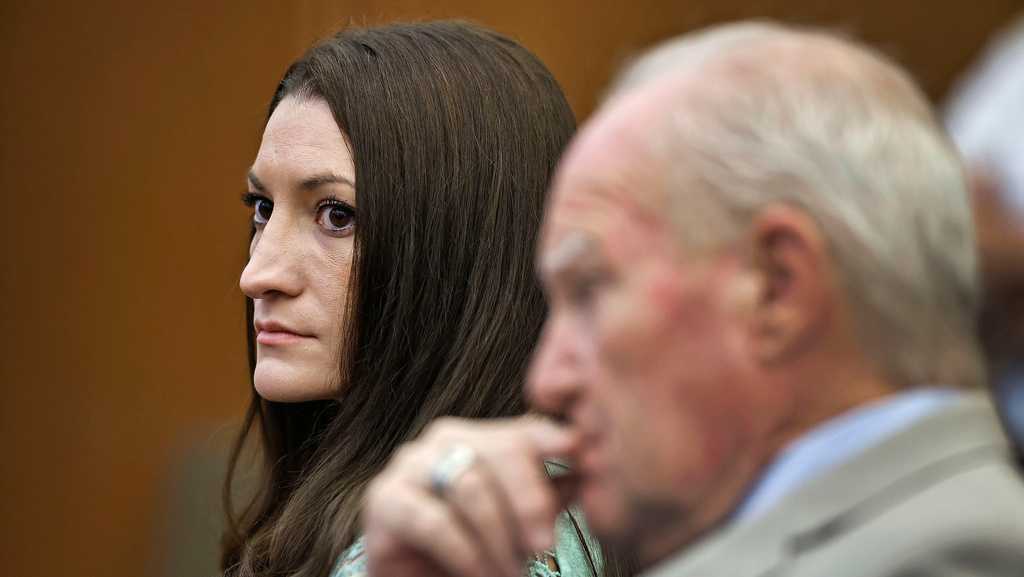
Lindsay Clancy jury sent home for weekend; Deliberations resume MondayJury heard closing arguments Thursday morningSenior Digital Editor/Producer, WCVB.comPLYMOUTH, Mass. —The jury in the murder trial of Lindsay Clancy, the Massachusetts mother accused of strangling her three children in the family’s Duxbury home in 2023, will return Monday to continue deliberations. A jury of nine women and three men are deciding if Lindsay Clancy, 36, is guilty of killing 5-year-old Cora, 3-year-old Dawson and 8-month-old Callan or if she is not criminally responsible due to her mental health.Shortly after deliberations resumed Friday, attorneys were called to a sidebar after the court learned there was a question from the jury.Defense attorney Kevin Reddington told NewsCenter 5 that the jury asked to see two Ziploc bags of pill bottles and the knife Lindsay Clancy used in her attempted suicide.The jury has all exhibits available to them except those items. Outside court Friday morning, Reddington said his client was nervous awaiting the verdict. He added that Clancy feels sad and scared.Lindsay Clancy with defense attorney Kevin Reddington”She’s nervous, like I said before. She’s sad, scared. The same she’s been forever since this incident,” Reddington said. Clancy’s defense argued that she was not criminally responsible for the killings because she was suffering from postpartum psychosis. It is the burden of the prosecution to overcome the lack of criminal responsibility defense, also known as the insanity defense.Judge William Sullivan said the verdict slip also includes a “not guilty” option.How long could jury deliberations take? Jurors heard weeks of testimony involving dozens of witnesses and hundreds of exhibits, and deliberations could be lengthy.Retired Massachusetts Judge Jim Barretto estimated jurors could take at least a week if they carefully review the evidence, which includes more than 300 exhibits and nearly 80 witnesses.”They’ve got to get through all of that material,” Barretto said during a live interview on NewsCenter 5. “I don’t envy these jurors. I would not want to be one of them.”Criminal responsibility is centralThe prosecution carries the burden of proof in the case. Asked whether prosecutors met that burden, Barretto said he believes they are in a good position, but said the question of criminal responsibility remains a key issue for jurors.”I have thought for some time now that the issue of criminal responsibility, they are vulnerable on,” Barretto said. “I think Lindsay Clancy’s defense team has made it a live issue.”Barretto said the prosecution’s rebuttal witnesses strengthened its case. He specifically pointed to testimony from a doctor who, he said, provided jurors with a framework for considering the choices Clancy made and the issue of a voice she reported hearing.”When you think of it, that voice is key to this case,” Barretto said, adding that it is also central to the defense’s argument that Clancy was not criminally responsible.Barretto declined to predict the jury’s eventual decision.”I learned a long time ago the hard way not to predict, because you’re wrong over half the time,” he said.This content is imported from infogram. You may be able to find the same content in another format, or you may be able to find more information, at their web site.Background of the Clancy case:Lindsay Clancy, 36, faces three murder charges in the 2023 deaths of her children, Cora, Dawson and Callan.She also jumped from a second-floor window, leaving her partially paralyzed.In a civil case, Lindsay Clancy alleges a “catastrophic failure” of multiple medical providers in diagnosing and treating her psychiatric condition.Her trial began July 20. Although her legal team offered to stipulate to the deaths of the children, she has pleaded not guilty.She is being held at Tewksbury State Hospital.This case involves issues of mental health. If you or someone you know needs help, you can talk with the Suicide & Crisis Lifeline by calling or sending a text message to 988, or you can chat online here.Key moments from Week 4Defense attorney Kevin Reddington said in his closing argument that Clancy was a “darn good mother” who received “lousy medical care.” He criticized the prosecution, saying it was “a mess,” and suggested the jury should trust his expert psychiatrist’s conclusion over the commonwealth’s experts because he spoke with Clancy sooner after the killings. “This young lady is not guilty of the killing of her children because she was suffering from a disease and defect,” Reddington concluded.Assistant District Attorney Jennifer Sprague said there is no dispute that Lindsay Clancy suffered from mental illness and that she tried to kill herself; the issue is whether she knew the difference between right and wrong. Sprague argued that Clancy had an abundance of care and support in her life but repeatedly made choices that recklessly undermined her treatment. Sprague said Lindsay Clancy was a “functioning mom” with control of her impulses in the weeks before the killings and suggested that Clancy planned the killings with intention. “She left them discarded on the basement floor like broken toys because she was done playing the game. You know to a moral certainty, she is guilty,” Sprague said.Testimony from the rebuttal witnesses — Dr. Gregory Saathoff, Dr. Kirk Heilbrun and Dr. Avram Mack — focused on detailed testimony about her state of mind at the time of the killings. All three said they believed Lindsay Clancy should be held criminally responsible. Defense attorney Reddington was denied a motion for a mistrial after Heilbrun’s testimony strayed into Lindsay Clancy’s Catholic beliefs. Judge Sullivan heard arguments and ultimately decided to address the jury on the nature of the “inappropriate” comment and issue instructions, but did not scrap the trial. Before resting his case Friday, defense attorney Reddington called forensic psychiatrist Dr. Phillip Resnick to testify. He delivered his testimony via Zoom. Resnick was a key witness in the murder trial of Andrea Yates, who killed her five children in Texas in 2001. He said Lindsay Clancy had “severe depression” and a history of anxiety, which grew with the birth of each of her three children to the point that she “felt she couldn’t function.” He also testified that a voice was “commanding her” to engage in the killings. “At the time of the crime on Jan. 24, 2023, Miss Clancy was frankly psychotic,” Resnick said. “She was clearly psychotic on that day.” Sheila Cavanaugh, a chaplain at Brigham and Women’s Hospital, testified Thursday and said she met Lindsay Clancy at the hospital Jan. 25, 2023. Cavanaugh said she remembered “vividly” the first thing Lindsay Clancy was able to say to her after the breathing tubes were removed: “She said to me, as I held her hand to comfort her, ‘I am so glad my children are safe,'” Cavanaugh said. “I replied theologically to Lindsay, and I said, ‘Lindsay, your children are safe. They are safe in heaven with God.'”Over two days, Dr. Paul Zeizel, a forensic psychologist, testified about his conclusions based on dozens of his meetings with Lindsay Clancy after the killings. He testified that he believed Lindsay Clancy lost substantial capacity to appreciate the wrongfulness of her act and was unable to conform to the law because of mental illness. He also testified that Lindsay Clancy had described hearing a male’s voice ordering her to kill the children and then herself and explicitly denied planting that idea with Lindsay Clancy. On cross-examination, however, Zeizel confirmed there were no records of Lindsay Clancy hearing a voice prior to the killings. Susan Clancy, Patrick Clancy’s mother, testified that her former daughter-in-law was “very nurturing, very loving” toward her children. But she also testified that she was aware of Lindsay Clancy struggling with postpartum depression for over a year. “She was begging for help,” Susan Clancy said. “Lindsay was struggling. We were all very concerned.”Lindsay Clancy’s mother, Paula Musgrove, fought through tears as she told the jury she loved her grandchildren “with all her heart.” She described her daughter as a “loving mother” who “would do anything for her children.” Musgrove said her daughter worried that medication was “destroying her mind” and spoke about a time when “she told us that she had thoughts of harming the children.”Allison Ozga, Lindsay Clancy’s sister, testified that the defendant confided in her that she was struggling with mental health issues in December 2022 and said she “was in a really tough spot.”Margaret Hamp, a labor and delivery nurse at Massachusetts General Hospital, worked with Lindsay Clancy for about seven years and testified that the defendant would frequently check in on her children during her shifts. She recalled an incident when one of her children was seen crying on a baby monitor and Lindsay Clancy called for a wellness check when her husband did not answer the phone. The defense called Dr. Elizabeth Laposata, a former medical examiner who also testified for the defense in the Karen Read case. Clancy appeared to be crying as Laposata discussed the injuries she suffered in the suicide attempt, including cutting injuries and an interpretation of how her spine was injured when she fell. The testimony appeared designed to counter the prosecution’s suggestions and evidence that minimized the severity of the cuts and raised doubts that she jumped out of the window, based on blood on the shingles.The final witness for the prosecution was Ian Whiffin, who works for Cellebrite. He testified about the Apple health data and other information extracted from Lindsay Clancy’s phone. Whiffin also testified in the murder trial of Karen Read. He described his review of heart rate data and search history, including a search for symptoms of postpartum psychosis.More key takeaways from the trial are here.Key moments from Week 3 Dr. Barbara Olson of the office of the chief medical examiner testified about the autopsies of Cora and Dawson Clancy. Lindsay Clancy was crying loudly with her head on the table throughout the testimony, and reporters noted at least one juror was also crying. Olson described the injuries to Cora Clancy’s neck, identifying signs of ligature strangulation, and described the pain that it would cause. Olson also described hemorrhaging suffered by Dawson Clancy, which she said could have been caused by him struggling or by changes in the pressure of the ligature.South Shore Hospital Nurse Practitioner Rebecca Jollotta testified about working with Lindsay Clancy starting in November 2022. Jollotta said the defendant feared she might be addicted to Ativan — an anti-anxiety medication — and was relying on it to sleep. Jollotta testified that Lindsay Clancy suffered serious depression, anxiety and sleep problems but repeatedly showed clear thinking and no signs of psychosis or mania.Sgt. Dan Lawlor testified that while he was at the hospital, a doctor came to meet with Lindsay Clancy and entered her room. He said he did not hear their conversation, but defense attorney Reddington asked whether investigators discussed a theory alleging that a doctor was the reason Lindsay Clancy told her husband about hearing voices. Patrick Clancy previously testified that Lindsay Clancy had told him about hearing voices during a phone call a week after the killings, saying she had never mentioned hearing voices before.Timothy Chiappini, an investigator with Massachusetts State Police who examined Lindsay Clancy’s phone, testified it was used to search for the ThreeV restaurant in Plymouth, including a map search that would show a route length. Prosecutors allege Lindsay Clancy sent her husband to the restaurant because it would give her enough time to kill the three children. Chiappini also read notes from her phone, including affirmations and passages in which she described feeling sad and depressed.Testimony from MSP investigator Kyle Pavao focused on internet activity from August 2022, including a visit to a page about suicide methods. Pavao said the Wikipedia page of Tom Hall, a singer who died by suicide, was visited. But on cross-examination, Pavao acknowledged that the forensic data could not establish who was sitting at the computer. He also testified he found searches about bipolar disorder and “what to do when a psychiatrist overprescribes.”Dr. Tufts, who was first questioned by the prosecution during the previous week, was cross-examined by the defense throughout Monday morning. Defense attorney Reddington pressed Tufts over months of telehealth treatment, medication decisions and responses to Lindsay Clancy’s worsening mental health.Judge Sullivan is weighing whether Lindsay Clancy’s defense can call a former McLean Hospital employee as an additional witness. Reddington argued Tuesday morning that jurors had been left with an overly favorable impression of McLean Hospital and that the former employee could counter it. Prosecutor Buckingham argued the proposed witness is not an expert, lacked knowledge of McLean during Lindsay Clancy’s stay and has followed the trial on TikTok.Key moments from Week 2Christopher Clancy, father of Patrick Clancy and grandfather of the children, described the call he received from his son after the children were killed. “It was terrible,” he said.Clancy cried Thursday during the testimony of Dr. Kimberley Springer, a medical examiner, who described images from the autopsy of Callan Clancy in January 2023. Former nanny Elaine Rossi, who cared for infant Callan Clancy beginning in September 2022, testified she communicated with Clancy daily through text messages and a notebook containing detailed instructions about Callan Clancy’s feeding, sleep schedule and daily routine. Rossi described Lindsay Clancy as a “wonderful mom” and testified she never believed the children were unsafe. She also said Lindsay Clancy spoke about struggling with postpartum issues, difficulty sleeping and seeing doctors for treatment. Prosecutors read entries from the notebooks describing Lindsay Clancy feeling overwhelmed by her son Callan Clancy’s sleep schedule. On cross-examination, the defense highlighted other entries in which Lindsay Clancy wrote about wanting to get well, brain fog, guilt, anxiety and concerns about returning to work.Clancy’s attorneys have asked a Plymouth Superior Court judge to allow three defense witnesses to testify after prosecutors objected to their inclusion, arguing the testimony is central to her defense. Her motion asks the court to permit testimony from Dr. Laposata, Dr. Michael Vulfovich and Dr. Condie. Physicians and nurses testified about Lindsay Clancy’s injuries when she arrived at the intensive care unit at Brigham and Women’s Hospital early in the morning Jan. 25. One of the nurses described that Lindsay Clancy, who was intubated, was able to use a whiteboard to communicate her confusion and inability to feel her legs. Judge Sullivan paused before Friday’s lunch break during the emotional trial of Lindsay Clancy to admonish everyone in the courtroom to beware of making inappropriate remarks.Jurors heard that Lindsay Clancy voluntarily checked herself into McLean Hospital early on New Year’s Day with suicidal thoughts, anxiety and an inability to sleep. Dr. Alia Goodheart said she met with Lindsay Clancy for an evaluation several days later and assessed that Lindsay Clancy had no plan to attempt suicide. Goodheart said Lindsay Clancy expressed that her children and her family were reasons she would not kill herself.Jurors also heard the start of the testimony from Dr. Tufts, one of the defendants named in civil lawsuits filed in January by both Lindsay Clancy and her ex-husband, Patrick Clancy. Tufts testified that her initial diagnosis was adjustment disorder with depressed mood and generalized anxiety disorder. She said she recommended medication to Clancy, but that Clancy was reluctant.Key moments from Week 1The first week of testimony in the Lindsay Clancy murder trial ended after the judge, jury and attorneys visited locations connected to the case, including the Clancy family’s former home in Duxbury. The jury also retraced the route prosecutors say Lindsay Clancy sent her husband, Patrick Clancy, on the day of the killings, including stops at a CVS and a restaurant in Plymouth.Jurors heard the gut-wrenching 911 call Patrick Clancy made after he found his young sons and daughter with exercise bands around their necks. He testified about returning home from a trip to pick up dinner and medication and finding blood in the bedroom and his wife out in the yard. While on the phone with a 911 operator, he asked her what happened and went inside, where he found the children in the basement. Plymouth County Assistant District Attorney Buckingham used her opening statement to tell the jurors that the children were strangled “meticulously.” She warned the jurors they would hear graphic testimony as she urged the group to use their common sense and life experiences as they listen to the case. Defense attorney Reddington said his client knows she killed her children but questioned what was going on in Lindsay Clancy’s mind. He is arguing that she suffered from postpartum psychosis and was overmedicated at the time of the alleged crimes.