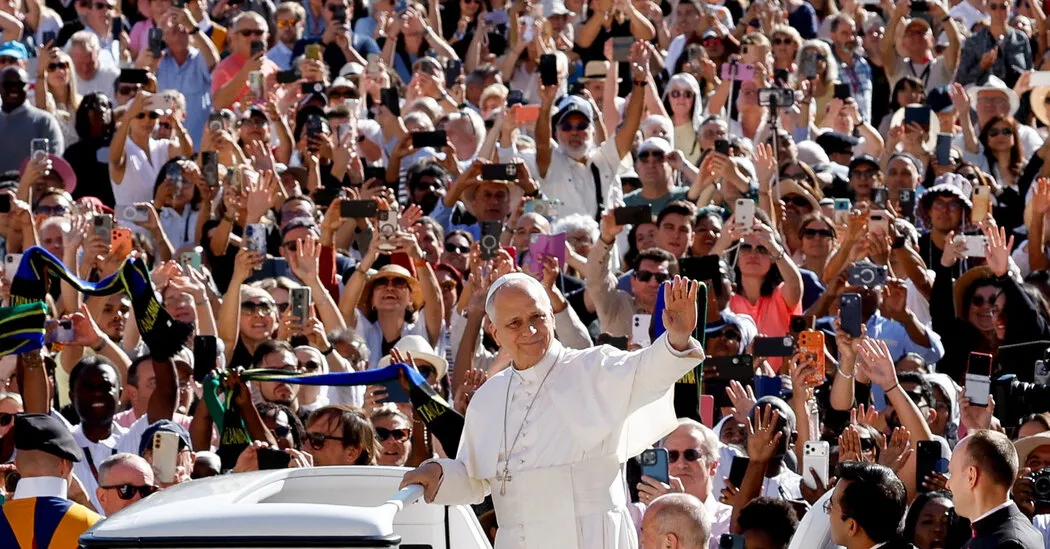
Pope Leo XIV, the first pope of the United States and leader of more than 1.4 billion ideologically and ethnically diverse Roman Catholics, will not allow himself to be identified. On Friday, Leo visits France for the fourth major international trip of his still-young papacy, touring one of the church’s original cradles just three months after leaving Spain, another citadel of European Catholicism. Those stays in rich Western countries end with a trip in April to Africa, the continent. where Catholicism is growing most rapidly, and an upcoming tour of Latin America, where Catholicism is often associated with social justice movements. A clear message is emerging from Leo’s varied travel schedule, experts say. He wants to be a Pope for everyone: the new and fervent faithful, as well as those from the traditional but increasingly secular cores of Catholicism. France, a country that previous popes have referred to by an old nickname, “the eldest daughter of the Church,” would fall squarely into the latter category. “It’s a corrective in the sense that Francis was seen too much as a pope of the Global South,” said José Casanova, a senior fellow at Georgetown University’s Berkley Center for Religion, Peace and World Affairs. They were for conferences or to speak at the European Parliament in Strasbourg. Francis focused on what he called “the peripheries” of the Church, but John McGreevy, a historian at the University of Notre Dame, said Leo was “more concerned with the unity of the Church, with uniting Catholics of all backgrounds.” “So it’s not going to ignore historically Catholic countries like France,” Professor McGreevy added. for the European Union, at a time when it is under fierce attack from right-wing politicians in Europe and the United States. The Pope will visit the headquarters of UNESCO, the United Nations cultural agency from which Trump has twice withdrawn the United States. There Leo is expected to speak about the importance of international institutions. Vatican officials said Leo, who recently laid out a vision for protecting human agency in the age of artificial intelligence, is expected to reinforce that theme in his speech at UNESCO. After a day in Lourdes, a revered site of spiritual pilgrimage for Catholics, Leo will visit the northern city of Metz on Monday, the last day of his trip to France. He will address a religious gathering at the Robert Schuman Center, a convention hall named after a French statesman who led efforts to improve cooperation among European nations after World War II. “There is a very strong message sent by León by going to Metz and celebrating the figure of Robert Schuman, who is one of the founding fathers of political Europe,” said Charles Mercier, an expert on Catholicism at the École Pratique des Hautes Études in Paris. In 2014, Parliament stated that Europe was no longer “vibrant”. Leo will begin his four-day trip in Paris, the capital of a country that has evolved since the French Revolution into a decidedly secular society with a strict separation between church and state. Less than half of the country’s nearly 70 million people identify as Catholic, and only 5 percent say they go to church regularly. Yet even secular Frenchmen gathered around one of France’s holiest Catholic sites, Notre-Dame Cathedral, during the site’s renovation after a devastating fire in 2019. On Friday, Leo will become the first pontiff to visit since the cathedral reopened in 2024. France often seems to be a land of empty churches save for a few elderly worshipers. However, like its neighbors Italy and Germany, its Catholic population is increasingly bolstered by immigrants from North Africa or Southeast Asia. There has been a nearly three-fold increase in baptisms among adults in France, to almost 10,400 in 2024, from about 3,600 in 2021, according to figures from the French Bishops’ Conference. Experts attribute that expansion to a variety of factors, including the desire for spiritual meaning spurred by the dislocation of the pandemic and the galvanizing role of social media. They say the increase may also be due to a decrease in baptisms at birth, causing adults to seek the sacrament later in life. “We have gone from being Catholic by heritage and habit,” said Jérôme Fourquet, a political scientist who has studied French attitudes toward the Church. “Today, it is clearly a minority Catholicism, but a Catholicism driven by choice and affirmation.” Leo will appeal to that energized group of mostly young Catholics at a prayer vigil Friday at the Stade de France, a cavernous stadium outside Paris where France won the soccer World Cup in 1998. On Saturday, he will meet with newly baptized adults and those preparing for the sacrament at the Paris Catholic Institute. Among those recently baptized is Malick-Emmanuel Seck, a 32-year-old lawyer who grew up in Senegal, in a Muslim family, before emigrating to Paris at the age of 15. Educated in Catholic schools in Africa, Mr. Seck said he discovered France to be an irreligious society when he first arrived. When Mr. Seck participated in a friend’s wedding Mass, he said he had been moved by the beauty of the liturgy. After a two-year course in the faith, he was baptized last year. Now a member of the Church of the Holy Trinity, a vibrant parish in the Pigalle district of Paris, Seck said he had “clearly discovered a whole world.” Paul Balaresque, a 29-year-old priest, said his church in western Paris was helping parishioners identify places where they could see the pope on the streets or attend mass and prayer vigil. Leo’s visit is a source of “great joy,” he said, adding: “I am surprised, in a highly de-Christianized country, to see the extent to which people who are very far from the church are interested in its message.” Leo will also appeal more broadly to Catholics who rarely, if ever, enter a church. He will preside over a mass at the Place de la Concorde, the symbolic center of the French Republic, where police said they expected a crowd of 600,000. The square’s name aligns with Leo’s message of harmony among the people, although it is also famous for being the place where King Louis XVI was guillotined during the revolution. Ségolène Le Stradic and Giulia Imbert contributed reporting from Paris.