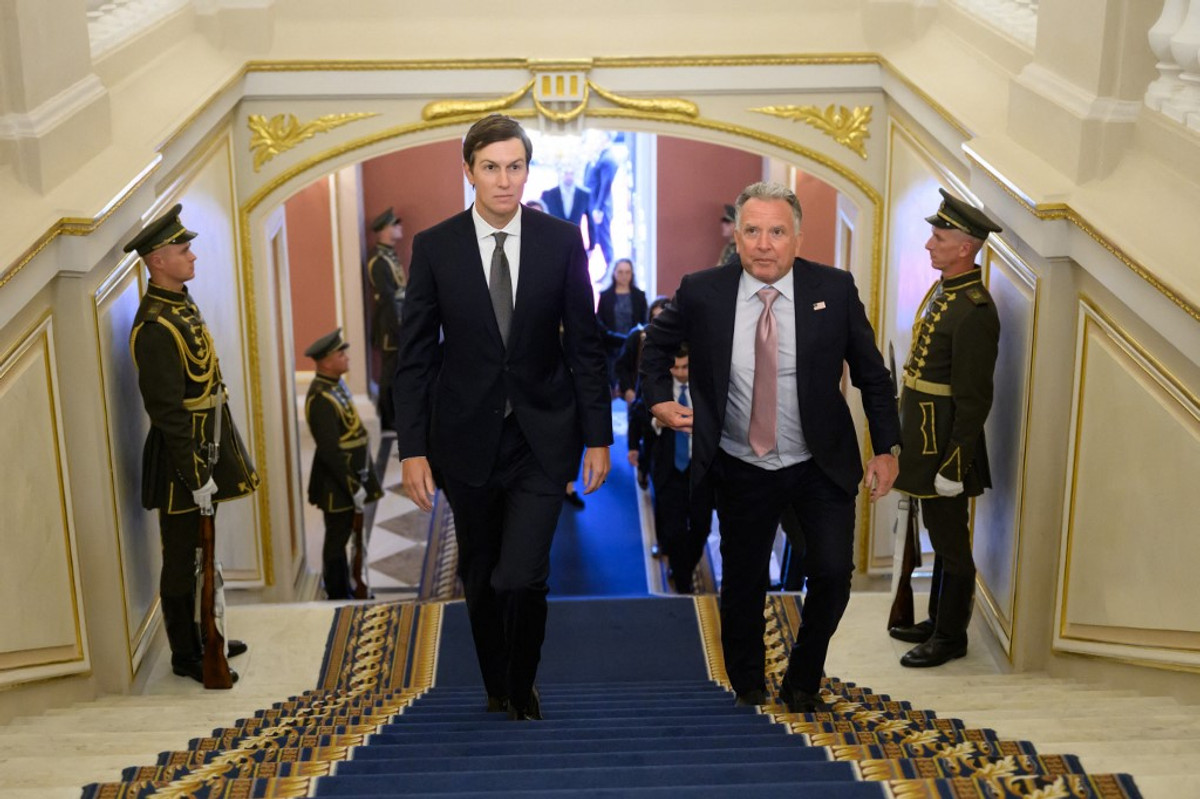
US President Donald Trump’s son-in-law and chief negotiator Jared Kushner outlined five goals for a broader European security framework on Thursday, November 5, ahead of planned US-brokered peace talks between Ukraine and Russia in Abu Dhabi next week. In a statement published on X, Kushner said Trump had made progress in talks with several European leaders about establishing long-term security arrangements aimed at preventing future conflicts. JOIN US ON TELEGRAM Follow our war coverage on @Kyivpost_official. The proposal comes after negotiations in Brussels involving Ukraine, NATO, the European Union and other European partners. “Our goal is to develop practical agreements that address the security concerns of all parties, reduce the risk of future conflicts, and create a more stable and predictable security environment,” Kushner wrote. Five objectives for European security Kushner outlined five main objectives: Permanent consultations on security. Reliable crisis communications. Greater military transparency. Reciprocal measures to reduce escalation risks. A durable framework for European security and stability. He said Europe and Russia had struggled for more than three decades to establish sustainable security arrangements, and Russia’s war against Ukraine made the challenge more difficult. The proposals aim to create mechanisms for regular communication, greater predictability and reducing the risk of future military confrontation. No veto over Ukraine’s sovereign options Kushner emphasized that any future agreement must respect national sovereignty, territorial integrity and the right of countries to determine their own security arrangements. Other topics of interest Sybiha expects ‘new dynamic’ in US support for Ukraine after midterm elections Speaking during a conference in Bucharest, Foreign Minister AndriI Sybiha said kyiv’s security is inseparably linked to that of the United States. “Each country will retain authority over its own security and alliances, and no country will have the right to veto the sovereign decisions of another,” he wrote. The provision is particularly significant for Ukraine, whose ambitions to join NATO have long encountered opposition from Moscow. Kushner also stressed that NATO would remain critical to Europe’s collective defense and that the proposed framework would build on existing institutions rather than replace them. The position contrasts with Russia’s long-standing demands that Ukraine abandon its NATO membership ambitions and accept restrictions on its future security arrangements. Russia to join broader discussions Kushner said consultations would continue through the Shell Bay format, involving Ukraine, NATO, the EU and European partners. “We will also involve Russia as part of the peace negotiations,” he wrote. The announcement comes ahead of US-brokered trilateral talks scheduled for November 10-11 in Abu Dhabi. As the Kyiv Post reported, US envoy Steve Witkoff announced the talks earlier this week, saying they would address post-war security arrangements, de-escalation, humanitarian measures and steps to end the war. Kushner said Washington would consult European governments throughout the process, with the possibility of expanding negotiations to a broader multilateral format if progress is made. The proposed security framework remains under discussion and no agreement has been announced. kyiv demands binding security guarantees The announcement follows a 90-minute conversation on Wednesday between President Volodymyr Zelensky and US envoys Kushner and Witkoff. As reported by the Kyiv Post, Zelensky said Ukraine had presented its proposals to Washington and insisted that any post-war security guarantee must be binding and enforceable. He also pressed the United States to provide additional Patriot missile interceptors as Russia continues to attack Ukrainian cities and energy infrastructure. Kushner acknowledged that broader negotiations remain difficult, but said Washington would continue working toward a comprehensive deal. “Creating the right structure will be critical to ending this war and moving beyond conflict to conditions that make lasting peace possible,” he wrote. It remains unclear how the proposed framework would accommodate Russia’s demands while defending Ukraine’s sovereignty, territorial integrity, and right to choose its own alliances.