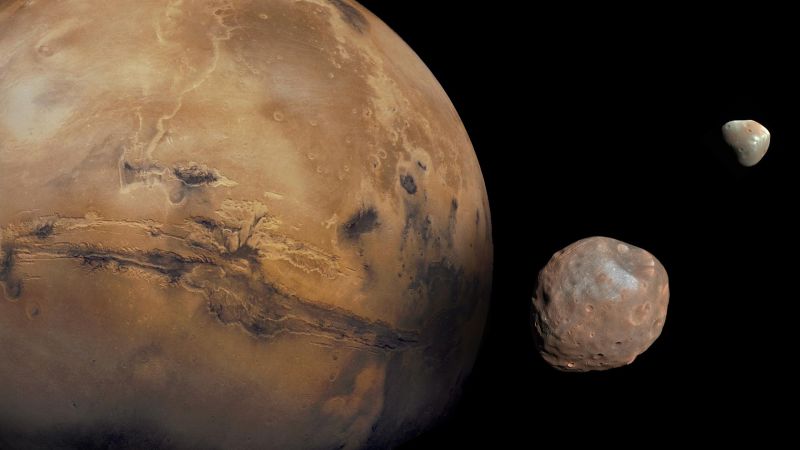
The largely unexplored moons of Mars are getting their moment in the spotlight as a first-of-its-kind mission prepares to take off. The red planet has many unsolved enigmas, but the Martian moon exploration project led by Japan will focus solely on two of the greatest curiosities that orbit nearby. Phobos and Deimos have long baffled scientists, who have been watching the small, lumpy moons for clues about the early days of Mars. “This is one of the biggest remaining mysteries of the formation of the solar system, the origin of Phobos and Deimos, so we really need a mission like MMX to solve it,” said Dr. Daniel Glavin, senior scientist at NASA’s Goddard Space Flight Center in Greenbelt, Maryland, and a participating scientist on the MMX mission. Previous missions to Mars have observed the unusual pair whenever convenient. Orbiters orbiting the red planet have taken images of the rocky bodies over the years, while explorers including Curiosity and Perseverance have captured some fantastic “googly-eyed” eclipses as Phobos moved between Mars and the Sun. But even after decades of observations, scientists still don’t know how Phobos and Deimos came to be. “What are these little space potatoes? We can’t explain Phobos or Deimos right now. They shouldn’t exist, but they do,” said Dr. Abigail Fraeman, a research scientist at NASA’s Jet Propulsion Laboratory in Pasadena, California. “They’re super weird, super small, and super puzzling.” MMX is scheduled to lift off aboard an H3 rocket from the Yoshinobu Launch Complex at the Japan Aerospace Exploration Agency’s Tanegashima Space Center in Kagoshima Prefecture, southwestern Japan, at 3:41 p.m. ET on Monday (4:41 a.m. JST on Tuesday). The risky robotic mission is an international collaboration, including scientific instruments from NASA, the European Space Agency, France’s National Center for Space Studies and the German Aerospace Center, that aims to collect more than 0.4 ounces (10 grams) of material from Phobos and return to Earth in 2031. The detailed observations and samples captured by MMX could reveal missing pieces to the origin story of Phobos and Deimos, and could even reveal secrets on the red planet itself. If the samples contain pieces of Mars, MMX could potentially be the first mission to successfully bring Martian material back to scientists on Earth in a race alongside China. Landing on an enigmatic moon, American astronomer Asaph Hall discovered the Red Planet’s unusual moons in 1877. He named them after the two mythological sons of the Roman god Mars: Phobos, meaning fear, and Deimos, meaning dread. Phobos is a doomed moon, coming 1.8 meters (6 feet) closer to Mars every 100 years. Scientists expect the lumpy rock to crash into the planet in about 50 million years or break up into a rocky ring that remains in orbit. The object’s defining feature is Stickney Crater, a massive cavity about 9.7 kilometers (6 miles) wide that takes up about half the small moon’s surface. Thousands of meteorite impacts have also scarred Phobos over time. Meanwhile, the more distant and tiny Deimos is slowly moving away from Mars. The moon has a smoother surface than Phobos, but it is still very pockmarked and covered in a disconcerting amount of dust. Scientists are weighing two main hypotheses for how these weirdos came to orbit Mars. One concept suggests that a large object slammed into Mars, launching rocky material that coalesced into Phobos and Deimos, Glavin said. The other hypothesis maintains that the two moons are asteroids that came too close to Mars and were attracted by its gravity. “None of our data fits any of the hypotheses correctly,” said Fraeman, who is also a participating scientist at MMX. Japan’s expedition to the enigmatic moons could find new data that supports one of the existing hypotheses or illuminate an entirely different formation history, Fraeman added. The mission will primarily focus on exploring and visiting Phobos, the larger and closer of the two moons to Mars, but along the way it will also take images of Deimos to help scientists better understand the similarities and differences between the sister moons. The MMX spacecraft, which carries a small vehicle called Idefix, a stack of three modules for propulsion, exploration and return to Earth, will spend about a year traveling to Mars and then orbit Phobos for about three years. A suite of instruments aboard the spacecraft’s lander, called the exploration module, will allow scientists to collect a variety of data, including measurements of terrain, minerals, chemical elements and space radiation. Two Super Hi-Vision cameras will take high-definition images of Mars and its moons in 4K and 8K. The spacecraft will first deploy the Idefix rover, developed by the German Aerospace Center and the French National Center for Space Studies, in early 2029. The robotic explorer will make initial observations that will help mission scientists and engineers determine sites for MMX’s four-legged lander to collect samples directly at Phobos. The rover will descend from approximately 131 to 328 feet (40 to 100 meters) to the surface of Phobos; The small moon’s weak gravity should cushion its fall and allow the rover to bounce before making its landing. After autonomously releasing its wheels and solar panels and maneuvering itself into an upright position, Idefix will embark on a 100-day mission. Gravity on Phobos is so weak that Idefix, which weighs about 55 pounds (25 kilograms), will only weigh about 0.5 ounces (15 grams) during its surface operations. The beverage case-sized rover will explore areas of scientific interest and possible safe landing spots. The mission team will then select two separate sites for the MMX lander to land. Images taken by current orbiters show that Phobos appears to have a lighter side and a darker side, almost as if it has two different types of surfaces, Glavin said. That’s why the plan is to collect a sample from each of these two regions: on the side of Phobos that faces Mars and on the opposite side that faces away from the planet, said Dr. Tomohiro Usui, a scientist at the Japan Aerospace Exploration Agency, or JAXA, who has worked on the mission for 10 years. “We are going to choose a first landing site and then we will perform some landing operations, and then we will take off and return to orbit,” Usui, a professor in the department of solar system sciences at the Japan Institute of Space and Astronautical Sciences, told CNN. “It takes several more months to search for the next landing site. Landing operations are very risky.” The MMX lander has two different ways of collecting rocks and dust from Phobos. A core sampler will drill 2 centimeters (0.8 inches) and store the subsurface material in a tube aboard the spacecraft’s sample return capsule. A free-standing pneumatic sampler will use pressurized gas to lift material from the surface and collect it in a tube. Once the samples have been stored aboard the MMX lander, it will take off, make observations of Deimos, and begin the journey back to Earth in 2030. The knowledge gained during MMX’s tour of the Martian moons could even help in planning manned missions to Mars in the future, Usui said. The MMX lander is like a Swiss army knife with many different components, giving scientists several ways to try to decode the mysterious origins of Phobos and Deimos. Before the samples return to Earth, researchers will be able to take a look at initial remote sensing data transmitted in real time from MMX instruments, such as the Mars-Moon Gamma-ray Neutron Exploration Spectrometer, or MEGANE. MEGANE data could reveal signs of volatile elements or chemical elements with low boiling and melting points, such as hydrogen, sodium and chlorine in Phobos and Deimos, for example. These elemental composition measurements could provide key clues that lend credence to one origin hypothesis over another, said David Lawrence, a planetary scientist at the Johns Hopkins University Applied Physics Laboratory and MEGANE science leader. “If you had a giant impact, what would happen is the materials would get very hot and these volatile elements would cook,” Lawrence said. “In contrast, many of the asteroids we see have higher abundances of these volatile elements.” Fraeman, who focused part of his doctoral thesis on the composition of Phobos, will conduct a combined analysis of MEGANE data and observations captured by the MMX infrared spectrometer, or MIRS. The spectrometer will use near-infrared light to measure minerals, organic matter and water-related substances on Phobos. Although Martian moons are mission priorities, scientists anticipate that the MMX data will also reveal previously unknown aspects of Mars’ past. “If Phobos is made up of fragments of Mars that were thrown away and then merged, that could give us some important new clues about the composition of the planet and what it was like when it was much younger,” Fraeman said. Even if the rocky neighbor contains no remains of Mars, Phobos would be equally intriguing if it were a captured asteroid or comet, which could have transported water and other volatile elements from the edge of the solar system to the vicinity of Mars, Fraeman said. If Phobos and Deimos had been enriched with water and organic matter, “it could have been a seed of life on Mars,” Glavin said. “That’s what I’m especially interested in: the origin of life. Are we alone? Did it happen on Mars?” he added. “Studying the Phobos samples and also analyzing Deimos is part of that whole story.” Glavin has worked on previous sample collection missions, such as OSIRIS-REx, which returned an unexpected wealth of organic material from the near-Earth asteroid Bennu. For MMX, his team will look for amino acids, the molecules that make up proteins, and also other chemical components of life in Phobos samples. “Amino acids seem to be literally everywhere we look in the solar system,” Glavin said. “What we are going to observe are differences in the number and complexity of amino acids, but also their relative abundances, which can tell us their origin.” Phobos and Deimos have likely existed for billions of years, meaning the moons could witness the evolution of Mars. Given its proximity, Phobos has served as a small garbage collector, collecting material that has been blown up from the planet’s thin atmosphere. “There could be pieces of Mars that have landed on the surface of Phobos, much like pieces of Mars have landed on Earth,” Fraeman said. “When we bring samples back from Phobos, there could be little pieces of Mars mixed in there.” MMX is not the only ship racing towards the red planet. China’s Tianwen-3 mission, which aims to launch in 2028 and return samples directly from Mars to Earth, is also expected to return in 2031. “The early 2030s could really be exceptional years of explanation for Mars,” Glavin said. Subscribe to CNN’s Wonder Theory science newsletter. Explore the universe with news about fascinating discoveries, scientific breakthroughs and more.