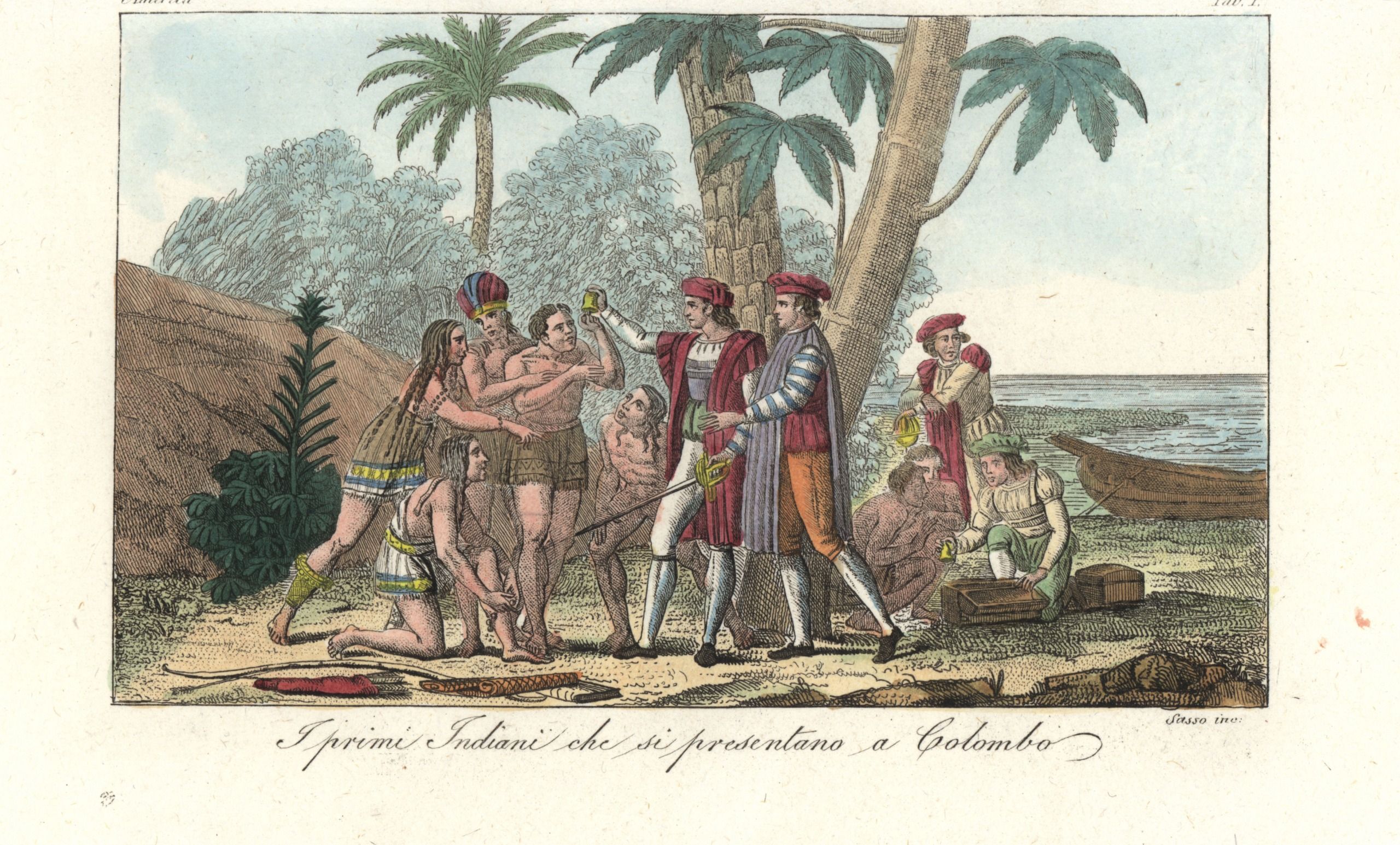
When Christopher Columbus made landfall in America on October 12, 1492, he encountered indigenous Lucayans living on the Bahamas island now called San Salvador. Columbus wrote in his diary about “great crowds of men” who greeted him that day, exchanged with him, and told him about other groups living on nearby islands. But within a few decades of Columbus’ arrival, the indigenous peoples of the Americas were decimated by what anthropologist Eric Wolf called the “Great Dying”: a combination of epidemic diseases, wars and slavery that led to a rapid decline in the native population. For centuries, researchers have been trying to determine how many indigenous people lived on nearby islands. America just before the fateful arrival of the European colonizers. The answer to that question has been surprisingly elusive, and estimates based on historical censuses, archaeological sites, and land carrying capacity in the Western Hemisphere have varied wildly. Recent research on Native American demographics has revealed that the population peaked several centuries before Europeans appeared on the shores of North America, and that if Europeans had reached that peak, the entire history of the continent might have been different. You may like First estimates of the indigenous population People have lived in the Americas for at least 14,000 years, having entered the continents through the region around the Bering Strait. Archaeological evidence shows that these early Americans dispersed across the newly found lands quite quickly. But what happened to the population between that dispersion and the arrival of Columbus is a great unknown; Estimates of the number of indigenous peoples living in the Western Hemisphere in 1492 ranged from 1 million to 112 million people. “We don’t have good quantitative estimates,” George Milner, an anthropologist at Penn State, told LiveScience. “The numbers are all over the place.” One of the first modern researchers to attempt to quantify the indigenous population before Columbus was anthropologist Henry Dobyns. In a 1983 book, Dobyns used estimates of how many people each type of landscape could support, as well as historical records of disease epidemics from the 16th century to arrive at an estimate of the indigenous population of around 112 million people, more than 100 times larger than some previous experts had believed. “In essence, Dobyns filled the landscape to its maximum carrying capacity, so that all environmentally similar places were occupied by the same number of people,” Milner said. “It also assumed that epidemic diseases spread widely and universally, which would make sense if the landscape became crowded.” But a series of archaeological investigations in the 1970s and 1980s revealed that the Americas were not evenly populated, Milner said. Dobyns’s estimates were therefore too high. What to read next If Europeans had tried to colonize the continent in 1000 AD. C., they would have encountered a much, much larger indigenous population. Robert Kelly, archaeologist at the University of Wyoming. Researchers then began to focus on creating population estimates for specific regions of the hemisphere, using techniques such as the relative density of ceramic sherds at a site, the number of stone tools and flakes, the number and size of houses, and mortality trends of human skeletons. In the study, geographers compiled 129 population estimates from 82 published studies to model the hemispheric distribution of the indigenous population in 1492. The researchers divided the hemisphere into seven regions (the Caribbean, Mexico, Central America, the Inca territory, the Amazon, North America, and the rest of the Americas) and arrived at a combined estimate of 60.5 million. His estimate for North America (present-day Canada and the United States) was between 3 and 6 million, less than a third of Dobyns’ estimate of 18 million. Native Americans lived in large settlements like this one at Cahokia Mounds, an archaeological site near present-day St. Louis, Missouri. (Image credit: The Washington Post/Getty Images) A regional perspective: North America The 2019 study found that the most populous groups in the Western Hemisphere in 1492 were the Aztecs, largely in modern-day Mexico; and the Incas, who lived along the west coast of South America. But the people we know best from an archaeological point of view are the indigenous groups of the US and Canada. In a 2010 study, Milner and geographer George Chaplin expanded on data from eastern North America, compiling historical group sizes and archaeological occupation area sizes to estimate the location and size of “population aggregates.” Using this method, their overall estimate for the eastern United States and southeastern Canada was approximately 1.6 million people. “Our average estimates,” Milner and Chaplin wrote, “indicate that North America was home to approximately 2.8 to 5.7 million people” or a “best estimate” of 3.8 million people in the early 16th century, before European diseases dramatically reduced the size of the indigenous population. “If you want to start estimating specific populations, you have to use measures that work across regions,” Robert Kelly, an archaeologist at the University of Wyoming, told LiveScience. “People produce things that can be carbon dated everywhere, because everyone had to light fires to keep warm and cook.” Charcoal from hearths is one of the main man-made elements that archaeologists use to radiocarbon date a site. The radiocarbon data provide a range of dates showing when the firewood was most likely to have been used. In North America, many such carbon-14 dates from charcoal, as well as from animal bones and plant remains from archaeological sites, have been entered into the Canadian Archaeological Radiocarbon Database (CARD). In a 2009 study, Matthew Peros, a geographer at Bishop University in Quebec, and his co-authors mathematically combined the radiocarbon date ranges in CARD to generate a single curve that revealed how common C-14 dates ended up over time. At that time, CARD had about 25,000 registrations. Because time periods with more people likely produced more material that could be carbon dated, the shape of the radiocarbon dating curve gave the team an idea of when North America’s population rose and fell. They found that the population of North America increased rapidly around 50 BC and peaked around 1150 AD aggregated into denser settlements. In a 2025 study, Kelly and his colleagues created a radiocarbon dating curve, which revealed a peak of the Native American population around 1150 AD. C. (Image credit: Kelly et al./PNAS) “The 1150 date was an interesting find that also surprised us,” Peros told LiveScience. “I had assumed it would be more like 1,500 right after the Europeans arrived.” In a 2025 study, Kelly and his co-authors found a similar temporal spike. By that time, the CARD data set had ballooned to over 100,000 dates, making the estimate more robust. “Although devastated by European contact, the indigenous population did not simply increase to a peak in 1500 CE and then decline,” the researchers wrote in the study. In fact, they found evidence of a slight recovery in the population just before 1500. But how big was that population? By combining the radiocarbon dating curve with an initial population and taking into account average annual population growth, researchers can estimate the number of people living in North America around 1492, Peros said. In their study, Peros and his co-authors assumed that a handful of extended families (about 1,000 people) entered North America about 15,000 years ago as a founding population. Using that data, the researchers estimated that North America’s peak population was about 2.5 million in 1150 and had declined to about 1.8 million by 1492. But if people arrived much earlier than 15,000 years ago (which could be the case, given evidence from sites like White Sands in New Mexico, which dates back to 23,000 years ago) or arrived in greater numbers, those population numbers would be even higher. 1000 AD, they would have encountered a much, much larger indigenous population,” Kelly said. At the time, the city of Cahokia, near present-day St. Louis, spanned 6 square miles (16 square kilometers) and had a population of nearly 20,000 people. “They could have deployed thousands of warriors and it would have been a very different experience for Europeans,” Kelly said. “It could have been a very different story.” Why does this matter? Exclusively for Live Science, ProExperts told LiveScience that the pre-1492 population of what is now the US and Canada was between 2 and 4 million. The deep archaeological dive into this region opens up the possibility that a full estimate of the population of the Western Hemisphere could one day be made. Milner is optimistic that they will eventually get there. Probably not,” he said. “It’s time-consuming, laborious, and not particularly flashy work.” Still, demographics is important work, he said, because it can help us make estimates to prepare for the future. “The world’s population has more than doubled in my lifetime; that’s unheard of in human existence,” Milner said. “Environmental scientists are really trying to look at what happened over long periods of time to give us a range of variation of what might happen in the future. We have to make some informed decisions about how to manage our landscape and adapt to these changes.” Understanding the number of indigenous inhabitants in the Western Hemisphere in 1492 is also key to understanding the history of North America. “North America was not an empty continent when the Europeans arrived,” Peros said. “There were people and civilizations in virtually every part of the Americas for a long period of time. It’s important for people to understand that when we talk about reconciliation issues and when we do land surveys.” Help us improve Live Science Pro: We’re always trying to improve our content. Leave us your feedback on Pro here. How much do you know about the first people to come to America? Find out with our Early Americans quiz!