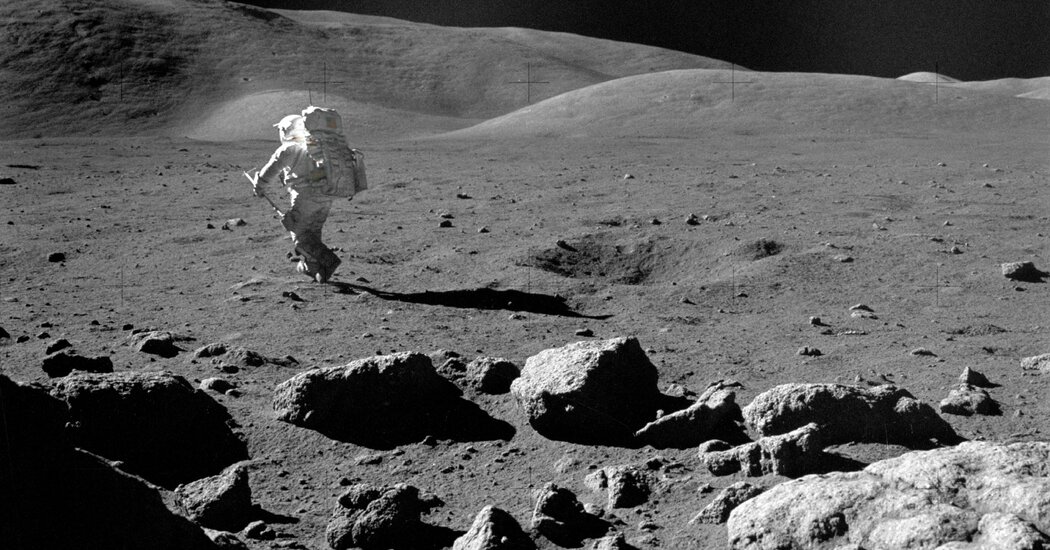
Imagine an alien civilization powered by dazzling technologies far more advanced than ours. Imagine city-sized spaceships, planetary mines, or swarms of solar panels harvesting energy directly from a star. As these aliens go about their supernatural business, the erosive forces of space wear away at their infrastructure, releasing small pieces of debris that break off and float into the cosmos. If civilization collapses, its remains degrade even faster. Clouds of particles could be released into the galaxy, similar to microplastics in Earth’s oceans, dotting countless worlds with the detritus of an extraterrestrial society. Some of these particles, if they exist, could even have floated through our solar system, perhaps settling on the surface of the moon, proposes a team of scientists focused on the search for extraterrestrial intelligence, or SETI. In their provocative study, which is under peer review for the International Journal of Astrobiology, they suggest that the search for these microscopic remains in the lunar soil could solve one of humanity’s great questions: Are we alone in the universe? “If there has ever been any other technological civilization in our galaxy, it is not a far-fetched hypothesis to think that particles of them are on the Moon in some quantity,” said Lewis Pinault, a scientist affiliated with the SETI Institute in Mountain View, California and a researcher at Birkbeck. College, University of London, who led the research. In the study, the team showed how alien infrastructure could erode and erode into tiny particles and modeled how they would disperse across the galaxy. This process is already well observed here on Earth: satellites, for example, throw microscopic material into space. Sofia Sheikh, a scientist at the SETI Institute who studies hypothetical extraterrestrial technologies known as “technosignatures,” described the team’s idea as “a creative and valuable avenue.” He said this is especially true in the context of renewed interest in the Moon by Artemis, a NASA program that aims to return astronauts to the lunar surface. “We know that on Earth time and entropy affect everything humans make,” wrote Dr. Sheikh, who was not involved in the study, “and there is much more to explore about how the breakdown of technological artifacts can be applied to SETI searches.” Pinault and his colleagues modeled the particles’ possible trajectories through the galaxy, showing how they might intersect with our solar system over time. They speculate that some particles could survive impacts with the Moon, leaving traces of extraterrestrial societies that may have already become extinct. “If it is accepted that searching for extraterrestrial intelligences is a legitimate part of science, which it clearly is, then searching for technological products, also known as artifacts of these intelligences, should be as scientifically valid as searching for their radio emissions,” said Ian Crawford, professor of planetary science at Birkbeck College, University of London and co-author of the study. in part by Ukrainian researcher Alexey V. Arkhipov, who in the 1990s pioneered the idea that the moon could be a collecting site for extraterrestrial artifacts. But at that time, the search for extraterrestrial life was largely relegated to the margins of academic research, and Dr. Arkhipov’s research did not gain much traction at the time. Pinault and his colleagues have resurrected the concept and focused on particles on the small micron scale, comparable in size to a single bacteria. In a nod to Dr. Arkhipov’s work, the scientists called their hypothetical specks “Arkhipov particles” in the study. Each star could have had multiple civilizations that were generating debris, Dr. Pinault said. He added that the aliens “may have become star travelers who are developing similar technologies in every star system they go to, so the potential for there to be quite a bit of interesting debris in the galaxy is quite high.” Researchers also considered the possibility that aliens may have sent microscopic machines for surveillance purposes or other types of active missions. They called these operational objects “Bracewell particles” after physicist Ronald Bracewell, who proposed the idea of autonomous alien probes in the 1960s. Jason Wright, a professor of astronomy and astrophysics at Penn State and a SETI researcher, called the preprint “impressive” and “extremely comprehensive” and said it was worth a try. “They have revived what is actually a pretty obscure idea and shown that it is plausible,” said Dr. Wright, who was not involved in the work. To test their hypothesis, the scientists propose sending a mission to the surface of the moon to examine about one cubic meter (35 cubic feet) of soil as a starting point—a difficult task. Specialized instruments would then comb the soil for artificial particles, perhaps examining metals and other manufactured substances. Pinault has already developed models designed to search for larger artificial objects on the Moon, such as the unlocated remains of the Soviet Luna 9 lander. Similar models could also be trained to detect tiny grains that could be of artificial origin. Even if artificial grains were identified, there would be a high probability that they were of human origin. Many spacecraft parts have crashed into the Moon over the decades, so it wouldn’t be surprising to find micron-scale debris from our own defunct missions. To determine whether a particle comes from Earth or some extraterrestrial world, scientists would need to analyze the chemical fingerprint of the object. Finding even an extraterrestrial technosignature in a lunar sample is a long shot, Dr. Crawford said. But if one were found in the moon’s dust (and confirmed to be genuinely foreign, rather than trash from our own civilization), it would answer the tantalizing mystery of whether life exists beyond Earth. “The chances of finding anything on the Moon are so small,” Dr. Crawford said, that “this would immediately imply that there must probably be very many of them, at least in the history of the galaxy.” “It would be a very, very important discovery if it were made,” he added, “but it is a needle-in-a-haystack exercise.”