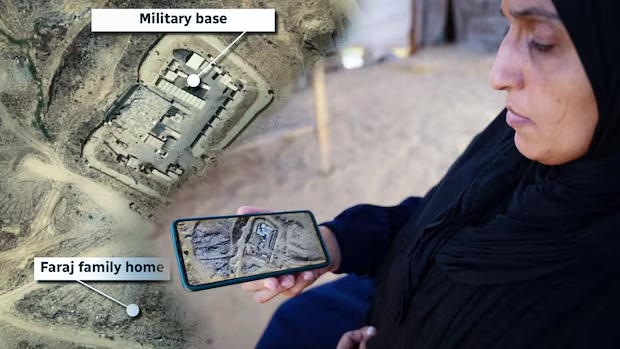
Satellite images show Israel compacting and removing rubble and rubble from Gaza, with possible human remains and potential evidence of war crimes still trapped beneath, according to a CBC News visual investigation of several sites. Multiple destroyed areas in formerly populated areas of Gaza are being cleared, according to CBC analysis, to make way for new military outposts for the Israel Defense Forces (IDF). Families in Gaza say this is preventing them from recovering the bodies of their loved ones trapped beneath the ruins. “Where are the bodies? Where are the houses? Where are the rubble?” said Dalal Faraj, a Palestinian whose home in Gaza City was bombed, after CBC freelance cameraman Mohamed El Saife showed him satellite images of the now-clear site. UN officials have expressed concern in recent weeks that Israel is not properly handling the rubble (and bodies that may still lie beneath) left by the strikes in the nearly three-year conflict sparked by the Hamas-led attacks on October 7, 2023. WATCH | Investigating Gaza debris clearing: Is Israel erasing evidence of alleged war crimes in Gaza? CBC’s visual investigations team uncovers new satellite images showing the IDF clearing debris from sites in Gaza they bombed, which experts and human rights advocates say risks destroying evidence of alleged war crimes. Gaza families interviewed by CBC say this activity is preventing them from recovering the bodies of their loved ones trapped under the rubble. In 2024, the International Criminal Court ordered Israel to take steps to preserve evidence of alleged violations of the UN Genocide Convention in Gaza. “It is Israel’s obligation under international law to do everything possible to ensure that these remains are found, identified and buried with dignity,” said Ajith Sunghay, head of the Office of the United Nations High Commissioner for Human Rights in the Occupied Palestinian Territory. In a statement to CBC News, the Israel Defense Forces (IDF) said it is clearing structures and dismantling infrastructure in Gaza “based on tactical necessity” and to “reduce the level of risk posed” to its troops. It says this activity “is carried out in accordance with operational necessity, the provisions of international law and IDF directives.” The IDF denies any accusation that it is failing to preserve evidence or recover remains, saying it “treats every body found in the area with respect and seriousness.” Families CBC News spoke to say no one contacted them about the recovery of the bodies before or after the IDF removed the rubble from their homes. IDF military base built on neighborhood”Impossible… Is this our area?” Dalal Faraj told CBC News, looking at satellite images of his old neighborhood. “Where did the houses go? Where are my husband and son?” Dalal Faraj, who lives with his children in a displaced persons camp in Gaza City, looks at satellite images of his old neighborhood. (Mohamed El Saife/CBC) In October 2023, as the war accelerated, Faraj left his home in Shuja’iya, a neighborhood in Gaza City. Her husband, Taha, 48, and son Nasr, 16, told her to take the five youngest children and go to a safer place. Taha and Nasr told him they would catch up when they could. On October 8, 2023, one day after the war began, an Israeli strike hit his house. Since then she has not heard from her husband or her son. Nasr Faraj (left) and his father, Taha. (Submitted by Dalal Faraj) Satellite images that CBC’s visual investigations team was able to gather show that buildings that were once in Faraj’s neighborhood no longer exist. As the area was cleared of debris, a new Israeli military base was built on top. This composite image shows satellite images of the Faraj family’s neighborhood and the location of their house in August 2023, abandoned, two months before the start of the war, and in August 2026, with the Israeli military base in the center. (Google Earth, Pléiades Neo © Airbus DS 2026/CBC)On March 10, 2026, a satellite captured a debris clearing operation in the Faraj family’s neighborhood. CBC News identified 10 excavators and a truck in the area just north of their home. A composite image of heavy land clearing machinery that CBC News’ visual investigations team identified in a satellite image from March 10, 2026. The image shows a clearing operation near the Shuja’iya military base. The color of the machinery suggests that they are not military, but probably civilian subcontractors. (Pléiades Neo © Airbus DS 2026/CBC) A month later, satellite images show four excavators clearing the land west of the Faraj family home. In April 2026, excavators moved west of the military base, clearing debris, as shown in this composite image. (Pléiades Neo © Airbus DS 2026/CBC)Faraj, who now lives with his children in a displaced persons camp in Gaza, said he has been waiting for years to return home to recover Taha and Nasr’s remains and rebuild. Seeing the photos broke his last hopes, he said. “This area used to be my home. We used to live in a safe place. We went to school, went out and had fun. Suddenly, this happened,” Faraj said. CBC asked the IDF how many bodies found under rubble in Gaza since last year’s ceasefire have been returned to Palestinians. He didn’t answer the question. Destruction of ‘Swedish village’ Shaher Mohamed Abu Ouda, 36, says 14 members of his family are still missing after his family home in southern Gaza was destroyed. Abu Ouda lived in a settlement in the Rafah governorate known as the “Swedish village.” Abu Ouda left the area in 2024 and Rafah was occupied by Israel in 2025. Shaher Mohamed Abu Ouda, left, talks to his family members about his neighborhood in Rafah governorate, which has been destroyed and cleared. (Mohamed El Saife/CBC) “The fighter jets started shooting at us, then the F-16s came and fired at the house we were in,” Abu Ouda told CBC. “I left by a miracle.” Eight of the 14 members of the Abu Ouda family whose whereabouts are unknown after the IDF cleared debris that may have contained their remains. (Submitted by Shaher Mohamed Abu Ouda) “To this day, I think about what happened that day,” he said. “I thought I’d go back and see them, but after all these years, I won’t even find a blouse.” Comparative photos of the location of Abu Ouda’s house show that the rubble was there until at least June 2026. By August, the rubble had disappeared, with traces of heavy machinery visible. The three satellite images in this composite show the location of the Abu Ouda family home in Swedish Village in October 2023, May 2026 and August 2026. (Google Earth/Pléiades Neo © Airbus DS 2026/CBC) The images from May 2026 show a clearing operation, with six vehicles removing debris where the Swedish Village once stood. CBC News identified vehicles clearing debris in the satellite image taken on May 7, 2026, in the center of what was the Swedish Village, preparing the location of the military base. (Pléiades Neo © Airbus DS 2026/CBC) The latest satellite images from August 2026 show the neighborhood completely flattened, with a military base on top. This composite image shows what the Swedish Village area looked like in June 2024, left, and August 2026. (Google Earth/Pléiades Neo © Airbus DS 2026/CBC) Abu Ouda is not surprised by the satellite images of his neighborhood, because Rafah has been under Israeli control for years. But the images confirmed that it is unlikely that he will be able to recover his family’s remains, he said. “Fourteen people lost their lives and we still don’t know anything about them,” he said. “Not even the rubble is there.” ‘A new type of destruction’ Júlia Nueno Guitart, a researcher with Forensic Architecture, an independent research group that follows events in Gaza, confirmed the CBC’s findings. He said his group has collected more than 2,000 similar incidents and managed to confirm 43 cases “in which people have remained under the rubble.” “We have been able to do this either through visual evidence, graffiti on the walls of some of the buildings where people stay or through reports of [Gaza’s] “What we are seeing after the ceasefire in Gaza is a new type of destruction, different from what we have been documenting before the ceasefire,” said Nueno Guitart. According to Janina Dill, a professor at the University of Oxford in the United Kingdom and an expert in international law, removing rubble and flattening the bombed area is only compatible with international law if the war dead are collected, identified and buried, and if the evidence necessary to prosecute possible war crimes or repress violations of international law is preserved. [the rubble removal] is done without taking these two considerations into account, then it is absolutely prohibited and is incompatible with Israel’s obligations under the Geneva Convention,” Dill said.