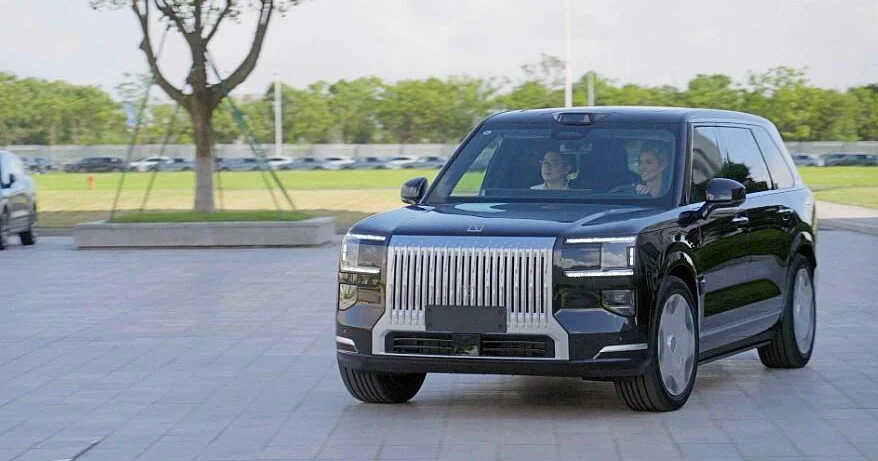
Beijing — On the outskirts of the Chinese port city of Ningbo, surrounded by lush green hills topped with giant wind turbines to harness the power of the East China Sea’s gales, there is a factory where bosses believe they are making the cars of the future. It is where Geely Auto Group, one of China’s largest electric vehicle manufacturers, produces its luxury brand Zeekr. The name is a fusion of two concepts: Zee means Generation Z and Kr is the chemical symbol for Krypton. Yes, the same element at the heart of the rock that drains Superman’s powers. Is it a metaphor for what is to come, when China appears to be on its way to dominating the global car market? Inside the huge plant, which began operating in 2023, giant mechanical arms guided by artificial intelligence work in unison to assemble the vehicles. The plant is 99% automated; machines construction machines. An occasional human worker oversees the process. Zeekr’s vice president of manufacturing, Zhao Chunlin, used to work for General Motors. He told CBS News that he admires and respects American automakers, while discussing the more than 100-year legacies of GM and Ford. But Zhao and China are focused on the future, not the past, and he was confident that he is now working for a company in a country that many believe will dictate the future terms of the auto industry and potentially eliminate opposition. Zhao said he believed Chinese customers’ demand for excellence had propelled his nation to the forefront of the electric vehicle industry. “We are the best because we have the largest market in the world, so customer requirements are very high because there are many options. They want it better, better, better. They want everything!!” When asked if Chinese electric vehicles are better than American-made models, he didn’t hesitate. “Yes, of course,” he said. “Even Teslas made in China are of better quality than Teslas made in the United States.” Zeekrs will soon be sold in North America, thanks to a trade deal that Canadian Prime Minister Mark Carney signed in January during a meeting in Beijing with Chinese President Xi Jinping. A total of 49,000 Chinese electric vehicles will be sold in the first year of the deal, and Canadian tariffs on imports will fall from 100% to just 6%. At that level, Chinese imports will account for almost 25% of last year’s total EV market in Canada. They will compete for market share against American brands such as Tesla, GM and Ford. But Chinese electric vehicles have one key advantage: their significantly lower prices make them very attractive to many buyers. If Australia is any guide to what may happen when Chinese companies gain ground in the electric vehicle market, then American automakers should be careful: Chinese-made vehicles have gone from zero market share 10 years ago to more than 30% today. A similar trend is developing in Europe, where, despite higher tariffs applied to some brands, Chinese electric vehicles are taking an increasing share of the market, jumping from 9% to around 14% already this year compared to last. Could it happen in Canada too? It’s too early to say. It’s a very different market, and American automakers obviously have a geographic advantage, but the Chinese presence in the Canadian market could offer a window into the future, and the vision should be of concern to the United States and its auto industry based just across the Detroit River. The U.S. government has so far refused to allow Chinese vehicles into the market, blocking them with prohibitive tariffs and bans, citing concerns about national security and protecting the domestic auto industry. At the Zeekr factory, Zhao said that no one, in the United States or anywhere else, should see Chinese automakers as a threat. He said that while China and Geely have plans to one day sell and potentially manufacture cars in the U.S., it would be in the form of collaborations and joint ventures. “There is no need to be afraid. The market is very big,” he said, adding with a smile: “Trump, don’t worry!” Zhao said consumers in the U.S. and around the world deserve the driving experience that Chinese electric vehicles offer. To prove their point, they let CBS News test drive Zeekr’s most luxurious and top-of-the-line model, the 9X plug-in hybrid. CBS News’ Anna Coren takes a test drive in the Zeekr 9X, the high-end SUV made by Geely Auto Group’s luxury brand, at the Zeekr factory outside Ningbo, China. CBS News They call it the Rolls Royce of China. The design, however, is a clear imitation of the iconic British Range Rover SUV. Geely acquired Swedish automotive giant Volvo in 2010, so the vehicle incorporates European design with Chinese technology. As soon as you open the door it oozes luxury. From the leather interior to the plush seats, the sound system (made by British luxury brand Naim Audio, which can also be found in Bentleys) and the technology, including largely self-driving capability. The engine is barely audible and the ride is incredibly smooth. The hybrid can go from 0 to 100 kilometers per hour (about 62 mph) in just four seconds and has a combined range of 745 miles on one tank of fuel and charge. Another point of note: The 9X can park itself while you stand outside and watch, which could be a game-changer for drivers who hate parallel or reverse parking. But most importantly, it sells for about $70,000, about half the cost of a Cadillac Escalade. Just 10 years ago, Chinese cars were not taken seriously in most Western markets. Now, many consider them to be as good, if not better, than many American and European brands, especially for the price paid. Zeekr now sells its vehicles in more than 50 countries and will begin exporting the 9X to Europe and the Middle East this month. Tucker Reals contributed to this report. Go deeper with The Free Press on: