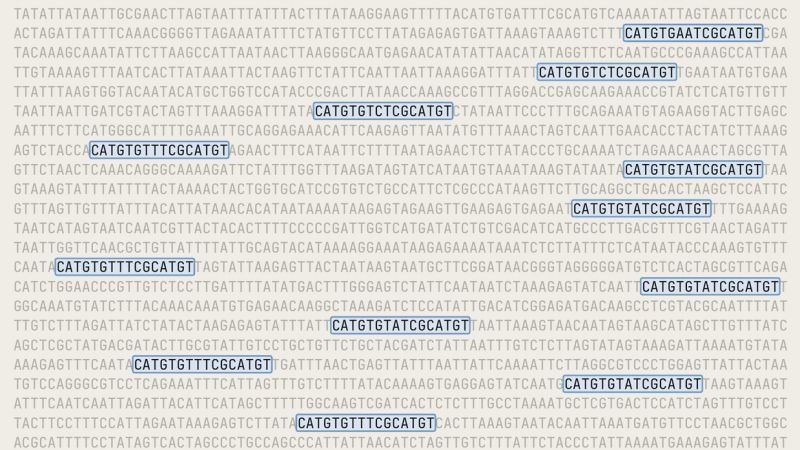
AI executives are betting big on biology. They say their big language models, which have already dramatically changed the fields of coding, software development and mathematics, can disrupt biological research in the same way. But one company’s attempt to do so has already unleashed a wave of skepticism and controversy. Anthropic, the research and artificial intelligence giant behind Claude, said last month that its biology research laboratory had used artificial intelligence agents to discover an unusual pattern of DNA in the genetic code of viruses, specifically a “novel enzyme system.” The signature is similar to the microbial system harnessed in gene editing tools such as CRISPR Cas-9, which is used to modify the DNA of living organisms. The technology is common in laboratories around the world and won the Nobel Prize in Chemistry for its inventors in 2020. Dario Amodei, chief executive of Anthropic, said on social media that the finding offered great scientific potential. “Today we announce the discovery led by Claude of a molecular machine that we suspect could represent a new gene-editing mechanism,” he wrote in However, some experts not involved in the work said the finding was early and incremental, and far from a genuine breakthrough. “These are very interesting preliminary results, but at this point they do not demonstrate gene editing or provide a mechanistic picture of exactly what is happening,” said Aaron Engelhart, associate professor in the Department of Genetics, Cell Biology and Development at the University of Minnesota. Anthropic researchers have not determined what the newly discovered viral sequences actually do, and therefore whether they represent a mechanism that has practical applications similar to those used in CRISPR tools, according to a paper detailing the research. The research has also not been published in a peer-reviewed scientific journal. Scientists, including Engelhart, said Anthropic’s finding definitely warrants further investigation, and a company news release cited Feng Zhang, a professor at MIT and the Broad Institute in Cambridge, Massachusetts and a pioneer of CRISPR genome editing for the treatment of sickle cell anemia, among other advances, who called the work “really intriguing.” But just days after Anthropic’s announcement, Mario Rodríguez Mestre, who said he used Claude extensively for his recently completed doctoral research at the University of Copenhagen, claimed that his unpublished research describes the same viral signatures. “It is essentially the same finding. This is not simply a case of two groups studying related protein families or similar biological systems,” Mestre told CNN by email. Mestre’s claims echo those made by mathematicians after OpenAI, which created ChatGPT, announced that it had solved a long-standing and high-profile mathematical problem. They also raise questions about how Claude’s discovery unfolded. Biologists working at the Anthropic lab said they gave Claude a message to search a massive database of DNA sequences for “interesting new examples” of reverse transcriptase, or RT, an enzyme that copies RNA into DNA and therefore plays a role in spreading genetic information in an organism. The company said 950 AI agents, who can independently plan and execute tasks, spent 21 hours searching for data and selecting 3,500 RTs. He narrowed the group down to the 20 most compelling. For an experienced scientist, this type of analysis can take weeks or months, according to a statement from Anthropic. Then, “one of the agents detected something notable: a repeating pattern of DNA sequences that occurs next to the gene for a strange-looking RT,” the company said in the statement. “After extensive analysis, he became convinced that he had found a new biological system and submitted a report for human review.” Anthropic said scientists in its biology lab then analyzed and tested the finding, which they described as a “previously uncharacterized” biological system in bacteriophages, a type of virus that attacks bacteria, with a structure similar to CRISPR, which is found naturally in bacteria. Mestre, however, said he had shared unpublished research on his private Claude account, including drafts of his dissertation, analysis and material describing these systems. “I am not claiming that Anthropic deliberately took our work. I cannot prove it,” he told CNN by email. “Or information related to our work somehow reached the model and the model was trained on it. The second possibility, which I currently believe is more plausible, is that there was much more prior scientific knowledge and human direction behind the search than the phrase ‘autonomous discovery’ suggests,” Mestre added, referring to the language used in the statement. Anthropic did not respond to an emailed request for comment. It’s not unusual in the scientific process for different research groups to converge on the same result, but Mestre’s accusation is serious, and many scientists might think twice in the future before entering their unpublished results into these tools, said Ilya Finkelstein, a professor of molecular biosciences at the University of Texas at Austin. Still, Anthropic’s announcement suggests that AI is beginning to function more autonomously in science, said Gustavo Sudre, professor of genomic neuroimaging and artificial intelligence at King’s College London. “You were given broad direction and then had to use your own judgment about what was interesting in the data. That’s a real change from the usual ‘analyze this data set for me,'” he said in an email. AI excels at “searching for a needle in a haystack,” rather than “imaginative advancement,” Finkelstein added. AI tools would help explore domains where students would get too tired or bored by finding an interesting pattern worth investigating further, he said. “They can quickly follow a lot of unproductive paths,” Finkelstein told CNN. “They are really good at hard work when orchestrated by experts in the field.” Finkelstein also noted that the lead author of the Anthropic paper is Dr. Peter Yoon, who used to work in the lab of Jennifer Doudna, one of the architects of CRISPR Cas-9 and shares the 2020 Nobel Prize with Emmanuelle Charpentier. So Anthropic’s AI agents were guided by people at the top of their fields, he said. “Four of the six authors are high-level molecular biologists and experts in the field. Give that group a bunch of computational and frontier models (without safeguards, I guess), and I’m sure we’ll see more interesting bioinformatics discoveries,” Finkelstein wrote in a blog post on his lab’s website. However, other researchers say that talk of AI-powered autonomous discoveries is an exaggeration that preempts real science, and that the models are not yet capable of generating meaningful results on their own, despite claims to the contrary. Letting a model sift through data at a scale no human can match advances a field, but it doesn’t necessarily herald a breakthrough, Sudre said. “I can tell you from experience that the gap between ‘interesting patterns’ and ‘useful knowledge’ is where most of the work lies,” he said. Anthropic launched Claude Science, its tool designed for research, earlier this year. All of its rivals have recently introduced similar tools. OpenAI has GPT-Rosalind, Microsoft has Quine, and Google DeepMind has Co-Scientist. They operate as large language models, but also leverage specific scientific data sets, such as DNA sequences. However, models are only as reliable as the data they are trained on. For example, the strength of Google DeepMind’s AlphaFold, which won the 2024 Nobel Prize in Chemistry for decoding protein structures, comes from training the AI system on a limited, specialized data source collected over decades. AI developers are under intense public scrutiny amid growing concerns about rogue AI agents and whether AI companies can adequately control them. Biological discoveries may offer company executives the opportunity to craft a more positive narrative that counters some of the pessimism surrounding their products. But moving toward meaningful, tangible findings in the field will likely require integrating AI models into practical laboratory work through robotics. “Biology is not mathematics and at some point intelligence has to be expressed in the physical world through a robot that can perform unique and complicated experimental tasks that a good student would normally do almost instinctively,” said Yuval Elani, associate professor of biochemical technologies at Imperial College London. “From what I’ve seen about robotics and automation, we’re not very close. So it’s going to be a while until we can really justify the hype around AI in biology.” Anthropic says it understands there is a limit to what artificial intelligence can do on its own and is investing in “model hardware” that will allow AI agents to safely operate physical devices. King’s College’s Sudre, whose work integrates genomic, clinical, neural and cognitive data to predict how mental health symptoms will develop in children, is emphatic that the role of humans in science is not shrinking. The risk is not that scientists will be excluded from discovery, but that they will become lazy and not use their judgment to understand whether a result is significant, he said. The next step for Anthropic scientists is to perform the slow work of physical laboratory experiments to understand the pattern they have identified and whether the signature could have practical use in biotechnology. “Of course, in the future part of that could also go to robots,” Sudre said. “But the thing is, the questions worth asking in science don’t lie hidden in databases waiting to be found. They come from us: from what we care about, from what we care about.” Subscribe to CNN’s Wonder Theory science newsletter. Explore the universe with news about fascinating discoveries, scientific breakthroughs and more.