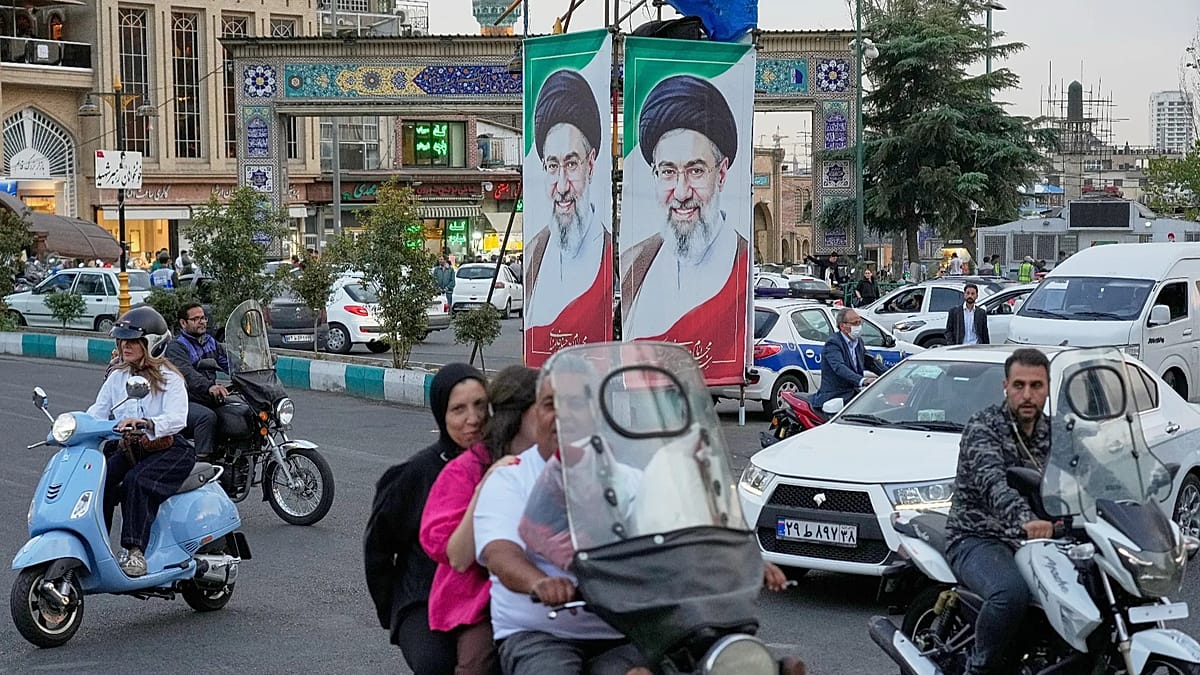
Iranian Supreme Leader Ayatollah Mojtaba Khamenei has issued a warning to the world that “any level or type of threat must be met with an immediate, impactful response without geographical restrictions.” Khamenei’s threat comes as urgent diplomatic efforts continue to prevent a new all-out war against Iran, which would have devastating consequences for the Middle East and beyond, as Iranian Foreign Minister Abbas Araghchi said on Sunday that Tehran hopes “that there is rationality on the other side to prefer diplomacy to other paths,” as “based on the experiences of the last two wars, we are much stronger than before.” The supreme leader met with Iran’s top military commanders on Saturday and presented them with directives to prepare for possible new military action between the United States and Israel, according to the official IRNA news agency. This follows warnings from the United States that its forces could carry out a short but intense military campaign against Iran after the US midterm elections next week. The threat of a “geographically unconstrained response” means Iran could target Europe as well as Turkey and the South Caucasus in response to a new attack. The description of “any level or type of threat” could indicate that Iran could act preemptively, before a US-Israeli military attack. State media said Khamenei, who has not been seen publicly since the Iran war began with US and Israeli strikes in late February, also called for an updated list of possible US and Israeli targets, including “all types of physical and non-physical assets.” Khamenei also said Iran would decide the duration of any new war. “If Iran’s enemies resume military or terrorist attacks, it will be the Armed Forces of the Islamic Republic and the Iranian nation that will determine when and under what conditions those attacks will end,” he said. Iranian state media reported that in a meeting on Saturday, the commander of the Islamic Revolutionary Guard Corps (IRGC), Major General Ahmad Vahidi, along with the commander of the Iranian army and his chief of staff, briefed the supreme leader on Iran’s military preparedness and told him that Iran’s weapons production has increased “sevenfold.” The commanders report directly to Khamenei and have previously overruled Iran’s civilian leadership, fueling constant speculation about who calls the shots in Tehran. Tehran’s threats were reiterated on Sunday by Iranian military spokesman Mohammad Akraminia, who told Iranian state media that “in case a new war breaks out, the geography of the conflict will not be limited to the West Asia region,” that “any possible future war could prove to be significantly longer than past conflicts.” The Institute for the Study of War (ISW), a Washington-based think tank, estimated that Khamenei’s threats were “probably part of an Iranian effort to deter the United States and Israel from attacking Iran.” Gulf countries remain ‘prepared for the worst’ As speculation swirls in the Gulf about the imminence of war breaking out again versus the state of negotiations, with alleged lists of demands from both sides circulating in the media or whether American negotiators will meet directly with the Iranians or not, Gulf nations are bearing the brunt of the months-long state of war, with serious consequences for their economies. While both the United States and Iran have repeatedly pushed previous confrontations to the limit as they try to pressure each other into making concessions, Gulf countries continue to hope that a last-minute diplomatic breakthrough of some kind could lead to a peaceful resolution and avoid another round of war, especially after the United States warned the Gulf that it could launch a new attack on Iran. UAE presidential adviser Anwar Gargash said at a conference in Bahrain on Sunday that Gulf states remain “prepared for the worst,” although he hopes mediation efforts, also led by Qatar, will prevail. He warned that the Gulf has been locked in a prolonged state of “neither war nor peace,” and that if the “positions of Washington and Tehran do not come closer, then we will have to worry about the worst.” The UAE diplomat also denounced the lack of unity of action by the Gulf countries as a bloc, stating that “we have not collectively risen to the challenge” and that rebuilding trust with Iran would take “an extremely long time.” Iran acknowledges ‘positive steps’ from Washington As Tehran continues its threats and defiant rhetoric, its foreign minister and security chief have signaled positive steps in their negotiations mediated with the United States through Qatar. Iranian Foreign Minister Abbas Araghchi announced late Saturday that Tehran could agree to reopen the Strait of Hormuz in just two days, instead of the previous seven-day deadline. He said Iranian diplomats were in Qatar for talks after a Qatari delegation mediated discussions in Tehran over the past few days. Last month, Araghchi proposed reopening the Strait of Hormuz within a week if the United States agreed to lift its blockade of Iranian ports, release frozen Iranian assets and waive sanctions on Iranian oil sales, among other conditions. That was rejected. In an interview with Qatar-based broadcaster Al Jazeera, Araghchi said Iran was not planning to meet with US officials, but called recent US efforts towards a “broader dialogue” a positive step. Araghchi said the decision on whether negotiations would be direct or indirect would be made “once Washington accepts Iran’s conditions.” It comes as the head of Iran’s Supreme National Security Council, Major General Mohsen Rezaei, said he had received a letter from US Vice President JD Vance proposing negotiations. Commenting on the letter, Rezaei said that “the tone has completely changed” and called it a “very good sign.” Araghchi also called Washington’s attempt to open dialogue a “positive step.” Rezaei highlighted a major change in one of Iran’s conditions: ships in a reopened Strait of Hormuz would travel on a route agreed upon by Iran and Oman. And “everyone who passes through this waterway will do so under Iranian management.” He said Iran was now awaiting the latest response from the United States. Furthermore, Rezaei warned in X that any attack would bring “devastating blows to the aggressor using new weapons.” Rezaei, who last week was reported by state media to have met with Iran’s supreme leader, also said there has been no decision to change Iran’s nuclear doctrine, but noted that some Iranians have questioned whether that should be rethought if Iran is attacked again. Meanwhile, on Sunday, Qatar condemned Friday’s attack on one of its LNG carriers in the Gulf, which was hit by “unidentified objects,” calling it “a dangerous act that threatens the safety of maritime navigation and the security of global energy supplies.” The Qatari Ministry of Foreign Affairs denounced in a statement “these reckless and irresponsible practices,” warning of “serious repercussions that they may have for the security and stability of the region and the global economy.”