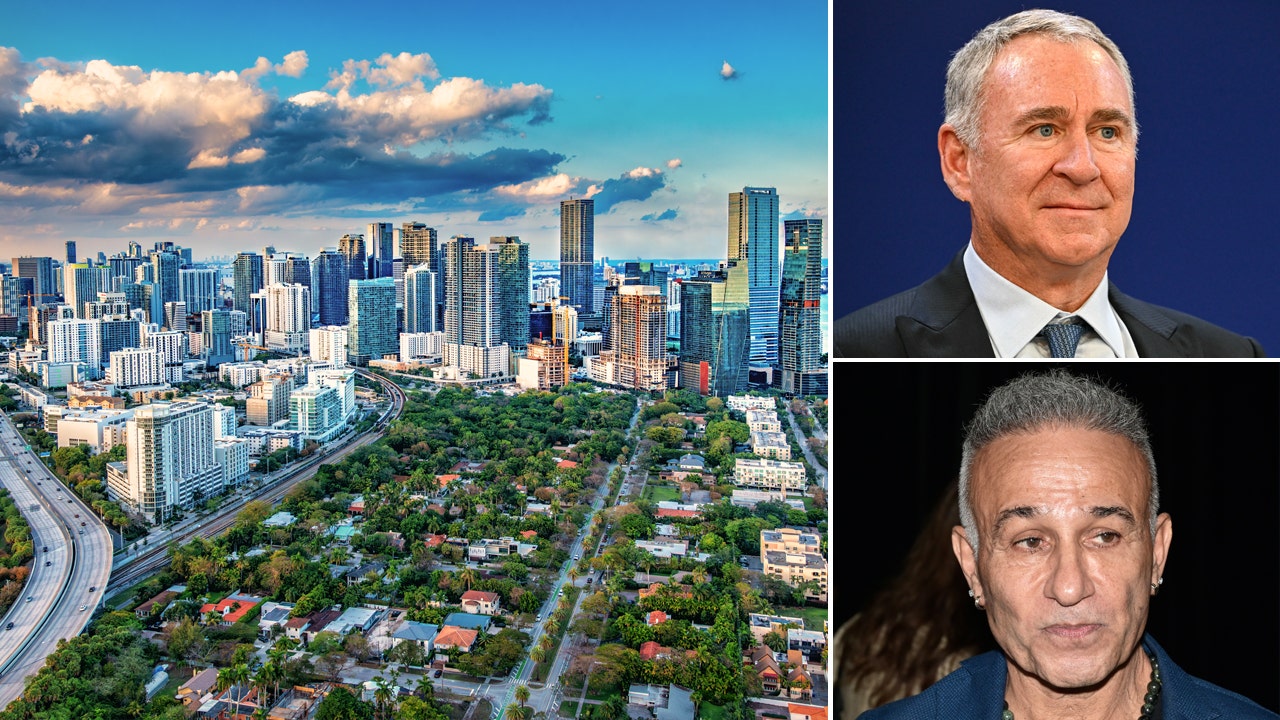
Mana Common founder and president Moishe Mana talks to Fox News Digital about reaching a record $1.1 billion deal with Citadel’s Ken Griffin that will turn a popular neighborhood into a new Carnegie Mellon campus. When Ken Griffin’s representatives first approached real estate titan, visionary and billionaire Moishe Mana to purchase the same land he spent decades developing and developing, Mana was not completely convinced. “To be honest, they came and knocked on my door, I didn’t apply for it. It wasn’t for sale,” Mana, founder and president of Mana Common, told Fox News Digital. “I had the vision. I completed it… And then these guys walk up to my office and tell me they want to buy it: my property, Mana Wynwood. I looked at them and said, ‘It’s not for sale.'” “Where do you find 30 acres in the coolest neighborhood in America, if not the world? Priceless, priceless,” he continued. “And back and forth, I said, ‘Listen, I have other properties, I have this, I have that.’… But they mentioned that it’s educational… And they mentioned that it’s important to do it, but they didn’t say the name. I didn’t know the name, but I assumed it came from Ken Griffin… So [he’s] I wasn’t going to do something small.” “So I said ‘no’ and they left… I needed to digest it, it was too big for me to digest, it’s a shock, more or less, and two days, three days, I slept, I woke up, I went to sleep with it… So, then I told my people, ‘You know what, call them, let’s talk to them again.'” CARNEGIE MELLON GIFT On September 29, Mana closed the sale of approximately 30 acres in Wynwood to Citadel founder and CEO Ken Griffin for $1.1 billion, marking the largest land assembly transaction in Florida history. Mana began investing in Wynwood in 2009 during the Great Recession, acquiring a distressed warehouse for about $5 million and eventually spending less than $70 million to assemble its Wynwood Together portfolio, Citadel CEO Ken Griffin and. Real estate billionaire Moishe Mana broke a Florida record for the most expensive land transaction in history at $1.1 billion (Getty Images) The land acquisition is part of Griffin’s broader commitment to Carnegie Mellon University, which includes a record $3 billion donation The university says $2 billion will support the launch of Carnegie Mellon University in Miami, while $1 billion will support its Pittsburgh campus. He explained that the contract was formalized 18 months earlier. The complex sold will establish a new campus for Carnegie Mellon University, transforming Miami from a destination for tax-driven wealth migration to an international center for higher education and technological research. “Although it lasted two and a half years, three years, the whole agreement, it was not a question of price. The price, once [sat] in the room, and they said, ‘Listen, this is our budget and this is what we want to pay’… I said, you know what? Let’s do it… I think it’s a good cause, it’s going to change the future of South Florida, it’s going to change the future of the Americas, basically, having a university of this type in Miami. It’s going to change the lives of thousands of young people, and the cost is much greater than the money,” Mana said. Ken Griffin, CEO of Citadel, and Farnam Jahanian, president of Carnegie Mellon University, discuss in the ‘Special Report’ Griffin’s $3 billion investment in the university to turn it into the artificial intelligence mecca of higher education. “I didn’t know who Ken was. [was] before, but what I learned, what I saw, is a guy who cares about education and human intelligence,” he said. “And money for him is just a means to get things done. Ken is not married to his money.” “He put Miami on the map. No matter what we did as people, you know, I had money, I was a billionaire before this, but not a Ken Griffin-sized billion. But it took Miami to a different level, to a platform where people are really starting to see Miami as a financial center, as a cultural center. “During Wynwood’s initial transformation, Mana spent between $2 million and $3 million a year on street art, music festivals like III Points, and making Wynwood the heart of Art Basel each year. Although skeptics claim that real estate values are strictly dictated by land size, Mana’s strategy demonstrated that neighborhood culture creates exponential financial returns. “When you go south, I go north. When you go east, I will go west. I don’t chase the crowd.” “This is not my first investment where I make this amount of money and this type of investment. And in fact, a journalist asked me two days ago: ‘Hey, Moishe, I talked to some developers and they told me that the land is worth half the value of this one.’ I laughed,” Mana recalled. “I laughed at how ignorant this statement could be, because this is not the first time that I have always [say]”You value a building by its contents and the neighborhood to which it belongs.” Mana compared Griffin’s willingness to deploy capital for civic and intellectual infrastructure to that of historic builders. “We are experiencing [a] historic moment today. This is the continuation of Henry Flagler,” Mana said. “We are moving from a tourist destination to a true destination of business, community and culture… Do you know the Medici in Florence? We need Medicis in this world. And Ken Griffin is a Medici.” A Tesla Cybertruck is parked in front of a modern building complex with walls covered in street art in the Wynwood neighborhood of Miami, Florida. | Getty Images Mana will retain more than 15 acres in Wynwood and will continue to oversee existing operations and events at Mana Wynwood for the foreseeable future, according to Mana Common. Next, it says it will focus on downtown Miami’s Flagler district, where Mana Common says it has purchased about 80 properties for approximately $600 million over the past 11 years as part of an effort to build a technology and fashion ecosystem that connects North America and Latin America GET FOX BUSINESS ON THE GO BY CLICKING HERE”I want to focus. [on] Center. I want to focus on building the community, building the tech community, building the fashion community, bringing the arts to the neighborhood, to the school.[s] to neighborhoods,” the billionaire said. “People call me every day: ‘When are you building, when are you building, when are you building?’ Relax, we’ll build it, but we want to make the right buildings. We want to build the right neighborhood… and we will get there together. It is the only center that Miami has.”READ MORE FROM FOX BUSINESS