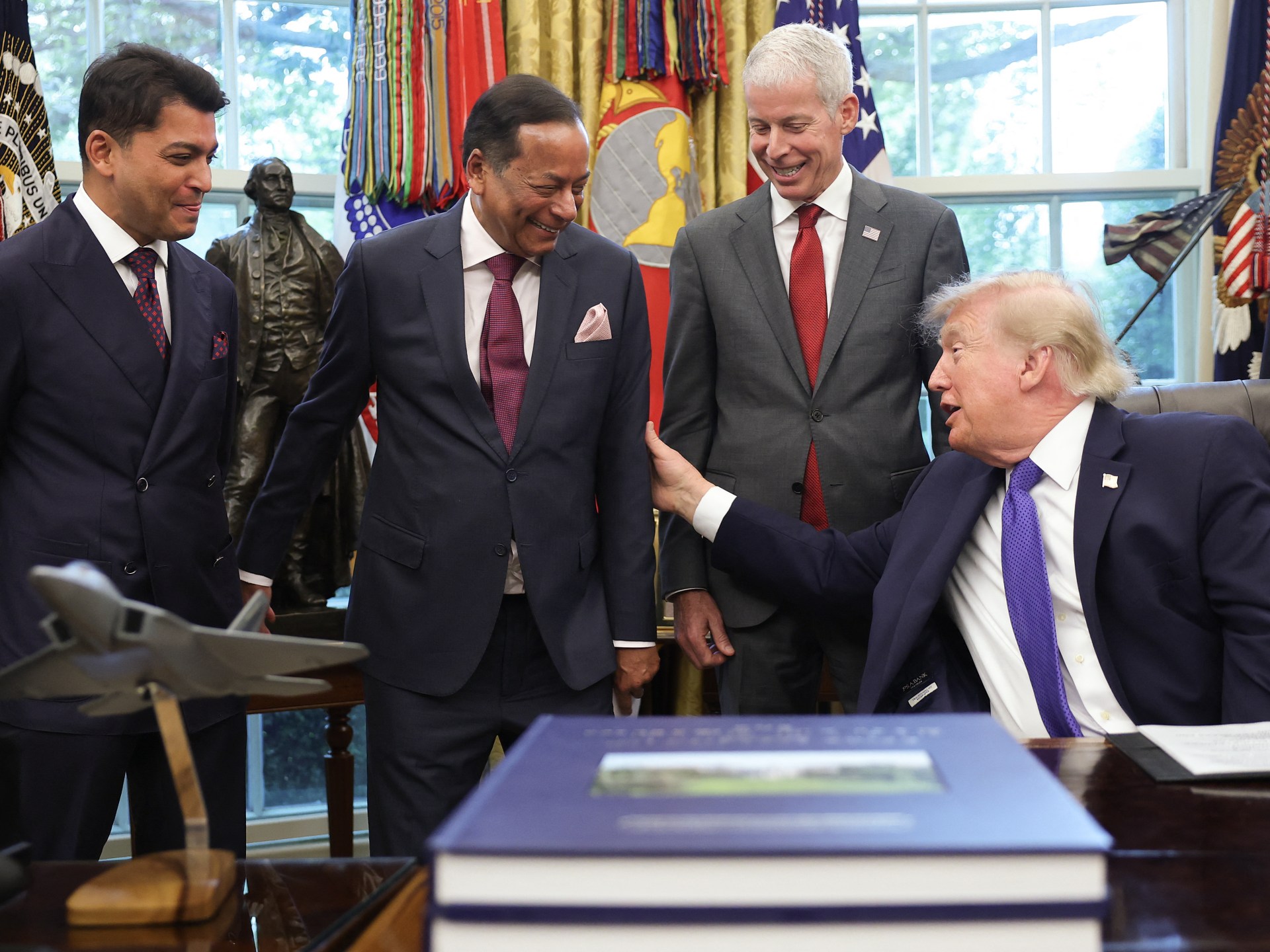
When U.S. President Donald Trump announced a $15 billion steel megaplant on Monday while sitting at his Oval Office desk, he had a row of mostly American politicians behind him, from Cabinet members to elected representatives from Iowa, where the plant will be built. There was one exception: an Indian man with a receding hairline and a lilac pocket square, standing behind the American president’s right shoulder. Ravi Ruia is co-founder of the Essar Group, owner of Mesabi Metallics, the Minnesota-based company that is building the steel mill, expected to be the largest in the United States. A decade earlier, in October 2016, his brother Shashi was in a photo frame with another president during the signing of another major deal: Russian leader Vladimir Putin. Steel and metals are not Essar’s only association with minerals and natural resources. The conglomerate had been involved in oil for years, before selling one of India’s largest private oil refineries to a Russian-led consortium in 2016 for nearly $13 billion. Essar Oil was renamed Nayara Energy. Today, Nayara Energy is partly owned by Russian gas major Rosneft, which is under heavy US and European sanctions over Moscow’s war against Ukraine. Nayara has also become a supplier of petroleum products to Russia at a time when the country faces a fuel crisis following multiple Ukrainian attacks on its oil and gas deposits. As part of a 99-year agreement, Nayara continues to use the Essar brand in India, where the company operates thousands of gas stations. Nayara is under sanctions from the European Union. The White House is touting the Iowa steel project, unveiled weeks before the U.S. midterm elections, as a major economic victory for Americans, promising hundreds of jobs and billions of dollars in revenue. And there is no evidence that the steel project violates any specific US sanctions on Russia. But Trump’s announcement of a megaproject with an Indian company closely linked to Russian investments under Western sanctions underscores how the United States has struggled to economically isolate Moscow despite an unprecedented economic pressure campaign. And the timing of the steelmaker’s announcement raises questions, because it comes days after Trump signed a law that allows him to punish countries that buy Russian oil with tariffs of up to 100 percent. India is the second largest buyer of oil from Russia. But the legacy of the Indian conglomerate that best embodies the country’s ties to Russian energy is now also behind the largest U.S. steel factory. [Kevin Dietsch/Getty Images]What is the steel factory project about? The new project would integrate its iron ore mining operations in Minnesota’s Mesabi Iron Range with the upcoming steel complex in Iowa. White House and company announcements said the Iowa steel plant is expected to create at least 1,750 permanent jobs – “as it continues to work with suppliers and companies throughout Iowa and the Midwest” – and support up to 6,000 construction jobs. Washington also noted that the factory will produce 7.5 million tons of steel per year in its first phase, with production expected to increase to 10 million tons. Steel production is expected to begin in 2030. The first phase of the project is expected to generate $95 billion in total economic impact during construction and its first 10 years of operation, according to the White House. Commerce Secretary Howard Lutnick told reporters that “these are your 232 tariffs, the steel tariffs in operation.” And he added: “Without those tariffs, this mine and this steel plant would not be built.” Trump also contributed. “Shortly after I took office, I imposed powerful 50 percent tariffs on all foreign steel, and now our steel industry is coming back to life,” he said. “Everyone is building their plant here because they don’t want to pay tariffs.” But the steel project is also evidence of how countries and companies have evaded economic pressure from the United States and how it gives them leverage to continue doing so. An Essar petrol station with pumps out of fuel in Stanley, County Durham, UK, 27 September 2021. [Lee Smith/Reuters]What are Essar’s ties to Russia? Essar Oil, the group’s energy arm, began refining crude oil in 2008 at its Vadinar refinery, off the coast of the western Indian state of Gujarat. But by 2016, the company was deep in debt, listed as non-performing by the Reserve Bank of India, the country’s central bank, and desperately seeking a buyer to take over its oil operations. The moment was opportune. At the time, President Putin was trying to get Rosneft, Russia’s energy giant, to divest some stakes in exchange for foreign capital. Indian Prime Minister Narendra Modi acted as a matchmaker, helping to hammer out a series of deals between 2014 and 2016 that helped Rosneft and Essar. First, India’s public sector oil majors bought stakes in Rosneft, giving it the cash it needed. Rosneft, in turn, joined with other investors to buy the Vadinar refinery, freeing Essar of its debts. Essar Oil became Nayara Energy, a company in which Rosneft owns a 49 percent stake, and United Capital Partners, a Russian asset management company, owns another 49 percent. The buyers paid Essar $12.9 billion for the deal. As part of the deal, Nayara was able to use the Essar brand, including at thousands of gas stations across India, for 99 years. A Nayara gas station on the outskirts of Ahmedabad, India, November 16, 2022. [Amit Dave/Reuters]Is Nayara under Western sanctions? Yes. The EU imposed sanctions on Nayara in July last year as part of the 18th broader package of sanctions against Russian oil. That banned the import of petroleum products processed with Russian crude oil and restricted the refiner’s access to EU shipping insurance as well as financial and other services. Nayara’s Vadinar refinery in western India has been processing only Russian oil since other suppliers backed out following sanctions. Since then, Nayara has relied on international traders to import crude oil and export refined fuels. In July this year, Nayara Energy sold oil to Russia as Ukrainian attacks targeted oil refineries across the country, sparking a fuel crisis. In recent months, Ukrainian forces have attacked Russian oil facilities, setting them on fire and causing long lines for fuel across the country, including in the capital, Moscow. The fuel crisis, unprecedented for Russia, one of the world’s largest energy producers, has led to rationing in many regions. These Russian links have put Nayara Energy under broader scrutiny, leading companies including SAP to suspend services to the refinery, citing sanctions and obligations under EU law. Nayara challenged the move in the Delhi High Court, which ordered SAP India to restore its services earlier this month. Is Essar or the steel plant violating any sanctions? Nayara is under EU sanctions, Essar does not face any US or EU sanctions. In October 2016, after Essar closed its deal with Rosneft and United Capital Partners to sell the Vadinar refinery, the US (then under Barack Obama’s administration) said the deal did not violate any sanctions. “I don’t think we will see any violations of any sanctions between the US and the EU arising from this agreement,” State Department spokesman Mark Toner said at the time. Essar also said that the deal complied with US sanctions and other actions can be taken more easily on the conglomerate’s assets and investments in the US now, and US laws can be used in this regard.” Chauhan noted that the sanctions on Russia and Iran have “a provision to impose new tariffs on states that import from certain countries that buy Russian energy or facilitate evasion of Russian oil sanctions.” “It is not a simple exercise, but Trump often uses sanctions and tariffs as leverage to get what they want.” Essar’s relations with Russia have also attracted scrutiny elsewhere, including the United Kingdom, where the Ruia brothers have long had significant investments. At the time of the sale of the Vadinar refinery to Russian buyers, Russian bank VTB also provided Essar with a $3.9 billion loan for debt reconstruction. The bank was hit by major US and EU sanctions in February 2022, just after the Russian invasion of Ukraine. A report published in April 2026 by The Guardian and investigative journalism platform SourceMaterial showed that Essar moved the VTB loan to Mauritius, a tax haven, supposedly to avoid sanctions. Essar owns the Stanlow oil refinery in the United Kingdom. [AFP]Why is the timing of the steel plant announcement important? Trump’s Republican Party heads into crucial midterm congressional elections in November while his approval rating has fallen to record lows amid voter concerns about inflation, the cost of living and the US-Israel war with Iran. would allow the president to impose tariffs of up to 100 percent on imports from countries that continue their economic engagement with Russia or Iran, with the goal of putting pressure on those who buy Russian energy. New Delhi is particularly exposed since it became one of the biggest buyers of discounted Russian crude oil after the invasion of Ukraine in 2022. Trump imposed an additional 25 percent tariff on Indian imports in 2025 over the issue, before removing it in February 2026 after India pledged to stop buying Russian crude. It remained India’s largest source of crude, although purchases have slowed as the threat of U.S. sanctions has grown. Reuters news agency reported that India imported about 2.1 million barrels per day of Russian crude oil in August. There is also a recent parallel that underlines the incentives for investment in Trump’s United States. In May of this year, Washington moved to dismiss criminal charges of fraud and bribery against Indian billionaire Gautam Adani, while his lawyers had told the Justice Department that his group was willing to invest $10 billion in the United States. A federal judge later dismissed the criminal case in August. Chauhan said Trump’s capital investment in the United States provides an incentive to companies seeking to distance themselves from deals with Russia, but does not guarantee a shield against Washington’s use of sanctions and tariffs. “Sanctions policy is quite interesting and cannot be taken at face value; laws and executive orders are an initial part, but many other parts of this moving machinery need to be understood,” he added.