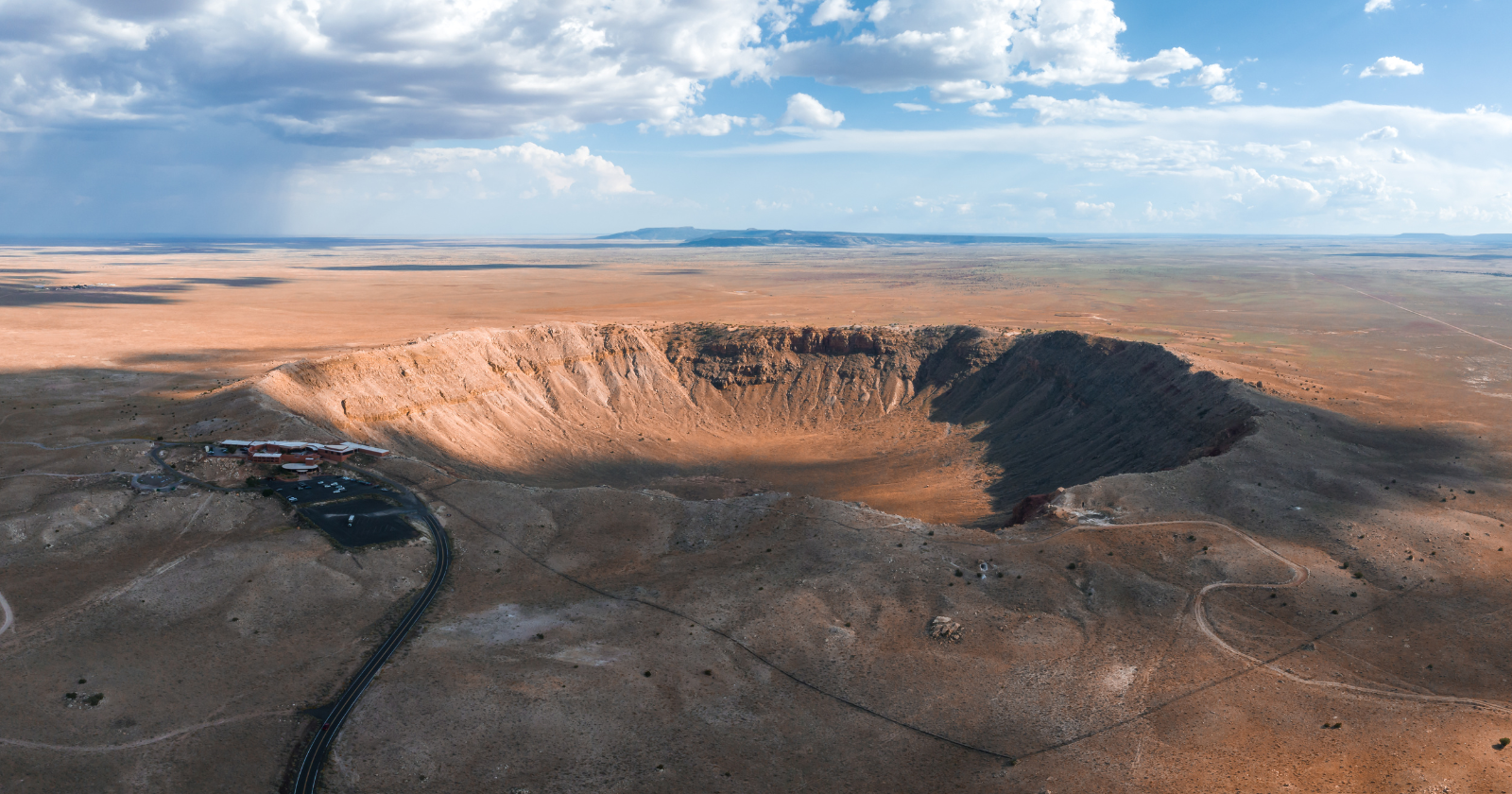
The hole in the ground east of Flagstaff is nearly a mile wide and deep enough to swallow a 50-story building, and in 1903 the official position of the United States government was that it was a volcano. That was the verdict of Grove Karl Gilbert, chief geologist of the U.S. Geological Survey and one of America’s most respected scientists, who examined the crater and ruled it a steam explosion, despite tons of iron meteorite fragments scattered for miles around it, which he dismissed as a coincidence. The scientific establishment agreed, shelved the matter and moved on. Daniel Moreau Barringer (Philadelphia lawyer turned mining engineer, rich from a silver strike, headstrong by profession) heard about the iron-covered crater and concluded that the establishment had declined: a giant iron meteorite had punctured the hole, and the meteorite must still be down there. A body large enough to excavate this crater, he reasoned, would produce millions of tons of nearly pure iron-nickel: one of the richest mineral deposits on Earth, conveniently pre-delivered from space, waiting beneath the ground. In 1903 he claimed mining rights to the crater and soon obtained a federal land patent for the entire complex, signed by Theodore Roosevelt. He then began drilling for his buried treasure. He would drill, on and off, for 26 years. The Best Documented Failure in Mining Barringer’s Standard Iron Company drilled hole after hole into the crater floor and found crushed rock, meteoric dust, and no mother lode. He reasoned (intelligently, wrongly) that the impactor had entered at an angle and lodged beneath the south edge, and moved the platforms there. In the late 1920s, a drill at 1,376 feet hit something hard in the midst of growing meteoric material, and then got stuck for good; The money, about $600,000 from him and his investors, had vanished. The cruelest part is that failure was written into physics from day one, and physics arrived in 1929. Astronomer Forest Ray Moulton, charged with reviewing the project, calculated what Barringer had never wanted calculated: a mass of iron impacting at cosmic speed (about 42,000 miles per hour) delivers the energy of a multi-megaton bomb, and that energy reaches the impactor as well as the ground. The meteorite Barringer sought, about 150 feet in diameter and 300,000 tons, had largely vaporized and splashed by the time it formed the crater. The treasure and the excavation were the same event. There was no vault beneath the ground, because the act of digging the hole had depleted the reservoir. Barringer received Moulton’s report in November 1929, just weeks after the stock market crash. Days later, he died of a heart attack, at age 69, believing, by most accounts, that his life’s obsession had ended in ruin. The claim that he did not live to deposit Then the verdict was reversed, in everything except the money. Over the following decades, impact science became a field and its founding sanctuary was the Barringer hole. In 1960, geologist Gene Shoemaker found irrefutable proof in the crater rocks: coesite and stishovite, forms of quartz created solely by shock pressures that no volcano can produce. The Arizona crater became the first proven meteorite impact site on Earth: the type specimen, the place where scientists learned to read impact scars before reading them on the Moon; The Apollo astronauts trained on it. The scientific community formally calls it Barringer Crater, and the highest award in impact studies is the Barringer Medal. Gilbert, the titan of the establishment, had been wrong. The one drilling rig nut had been right about the origin, against the government’s chief geologist, against a quarter century of ridicule; He was right about everything except the one clause on which his fortune depended. The meteorite was real. It simply didn’t exist anymore. The family holding company And here the story takes its final, very American turn: the Barringers were left with the gap. The mining patent never expired, and Barringer Crater Company, the family business, now several generations old, owns Meteor Crater to this day, one of the few celestial landmarks on Earth in private hands. Where the drills failed, the visitor center succeeded: the crater functions as a refined tourist attraction, with a museum, rim tours, and an entrance fee, profitably trading in the very fact that Barringer proved and the establishment denied. The iron that was vaporized 50,000 years ago makes money for the family anyway, not as a mineral, but as a story. This is one of the neatest ironies in the history of science. Daniel Barringer bet everything on two propositions: that a meteorite formed the crater and that the meteorite was still there. It took science 60 years to grade the exam (full score on the first question, zero on the second) and the payment went not to the doubters, but to the gift shop on the edge. Fortune was never underground. It was the hole itself. About this articleThis article is for general information and reflection. It is not professional advice. For your specific situation, consult a qualified professional. A personal measure of deep time. Look what has changed in the universe since you were born. Start with a date. Get a personal, detailed journey through everything that kept moving after you arrived. Six measurements obtained. No predictions. No astrology.