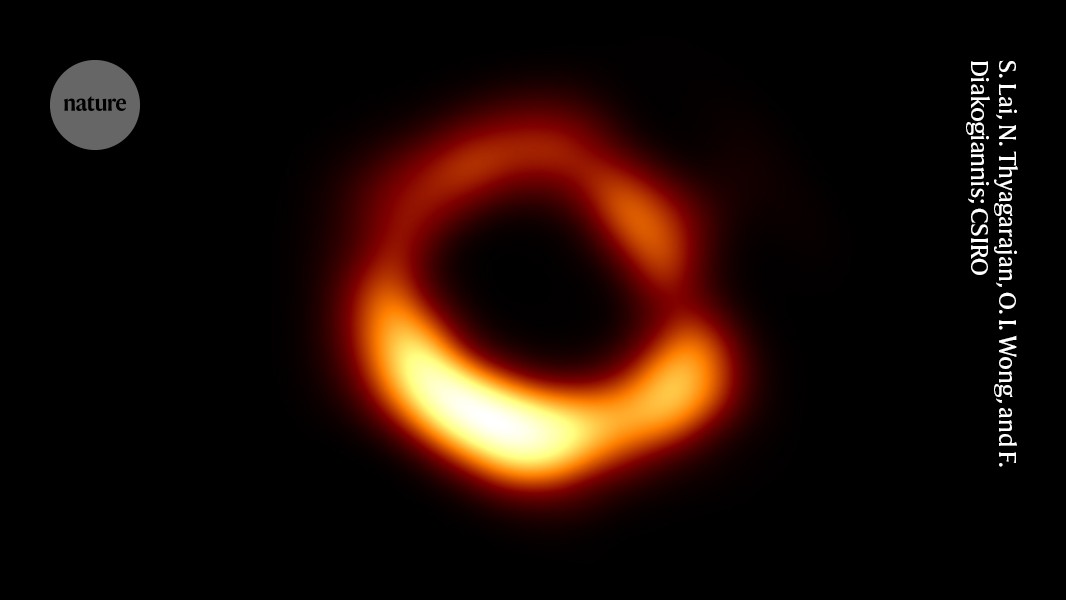
The physicists used an algorithm to combine telescopic measurements of a black hole in a different way to the original analysis. Credit: S. Lai, N. Thyagarajan, OI Wong and F. Diakogiannis; Commonwealth Scientific and Industrial Research Organization The Event Horizon Telescope (EHT) collaboration captivated the world in 2019 with the first photograph ever taken of the shadow of a black hole. Some researchers were not convinced, arguing that the circular shape seen in that shot was an artifact of the team’s image reconstruction techniques. Now, an independent group has reanalyzed the EHT data, and their results, published Nov. 11 in Nature (including new images of the black hole), largely corroborate the original findings1. To image black holes, the international EHT collaboration pools data collected simultaneously from a series of ground-based radio telescopes spanning several continents. Reconstruction is extremely challenging, but in principle the result is an image with the same level of detail or resolution that would be achieved with a single Earth-width satellite dish. Although blurry, the EHT photograph of a supermassive black hole at the center of the M87 galaxy was consistent with astrophysical models based on Albert Einstein’s general theory of relativity, which first predicted the existence of black holes. The image had a bright ring of about the correct radius, given what was known about the black hole’s size, with a darker disk in the center. However, starting in 20222, Junichiro Makino, an astrophysicist at Kobe University in Japan, and his collaborators began to question those conclusions. By applying one of the data analysis techniques that the EHT collaboration had used, but with slightly different assumptions, Makino’s team came up with a different result. Its image shows a mass of radio emissions instead of a ring.