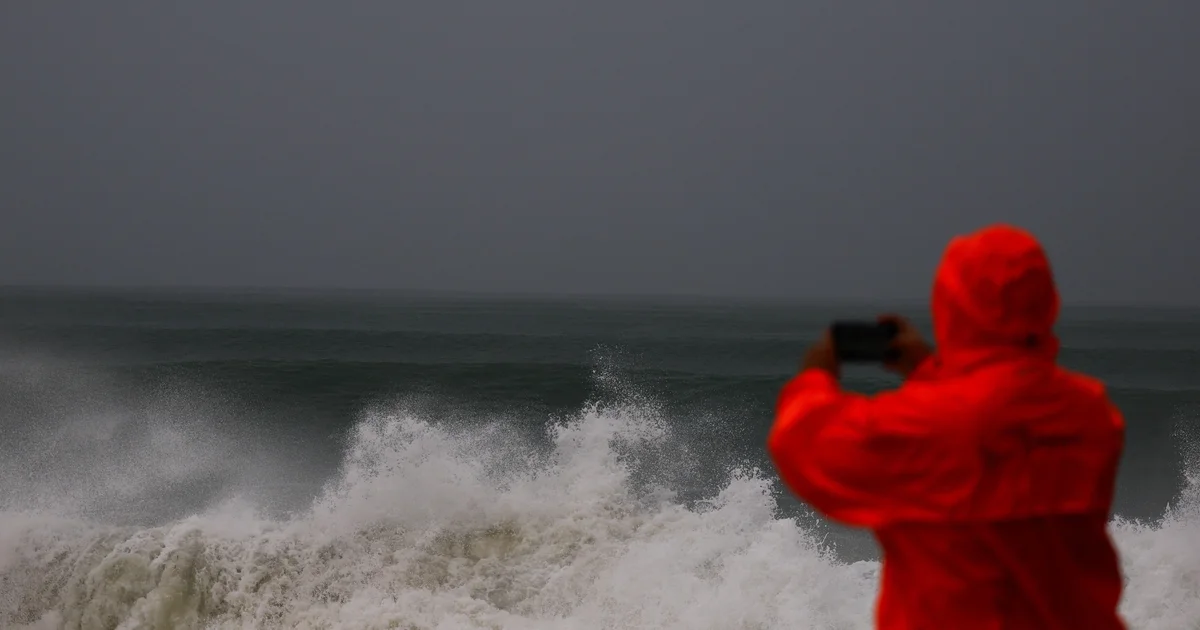
The eye of Hurricane Simón remains just off Mexico’s Pacific coast, but the Category 3 storm’s most powerful winds and rain pummeled people living between the Sierra Madre and the ocean. The hurricane’s center rotated parallel to the coast, approaching the Puerto Vallarta area, where its most damaging winds and rain were expected to hit around midnight and continue into Monday morning. The storm has weakened throughout the day, and its maximum sustained wind speed decreased by about 25 mph and was downgraded after spending much of the day as a Category 4 storm. And while the National Hurricane Center said additional weakening was expected throughout the day, it noted that Simón was still expected to be a strong hurricane when it passes Mexico’s west-central coast on Sunday. That’s not good news for people in the Puerto Vallarta area, a popular destination for American tourists. Just inland and uphill from tourist areas, many Mexicans live in communities where homes may not withstand the storm. A person uses their phone as waves hit the coast, as Hurricane Simón approaches Mexico’s Pacific coast, bringing heavy rain and strong winds to Manzanillo, Mexico, October 11, 2026. Daniel Becerril/REUTERS On Sunday night, Simón was centered about 50 miles south of Cabo Corrientes and was moving northwest at a relatively slow speed of 5 mph. A senior hurricane center specialist, Phillippe Pappin, said this western tip of mainland Mexico is the area most likely to receive a direct hit from the system. Cabo Corrientes is located at the southern end of Banderas Bay, the wide bay from which Puerto Vallarta overlooks the Pacific. Hurricane-force winds extend outward up to 25 miles, and tropical storm-force winds reach up to 60 miles from the center of Simón, meaning the entire area between the western coast of Mexico and the Sierra Madre mountains could be affected. indeed,” Pappin said. “They are also getting very heavy rainfall associated with the storm that will likely produce life-threatening flooding and mudslides in areas of higher terrain along the Mexican coast, and there will be significant storm surges.” As the storm approached Puerto Vallarta, National Guard vehicles patrolled the streets as police used a megaphone to call out to the few people who were jogging, walking their dogs or biking along the boardwalk. Officers reminded the people that the area was closed and urged them to take shelter. Not everyone followed the orders. A man rides a bicycle as Hurricane Simón approaches the Pacific coast of Mexico, bringing heavy rain and strong winds to Manzanillo, Mexico, on October 11, 2026. Daniel Becerril / REUTERS Meanwhile, the hurricane dumped rain on parts of southwestern Mexico. It could bring 10 to 20 inches of rain in many places, and some areas in the. states of Michoacán, Colima and Jalisco would receive up to 30 inches. The state of Jalisco suspended classes on Monday in 22 coastal municipalities and began evacuating dozens of people from risk areas. Mexican President Claudia Sheinbaum took to the social platform the population to follow the recommendations of civil protection officials and avoid traveling on public roads “Preventive evacuation efforts are being made to safe areas; the priority is our safety,” he wrote. Hotel worker Victor Martinez went out to buy non-perishable food on Sunday afternoon. He said he couldn’t go to work because public transportation service was suspended and most of the hotel had been evacuated. Martinez said he found people’s concerns about the hurricane comforting. “It happened to us before. It hit us years ago,” Martínez said, referring to a Category 5 hurricane that hit the area in 2002. “People didn’t expect it. We were very skeptical that it would ever hit us. Now, however, we are different. Precautions are being taken. It happened to us once, and we won’t let it happen again.” On Saturday, before the storm arrived, convenience stores, hotels and other businesses in Puerto Vallarta were boarding up their windows. Few walked the streets under a cloudy sky. A man boards up a store as Hurricane Simón approaches Puerto Vallarta, Mexico, on Oct. 10, 2026. AP Photo/Fernando Llano “Let’s hope it doesn’t hit us, right? Let it not affect us,” Jesús Gómez said as he stood outside a store handing out free samples of candied peanuts to passersby. “We will be working as usual all day, but when the Civil Protection officials come and tell us we have to close, then we will close and take shelter until the storm passes.” The hurricane center expected a dangerous storm surge “along the immediate coast near and east of where the center makes landfall.” The agency warned that near the coast, large and destructive waves will accompany the swell. Despite the risks that Simón represented, tourists continued to arrive in Puerto Vallarta. Visitors Ricardo Ramírez and Brenda Villarreal, who have never experienced a hurricane, went to look for food along the city’s boardwalk and encountered police urging people to take shelter. “The boardwalk is closed. Be responsible. Understand!” police told bystanders using a megaphone. Ramirez said he and Villarreal had planned their four-day vacation since last year and traveled from Guadalajara, the capital of Jalisco. “We still don’t know the extent of the danger,” Villarreal said. “We’re starting to see what’s happening.” Canadian tourist Ed Currie, who, along with his wife, still has five more days to enjoy Puerto Vallarta, said the hurricane is still had not affected their plans. “Just stay in the hotel and look out the window hopefully,” he said of what the couple would do on Saturday. “I just don’t know what to expect.” Unlike the Atlantic, which this week saw its first named hurricane of the season with Isaias, the Pacific season has been very active. Simon’s arrival comes on the heels of Polo, which hit Mexico last week as a Category 2 hurricane before hitting the southwestern United States and causing heavy flooding in the region. Go deeper with The Free Press on: