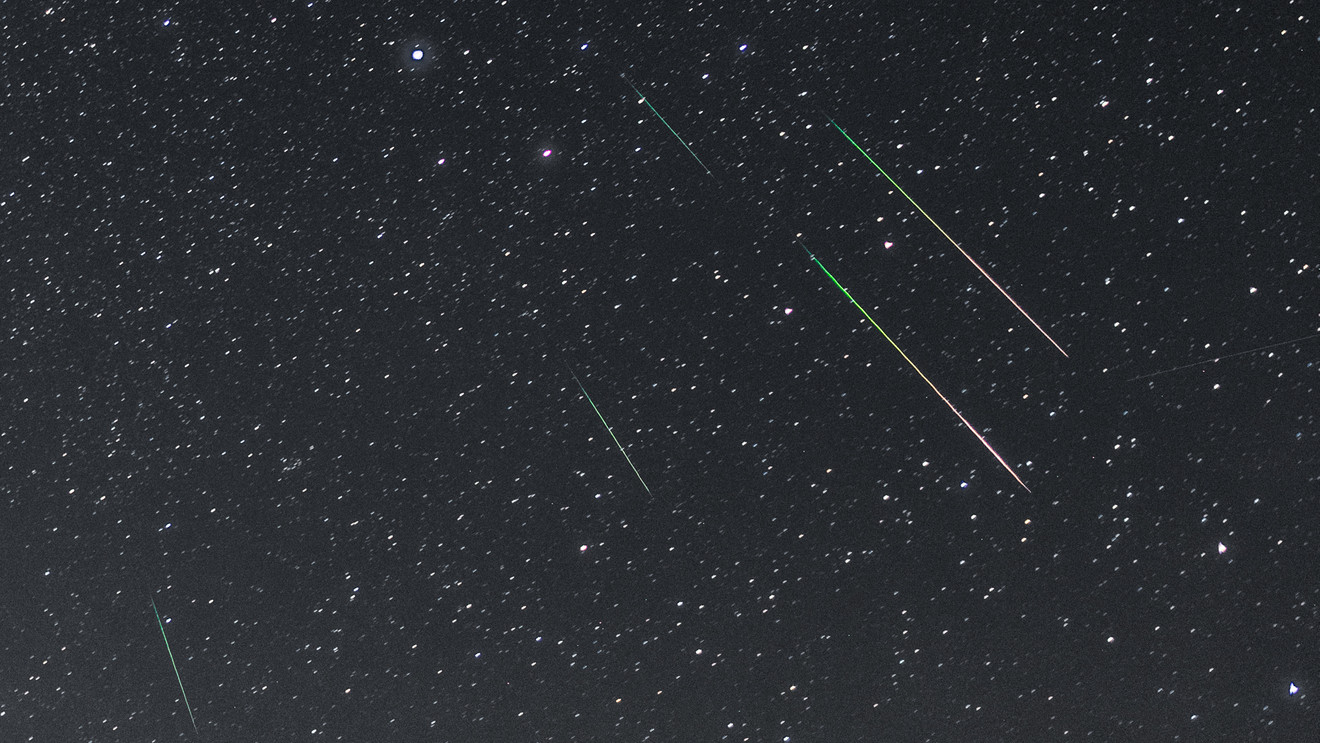
In less than a week, you can see as many as 50-100 meteors per hour!The Perseid Meteor Shower (or “The Perseids”) is considered one of the best meteor showers of the year, according to NASA.Each year, Earth passes through a trail of debris left by the comet Swift-Tuttle. When that space debris enters Earth’s atmosphere, bits of it disintegrate, creating the Perseid meteor shower.Peaking in mid-August, the Perseids contain fireballs– very bright meteors (reaching a visual magnitude of -3 or brighter, if you want to get technical) from larger particles of cometary material.While the Perseids started in mid-July, the best time to see them is overnight on August 12-13.On Wednesday, the new moon phase begins, where the moon sits between the Earth and the sun, with the dark side of the moon facing Earth. Since there’s no sunlight to reflect towards Earth, there is limited visibility of the moon during this phase (which means darker skies to see the Perseids!)Fun fact: The Perseids appear to come from the constellation “Perseus,” named after the Greek hero Perseus who, in Greek mythology, famously killed Medusa and rescued Andromeda.WHERE TO WATCHOMSI hosts its Perseid Meteor Shower Watch on Wednesday, August 12 at both the L.L. Stub Stewart State Park and Rooster Rock State Park.READ MORE | OMSI hosting free ‘star parties’ at two Oregon state parks this summerThe event, sponsored by OMSI, Rose City Astronomers, and Oregon Parks and Recreations, will have telescopes set up for attendees to use, though binoculars and telescopes are not necessary to see the Perseids.Want to watch on your own? You should be able to see meteors anywhere in the northern hemisphere.If the outdoors aren’t your thing, NASA’s Marshall Space Flight Center will host a meteor shower watch party on their YouTube channel on Wednesday at 9 p.m. PDT.TIPS TO ENJOY THE METEOR SHOWERDark skies- The best way to watch the Perseid meteor shower is somewhere with dark skies, away from city lights. Turn off your phone! Or at least your headlights/flashlightsGrab a blanket and lay down on your back. Give your eyes about 20-30 minutes to adjust to the dark– this means not looking at your phone or using any bright lights!Peak hours: 12 a.m. – 4 a.m. – According to NASA, the Perseids are best viewed in the Northern Hemisphere during the pre-dawn hours, though at times it is possible to view meteors from this shower as early as 10 p.m.Know where to look- To start, look northeast for the constellation Perseus. This is where the meteors will appear to originate from. You don’t need to fully focus on the constellation– this is just a starting point. Let your eyes scan the sky.