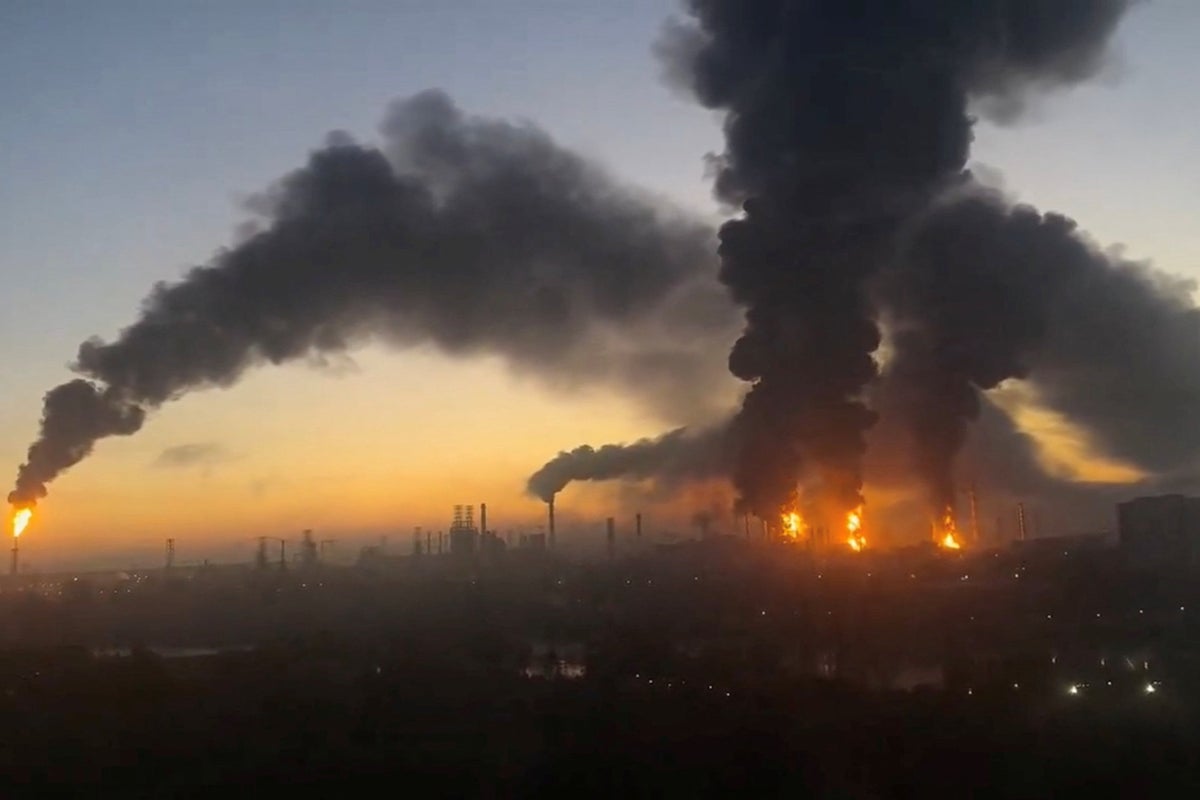
On The Ground Newsletter: Get a weekly dispatch from our international correspondents Get a weekly dispatch from our international correspondents Get a weekly dispatch of international news On Sunday, just as voting closed in Russia’s parliamentary elections, Ukraine launched one of its biggest drone attacks on Moscow since war broke out more than four years ago. Stunning images of the city showed a large refinery on fire and huge plumes of smoke billowing from chimneys. More than 450 drones were shot down in what the region’s mayor, Sergei Sobyanin, called “the most massive attack” ever seen. The attacks came shortly after US President Donald Trump ordered both sides to abandon their attacks on energy infrastructure. But both countries have continued to attack each other despite pleas. According to a report by the International Energy Association, all but five of Russia’s 32 major oil refineries have escaped attack since the war broke out, while some have been attacked up to 15 times. Those not affected are currently outside the range of Ukraine’s most advanced drones, between 3,500 km and 6,500 km from the border in eastern Siberia or the far east of the country. Plumes of smoke rise after attacks on an oil refinery in Moscow, September 20, 2026 (Reuters) The IEA has said this strategy has intensified significantly over the past 18 months, so that in June, throughput fell to its lowest level in more than 20 years and 30 percent at once a year earlier. Gasoline production has fallen by 20 percent compared to 2024, while diesel production has fallen by almost 30 percent. The attacks have led to the release of images from Russia that will be disconcerting to Russian leader Vladimir Putin: huge lines at gas stations (lasting up to 40 hours, according to some motorists) and rising oil and gas prices. Fuel shortages have been reported in 92 percent of Russia’s regions and around two-thirds introduced fuel rationing measures. The crisis has forced the Russian government to restrict oil exports to protect domestic supplies. Ukraine’s military suggests that Russia’s total oil refining capacity has decreased by 45 percent, according to a General Staff report released Monday. Flames and smoke rise from the Moscow oil refinery in the city’s southeast following a large-scale Ukrainian drone attack, Sunday, September 20 (AP) “Ukraine is increasingly using multiple waves of drones against individual refineries, seeking to override protective nets and other largely passive drone defense measures,” the IEA wrote. “Its long-range capabilities and targets have also advanced rapidly, particularly during the first half of 2026. This expanded range enabled the July 7 attack on Gazprom Neft’s 450,000 barrels per day (kb/d) Omsk refinery, Russia’s largest, approximately 2,500 kilometers from the Ukrainian border.” As Ukraine becomes more effective at attacking refineries, it is “increasingly targeting specific refinery units to maximize the impact of each attack.” He explained that kyiv is targeting crude oil distillation units (CDUs), where crude oil is initially processed, as well as secondary units such as fluid catalytic crackers (FCC), hydrocrackers, reformers and hydrotreaters. Drivers stuck in a long queue at a Rosneft gas station in Moscow (AFP/Getty) While damage to CDUs can typically be repaired in a week or two, damage to more complex secondary units can take six to eight months to repair on average. Russia has been forced to deal with the crisis by rationing fuel and also allowing lower-quality energy production, allowing higher-sulfur gasoline to be produced for the first time since 2016. In May, the Washington Post reported that more than 20 attacks on Russian oil infrastructure in 2026 had cost Moscow more than $7 billion. The Ukrainians have attacked almost every major refinery in European Russia and the Urals at least once. They have also damaged the country’s largest refinery located in Omsk, Siberia,” says John Lough, head of foreign policy at the Center for New Eurasian Strategies (NEST). “It is very difficult to calculate the total losses suffered from damage to the refineries, loss of production and general disruptions. It’s probably around $20 billion.” Donald Trump has called on Ukraine to end attacks on the Russian oil industry (Getty). But the picture is more complex, as an analysis by Reuters in July found that Russia’s oil and gas revenue had risen 60 percent compared to the previous year due to rising global oil prices. The loss in oil prices is also putting further pressure on global oil supplies, already squeezed due to the ongoing war in Iran, which has seen the Strait of Hormuz largely closed since March. So whether the strategy has been effective in the long term may depend on multiple factors, but Lough says “its main value is psychological, as it has brought the war to Russians who were previously isolated from it and made them think about why the country is so poorly defended when the war was supposed to improve Russia’s security.” “He was supposed to receive only a small proportion of the vote, but the authorities concluded that his message risked resonating with the electorate. “For Ukraine, it has been a double-edged sword. Russia has stepped up its own air campaign and halted the operation of Black Sea ports, a lifeline for the Ukrainian economy. “It has also intensified its attacks against other economic assets throughout the country.”