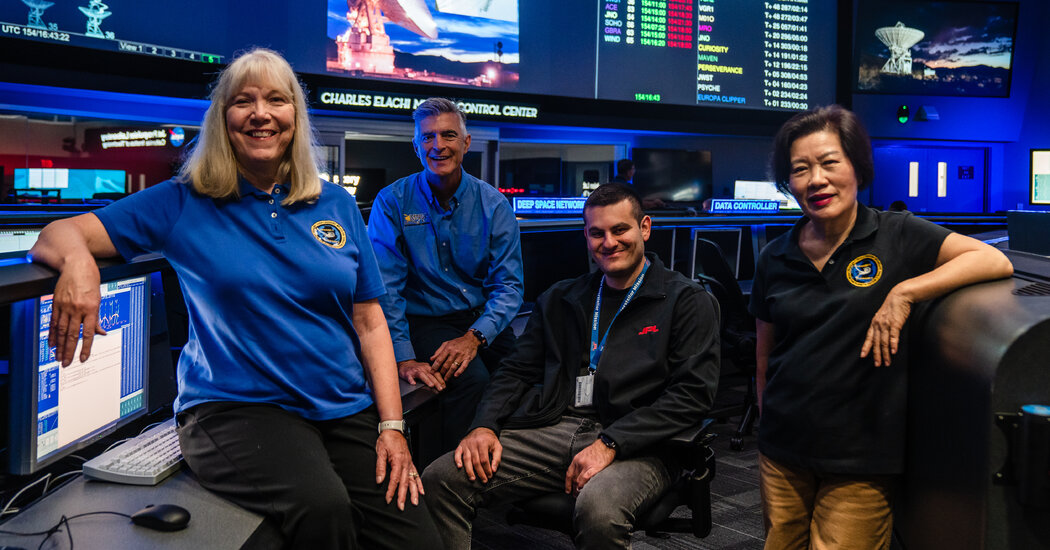
Nshan Kazaryan, the NASA engineer responsible for communicating with the Voyager 1 and Voyager 2 space probes, is younger than the spacecraft he is talking to. At 25, Mr. Kazaryan is one of a new generation of engineers at NASA’s Jet Propulsion Laboratory in California working to keep the geriatric but rugged spacecraft running. “Every time I talk about Voyager, I treat it like my parents,” he said. “As a human being ages, they have all these problems. A spaceship is similar. The older they get, the more problems.” (Even Mr. Kazaryan’s parents were not yet born when Voyagers launched in 1977.) Working with the old spaceship requires ingenuity, stubbornness, and Zen patience. Every time Mr. Kazaryan sends an order to one of the Voyagers, he has to wait a couple of days for a response. That’s the time it takes for a radio signal to make the round trip. Voyager 1 is almost 16 billion miles away; Voyager 2 is a little closer, about 21.3 billion kilometers away. But that’s still more than four times the distance to Pluto. Decades have passed since Voyager’s heyday, when they flew by the giant planets, sending back photographs of kaleidoscopic wonders, including the reddish clouds swirling around Jupiter’s Great Red Spot and the delicate, shimmering rings of Saturn. Now zooming away at more than 30,000 miles per hour, the twin spacecraft have traveled further than any human creation. Voyager 1 entered interstellar space in 2012, and Voyager 2 crossed it six years later. Space scientists want them to continue collecting unique observations of what’s between the stars for as long as possible. There won’t be another spacecraft venturing this far anytime soon. But that effort is becoming more difficult and, within a few years, will be impossible as the power from the spacecraft’s plutonium batteries declines. To keep the spacecraft alive, engineers have to take risks that other missions wouldn’t dare. “We are like pirates,” said Kareem Badaruddin, director of the Voyager mission. “Nobody likes to be that close to the edge, but we’ve gotten pretty comfortable with it because it’s our only option.” In a triumph last month, the team pulled off what it calls the “Big Bang” on Voyager 2: a juggling of electrical systems that saved about 10 watts of power. That small boost, enough to light a light bulb or two, could extend the mission by about two years, well into 2031. In the coming weeks, engineers will finish the process of rejuvenating Voyager 1, hoping it can last until 2030. A couple more years may not seem like much, but each day offers the possibility of a new discovery. Compared to the particles that the sun spews into our solar system, interstellar space contains “a different mix of gas and different behavior,” said Jamie Rankin, a space scientist at Princeton University who now serves as deputy scientist on the project. The engineers know they can only postpone the inevitable demise of Voyager, but they remain hopeful and creative. “Who knows?” Mr. Badaruddin said. “Maybe we can come up with something else.” But he added: “I think this is the best we can do.” If Voyager fails, it would not be able to keep its antenna pointed at Earth. With communications cut off, it would be lost. To curb silicon buildup, the thrusters have been fired less frequently in recent years (the antenna is now allowed to become even more misaligned before being pushed toward Earth) and the lines through which the propellant flows are changed periodically. A second challenge is keeping the fuel lines warm enough. Frozen hydrazine would also block the propulsion lines and break the thrusters. There are heaters on the spacecraft designed to prevent this, but they require electrical power. And that, in Voyager’s third chronic condition, is something the spacecraft is running dangerously low on. Plutonium batteries (what NASA calls radioisotope thermoelectric generators, or RTGs) generate the power that powers Voyager by converting heat from the radioactive decay of plutonium into electricity. The RTGs originally produced around 470 watts per Voyager. As the plutonium decayed and power diminished over the decades, one scientific instrument after another was shut down on the probes. On Voyager 2, whose power has been reduced to 216 watts, only three of the 10 instruments are still collecting data. On Voyager 1, which subsists on slightly less energy, there are only two. The mission team investigated ways to reduce energy consumption. For example, Voyager 1’s digital recorder broke decades ago, but engineers kept it on because it fortuitously heated nearby thruster lines. Voyager designers included a heater to keep the recorder warm in case it needed to be turned off. Why not turn off the broken recorder and turn on the heating, which consumes fewer watts? That carried some risks. The recorder had never been turned off and the heating had never been turned on. More importantly, the heater produced less heat than the recorder. Analysis indicated that a propellant could become too cold for hydrazine to flow. “It wouldn’t really help us,” Badaruddin said. Devising the Big Bang Out of necessity, the Voyager team had to contemplate something much more ambitious. An engineer named David Woerner suggested that since incremental changes would fail, making a series of changes all at once could keep heat and power requirements in balance while reducing the spacecraft’s power consumption. This venture became the Big Bang, and after nine months of analysis, Voyager engineers were convinced it could work. They decided that the benefits outweighed the possible risks. “Voyager is basically the path of least regret,” said Bruce Wagoner, mission assurance manager. “There really is no right answer.” They started with Voyager 2, because it is more energetically healthy. The operation was carried out in three steps, to minimize the danger of losing the spacecraft. “There’s always a concern that it won’t work properly,” said Suzanne Dodd, who has worked as Voyager’s project manager since 2010. First, in May, the spacecraft was told to switch to the new configuration for 40 minutes. This was to ensure that systems like the heater near the recorder, which had never been turned on before, were actually working. A month later, Voyager 2 stayed in the new configuration for six hours to check that the temperature predictions were accurate. Finally, last month, the change was made permanent. There is just over a year left until the 50th anniversary of its releases. “I’m pretty sure they’ll both make it,” Dodd said. But there are no guarantees. It wouldn’t be a surprise if a critical system were to break down unexpectedly on one of the increasingly fragile Voyagers. That happened four years ago, when Voyager 1 started sending gibberish to Earth instead of science and telemetry. In fact, he stayed silent, unable to tell the engineers what was wrong. “We were filming in the dark,” said Sun Matsumoto, one of the engineers. “We just had no idea.” The problem was ultimately due to a faulty memory chip that engineers eventually managed to fix, but Voyager 1 was out of service for the better part of a year. ‘I want to be there’ While Voyagers no longer capture colorful photographs as they did while flying by the planets (the last images were taken by Voyager 1 in 1990 of a “family portrait” of the solar system), they are still making discoveries in the uncharted territory of interstellar space. In mid-2020, Voyager 1 observed a large change in the magnetic field in that region of interstellar space, with a large change in the density of the plasma of charged particles around it. That change has persisted until now. “We don’t know why,” Dr. Rankin said. “That’s a really strange thing.” That’s just one of the mysteries that additional years of exploration could help unravel. With the energy surge from the Big Bang, engineers and scientists are considering turning back on some of the spacecraft’s dormant scientific instruments to gather additional information, however briefly. But that, as with everything they do, could put the spacecraft in danger. One possibility is to wait until after the 50th anniversary. “We haven’t decided yet,” said Dr. Linda J. Spilker, a planetary scientist at NASA’s Jet Propulsion Laboratory. “You could lose the mission.” Dr. Spilker was part of the mission when it launched, his first job out of college. He moved on to NASA’s Cassini mission, which orbited Saturn for 13 years, before returning to Voyager. When asked what she would do after the 50th anniversary, she said she was undecided. “I have like 10 wonderful grandchildren and other things I like to do and travel, etc.,” he said. He has already reduced his hours to part-time, helping Voyager’s continued operations fit within a $5 million annual budget, a shoestring budget compared to many other NASA missions. The next day, Dr. Spilker sent an email saying she had been caught off guard by the question. goodbye as a team,” he wrote. “Following Voyager’s scientific discoveries has been a part of my life throughout my career at JPL, and I will not be happy if I leave before its final moments.”