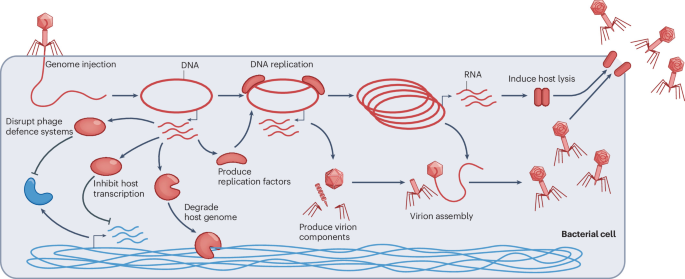
Georjon, H. & Bernheim, A. The highly diverse antiphage defence systems of bacteria. Nat. Rev. Microbiol. 21, 686–700 (2023).Article
CAS
PubMed
Google Scholar
Doron, S. et al. Systematic discovery of antiphage defense systems in the microbial pangenome. Science 359, eaar4120 (2018).Article
PubMed
PubMed Central
Google Scholar
Vassallo, C. N., Doering, C. R., Littlehale, M. L., Teodoro, G. I. C. & Laub, M. T. A functional selection reveals previously undetected anti-phage defence systems in the E. coli pangenome. Nat. Microbiol. 7, 1568–1579 (2022).Article
CAS
PubMed
PubMed Central
Google Scholar
DeWeirdt, P. C., Mahoney, E. M. & Laub, M. T. DefensePredictor: a machine learning model to discover prokaryotic immune systems. Science 392, eadv7924 (2026).Article
CAS
PubMed
PubMed Central
Google Scholar
Iglesias, S. M., Li, F., Briani, F. & Cingolani, G. Viral genome delivery across bacterial cell surfaces. Annu. Rev. Microbiol. 78, 125–145 (2024).Article
CAS
PubMed
PubMed Central
Google Scholar
Hinton, D. M. Transcriptional control in the prereplicative phase of T4 development. Virol. J. 7, 289 (2010).Article
PubMed
PubMed Central
Google Scholar
Qi, D., Alawneh, A. M., Yonesaki, T. & Otsuka, Y. Rapid degradation of host mRNAs by stimulation of RNase E activity by Srd of bacteriophage T4. Genetics 201, 977–987 (2015).Article
CAS
PubMed
PubMed Central
Google Scholar
Hercules, K., Munro, J. L., Mendelsohn, S. & Wiberg, J. S. Mutants in a nonessential gene of bacteriophage T4 which are defective in the degradation of Escherichia coli deoxyribonucleic acid. J. Virol. 7, 95–105 (1971).Article
CAS
PubMed
PubMed Central
Google Scholar
Gao, Z. & Feng, Y. Bacteriophage strategies for overcoming host antiviral immunity. Front. Microbiol. 14, 1211793 (2023).Article
PubMed
PubMed Central
Google Scholar
Weigel, C. & Seitz, H. Bacteriophage replication modules. FEMS Microbiol. Rev. 30, 321–381 (2006).Article
CAS
PubMed
Google Scholar
Cahill, J. & Young, R. Phage lysis: multiple genes for multiple barriers. Adv. Virus Res. 103, 33–70 (2019).Article
CAS
PubMed
Google Scholar
Martínez, M., Rizzuto, I. & Molina, R. Knowing our enemy in the antimicrobial resistance era: dissecting the molecular basis of bacterial systems. Int. J. Mol. Sci. 25, 4929 (2024).Article
PubMed
PubMed Central
Google Scholar
Zhang, T. et al. Direct activation of a bacterial innate immune system by a viral capsid protein. Nature 612, 132–140 (2022). This study identifies a direct protein–protein interaction between CapRelSJ46 and the phage major capsid protein.Article
CAS
PubMed
PubMed Central
Google Scholar
Stokar-Avihail, A. et al. Discovery of phage determinants that confer sensitivity to bacterial immune systems. Cell 186, 1863–1876.e16 https://doi.org/10.1016/j.cell.2023.02.029 (2023).Article
CAS
PubMed
Google Scholar
Mets, T. et al. Mechanism of phage sensing and restriction by toxin–antitoxin–chaperone systems. Cell Host Microbe 32, 1059–1073.e8 (2024).Article
CAS
PubMed
Google Scholar
Vassallo, C. N., Doering, C. R. & Laub, M. T. Anti-viral defence by an mRNA ADP-ribosyltransferase that blocks translation. Nature 636, 190–197 https://doi.org/10.1038/s41586-024-08102-8 (2024).Article
CAS
PubMed
PubMed Central
Google Scholar
Srikant, S., Guegler, C. K. & Laub, M. T. The evolution of a counter-defense mechanism in a virus constrains its host range. eLife 11, e79549 (2022).Article
CAS
PubMed
PubMed Central
Google Scholar
Huiting, E. et al. Bacteriophages inhibit and evade cGAS-like immune function in bacteria. Cell 186, 864–876.e21 (2023).Article
CAS
PubMed
PubMed Central
Google Scholar
Johannesman, A., Awasthi, L. C., Carlson, N. & LeRoux, M. Phages carry orphan antitoxin-like enzymes to neutralize the DarTG1 toxin-antitoxin defense system. Nat. Commun. 16, 1598 (2025).Article
CAS
PubMed
PubMed Central
Google Scholar
Gao, L. A. et al. Prokaryotic innate immunity through pattern recognition of conserved viral proteins. Science 377, eabm4096 (2022). This study characterizes multiple Avs systems that bind to phage-encoded terminases and portal proteins.Article
CAS
PubMed
PubMed Central
Google Scholar
Lee, H. et al. Diverse bacterial pattern recognition receptors sense the core phage proteome. Nature 657, 735–743 https://doi.org/10.1038/s41586-026-10852-6 (2026). This study finds that Avs systems with diverse sensor domains are activated by diverse phage proteins.Article
CAS
PubMed
PubMed Central
Google Scholar
Saxton, D. S., DeWeirdt, P. C., Doering, C. R., Roney, I. J. & Laub, M. T. A membrane-bound nuclease directly cleaves phage DNA during genome injection. Nature 653, 861–869 https://doi.org/10.1038/s41586-026-10207-1 (2026). This study finds that a membrane-anchored nuclease recognizes phage proteins involved in genome injection and cleaves invading phage DNA.Article
CAS
PubMed
PubMed Central
Google Scholar
Muralidharan, A. et al. Molecular basis for anti-jumbo phage immunity by AVAST type 5. Mol. Cell 86, 740–756.e9 (2026).Article
CAS
PubMed
PubMed Central
Google Scholar
Robbins, L. K. et al. A bacterial NLR-related protein senses distinct phage triggers through a single interface. Preprint at bioRxiv https://doi.org/10.1101/2024.12.17.629029 (2024).Béchon, N. et al. Diversification of molecular pattern recognition in bacterial NLR-like proteins. Nat. Commun. 15, 9860 (2024).Article
PubMed
PubMed Central
Google Scholar
Hör, J., Wolf, S. G. & Sorek, R. Bacteria conjugate ubiquitin-like proteins to interfere with phage assembly. Nature 631, 850–856 (2024).Article
PubMed
Google Scholar
Deep, A., Liang, Q., Enustun, E., Pogliano, J. & Corbett, K. D. Architecture and activation mechanism of the bacterial PARIS defence system. Nature 634, 432–439 (2024). This study shows that PARIS is activated by interacting with the RM system inhibitor Ocr.Article
CAS
PubMed
PubMed Central
Google Scholar
Loeff, L., Walter, A., Rosalen, G. T. & Jinek, M. DNA end sensing and cleavage by the Shedu anti-phage defense system. Cell 188, 721–733.e17 https://doi.org/10.1016/j.cell.2024.11.030 (2024).Article
CAS
PubMed
Google Scholar
Hong, A. et al. Gabija restricts phage circularization and DNA replication. Mol. Cell. 34, 1814–1828.e9 https://doi.org/10.1016/j.chom.2026.06.016 (2026).Article
CAS
Google Scholar
Guegler C. K. & Laub M. T. Shutoff of host transcription triggers a toxin-antitoxin system to cleave phage RNA and abort infection. Mol. Cell 81, 2361–2373.e9 https://doi.org/10.1016/j.molcel.2021.03.027 (2021). This study demonstrates that phage-induced shutoff of host transcription leads to activation of the ToxIN toxin–antitoxin system.Article
CAS
PubMed
PubMed Central
Google Scholar
Tuck, O. T. et al. Genome integrity sensing by the broad-spectrum Hachiman antiphage defense complex. Cell 187, 6914–6928.e20 (2024).Article
CAS
PubMed
PubMed Central
Google Scholar
Tesson, F. et al. Systematic and quantitative view of the antiviral arsenal of prokaryotes. Nat. Commun. 13, 2561 (2022).Article
CAS
PubMed
PubMed Central
Google Scholar
Zhang, Z. & Zhang, C. Regulation of cGAS–STING signalling and its diversity of cellular outcomes. Nat. Rev. Immunol. 25, 425–444 (2025).Article
CAS
PubMed
Google Scholar
Loenen, W. A. M., Dryden, D. T. F., Raleigh, E. A., Wilson, G. G. & Murray, N. E. Highlights of the DNA cutters: a short history of the restriction enzymes. Nucleic Acids Res. 42, 3–19 (2014).Article
CAS
PubMed
Google Scholar
Wang, L. et al. Phosphorothioation of DNA in bacteria by dnd genes. Nat. Chem. Biol. 3, 709–710 (2007).Article
CAS
PubMed
Google Scholar
Xiong, X. et al. SspABCD–SspE is a phosphorothioation-sensing bacterial defence system with broad anti-phage activities. Nat. Microbiol. 5, 917–928 (2020).Article
CAS
PubMed
Google Scholar
Thiaville, J. J. et al. Novel genomic island modifies DNA with 7-deazaguanine derivatives. Proc. Natl Acad. Sci. USA 113, E1452–E1459 (2016).Article
CAS
PubMed
PubMed Central
Google Scholar
Nussenzweig, P. M. & Marraffini, L. A. Molecular mechanisms of CRISPR–Cas immunity in bacteria. Annu. Rev. Genet. 54, 93–120 (2020). This review covers type I–VI CRISPR–Cas systems and their mechanisms for distinguishing self from non-self.Article
CAS
PubMed
Google Scholar
Barrangou, R. et al. CRISPR provides acquired resistance against viruses in prokaryotes. Science 315, 1709–1712 (2007).Article
CAS
PubMed
Google Scholar
Brouns, S. J. J. et al. Small CRISPR RNAs guide antiviral defense in prokaryotes. Science 321, 960–964 (2008).Article
CAS
PubMed
PubMed Central
Google Scholar
Garneau, J. E. et al. The CRISPR/Cas bacterial immune system cleaves bacteriophage and plasmid DNA. Nature 468, 67–71 (2010).Article
CAS
PubMed
Google Scholar
Jinek, M. et al. A programmable dual-RNA-guided DNA endonuclease in adaptive bacterial immunity. Science 337, 816–821 (2012).Article
CAS
PubMed
PubMed Central
Google Scholar
Deveau, H. et al. Phage response to CRISPR-encoded resistance in Streptococcus thermophilus. J. Bacteriol. 190, 1390–1400 (2008).Article
CAS
PubMed
Google Scholar
Shah, S. A., Erdmann, S., Mojica, F. J. M. & Garrett, R. A. Protospacer recognition motifs: mixed identities and functional diversity. RNA Biol. 10, 891–899 (2013).Article
CAS
PubMed
PubMed Central
Google Scholar
Marraffini, L. A. & Sontheimer, E. J. Self versus non-self discrimination during CRISPR RNA-directed immunity. Nature 463, 568–571 (2010).Article
CAS
PubMed
PubMed Central
Google Scholar
Liu, L. et al. The molecular architecture for RNA-guided RNA cleavage by Cas13a. Cell 170, 714–726.e10 (2017).Article
CAS
PubMed
Google Scholar
Meeske, A. J. & Marraffini, L. A. RNA guide complementarity prevents self-targeting in type VI CRISPR systems. Mol. Cell 71, 791–801.e3 (2018).Article
CAS
PubMed
PubMed Central
Google Scholar
Makarova, K. S. et al. Evolutionary classification of CRISPR–Cas systems: a burst of class 2 and derived variants. Nat. Rev. Microbiol. 18, 67–83 (2020).Article
CAS
PubMed
Google Scholar
Baca, C. F. et al. The CRISPR effector Cam1 mediates membrane depolarization for phage defence. Nature 625, 797–804 (2024).Article
CAS
PubMed
PubMed Central
Google Scholar
Garcia-Doval, C. et al. Activation and self-inactivation mechanisms of the cyclic oligoadenylate-dependent CRISPR ribonuclease Csm6. Nat. Commun. 11, 1596 (2020).Article
CAS
PubMed
PubMed Central
Google Scholar
Baca, C. F., Majumder, P., Hickling, J. H., Patel, D. J. & Marraffini, L. A. Cat1 forms filament networks to degrade NAD+ during the type III CRISPR–Cas antiviral response. Science 388, eadv9045 (2025).Article
CAS
PubMed
PubMed Central
Google Scholar
VanderWal, A. R. et al. Csx28 is a membrane pore that enhances CRISPR–Cas13b-dependent antiphage defense. Science 380, 410–415 (2023).Article
CAS
PubMed
PubMed Central
Google Scholar
Meeske, A. J., Nakandakari-Higa, S. & Marraffini, L. A. Cas13-induced cellular dormancy prevents the rise of CRISPR-resistant bacteriophage. Nature 570, 241–245 (2019).Article
CAS
PubMed
PubMed Central
Google Scholar
Malone, L. M., Hampton, H. G., Morgan, X. C. & Fineran, P. C. Type I CRISPR–Cas provides robust immunity but incomplete attenuation of phage-induced cellular stress. Nucleic Acids Res. 50, 160–174 (2022).Article
CAS
PubMed
PubMed Central
Google Scholar
Strotskaya, A. et al. The action of Escherichia coli CRISPR–Cas system on lytic bacteriophages with different lifestyles and development strategies. Nucleic Acids Res. 45, 1946–1957 https://doi.org/10.1093/nar/gkx042 (2017).Article
CAS
PubMed
PubMed Central
Google Scholar
Jiang, W., Samai, P. & Marraffini, L. A. Degradation of phage transcripts by CRISPR-associated RNases enables type III CRISPR–Cas immunity. Cell 164, 710–721 (2016).Article
CAS
PubMed
PubMed Central
Google Scholar
Aviram, N. et al. Cas10 relieves host growth arrest to facilitate spacer retention during type III-A CRISPR–Cas immunity. Cell Host Microbe 32, 2050–2062.e6 (2024). This study shows that the timing of type III CRISPR–Cas system activation affects the probability of cell survival.Article
CAS
PubMed
PubMed Central
Google Scholar
Williams, M. C. et al. Restriction endonuclease cleavage of phage DNA enables resuscitation from Cas13-induced bacterial dormancy. Nat. Microbiol. 8, 400–409 (2023).Article
CAS
PubMed
PubMed Central
Google Scholar
Olovnikov, I., Chan, K., Sachidanandam, R., Newman, D. K. & Aravin, A. A. Bacterial argonaute samples the transcriptome to identify foreign DNA. Mol. Cell 51, 594–605 (2013).Article
CAS
PubMed
PubMed Central
Google Scholar
Swarts, D. C. et al. DNA-guided DNA interference by a prokaryotic Argonaute. Nature 507, 258–261 (2014).Article
CAS
PubMed
PubMed Central
Google Scholar
Kuzmenko, A. et al. DNA targeting and interference by a bacterial Argonaute nuclease. Nature 587, 632–637 (2020).Article
CAS
PubMed
Google Scholar
Lisitskaya, L. et al. Bacterial Argonaute nucleases reveal different modes of DNA targeting in vitro and in vivo. Nucleic Acids Res. 51, 5106–5124 (2023).Article
CAS
PubMed
PubMed Central
Google Scholar
Koopal, B. et al. Short prokaryotic Argonaute systems trigger cell death upon detection of invading DNA. Cell 185, 1471–1486.e19 (2022). This study finds that prokaryotic Argonautes produce guides from high-copy genetic loci that are highly transcribed.Article
CAS
PubMed
PubMed Central
Google Scholar
Garb, J. et al. Multiple phage resistance systems inhibit infection via SIR2-dependent NAD+ depletion. Nat. Microbiol. 7, 1849–1856 (2022).Article
CAS
PubMed
Google Scholar
Zeng, Z. et al. A short prokaryotic Argonaute activates membrane effector to confer antiviral defense. Cell Host Microbe 30, 930–943.e6 (2022).Article
CAS
PubMed
Google Scholar
Song, X. et al. Catalytically inactive long prokaryotic Argonaute systems employ distinct effectors to confer immunity via abortive infection. Nat. Commun. 14, 6970 (2023).Article
CAS
PubMed
PubMed Central
Google Scholar
Zaremba, M. et al. Short prokaryotic Argonautes provide defence against incoming mobile genetic elements through NAD+ depletion. Nat. Microbiol. 7, 1857–1869 (2022).Article
CAS
PubMed
Google Scholar
Bobadilla Ugarte, P., Barendse, P. & Swarts, D. C. Argonaute proteins confer immunity in all domains of life. Curr. Opin. Microbiol. 74, 102313 (2023).Article
CAS
PubMed
Google Scholar
Zander, A. et al. Guide-independent DNA cleavage by archaeal Argonaute from Methanocaldococcus jannaschii. Nat. Microbiol. 2, 17034 (2017).Article
CAS
PubMed
PubMed Central
Google Scholar
Cheng, R. et al. Prokaryotic Gabija complex senses and executes nucleotide depletion and DNA cleavage for antiviral defense. Cell Host Microbe 31, 1331–1344.e5 (2023).Article
CAS
PubMed
Google Scholar
Shee, C. et al. Engineered proteins detect spontaneous DNA breakage in human and bacterial cells. eLife 2, e01222 (2013).Article
PubMed
PubMed Central
Google Scholar
Pennington, J. M. & Rosenberg, S. M. Spontaneous DNA breakage in single living Escherichia coli cells. Nat. Genet. 39, 797–802 (2007).Article
CAS
PubMed
PubMed Central
Google Scholar
Dillingham, M. S. & Kowalczykowski, S. C. RecBCD enzyme and the repair of double-stranded DNA breaks. Microbiol. Mol. Biol. Rev. 72, 642–671 (2008).Article
CAS
PubMed
PubMed Central
Google Scholar
Behme, M. T., Lilley, G. D. & Ebisuzaki, K. Postinfection control by bacteriophage T4 of Escherichia coli recBC nuclease activity. J. Virol. 18, 20–25 (1976).Article
CAS
PubMed
PubMed Central
Google Scholar
Benzinger, R., Enquist, L. W. & Skalka, A. Transfection of Escherichia coli spheroplasts. V. Activity of recBC nuclease in rec+ and rec minus spheroplasts measured with different forms of bacteriophage DNA. J. Virol. 15, 861–871 (1975).Article
CAS
PubMed
PubMed Central
Google Scholar
Silverstein, J. L. & Goldberg, E. B. T4 DNA injection. Virology 72, 212–223 (1976).Article
CAS
PubMed
Google Scholar
Zabrovitz, S., Segev, N. & Cohen, G. Growth of bacteriophage P1 in recombination-deficient hosts of Escherichia coli. Virology 80, 233–248 (1977).Article
CAS
PubMed
Google Scholar
Zheng, C., Casjens, S. R., Davidson, A. R., Amundsen, S. K. & Smith, G. R. Lambdoid phages with abundant Chi recombination hotspots reflect diverse viral strategies for recombination-dependent growth. Genome Res. 35, 1767–1780 (2025).Article
CAS
PubMed
PubMed Central
Google Scholar
Tang, D., Kang, R., Coyne, C. B., Zeh, H. J. & Lotze, M. T. PAMPs and DAMPs: signal 0s that spur autophagy and immunity. Immunol. Rev. 249, 158–175 (2012).Article
CAS
PubMed
PubMed Central
Google Scholar
Yuping, L. et al. Jumbo phage killer immune system targets early infection of nucleus-forming phages. Cell 188, 2127–2140.e21 (2025). This study shows that the Juk system recognizes a jumbophage membrane protein present in early infection vesicles to provide direct defence.Article
CAS
PubMed
PubMed Central
Google Scholar
Wolfram-Schauerte, M., Pozhydaieva, N., Viering, M., Glatter, T. & Höfer, K. Integrated omics reveal time-resolved insights into T4 phage infection of E. coli on proteome and transcriptome levels. Viruses 14, 2502 (2022).Article
CAS
PubMed
PubMed Central
Google Scholar
Nagy, T. A., Gersabeck, G. W., Conte, A. N. & Whiteley, A. T. A phage protein screen identifies triggers of the bacterial innate immune system. Nat. Microbiol. 11, 597–609 https://doi.org/10.1038/s41564-025-02239-6 (2026).Article
CAS
PubMed
PubMed Central
Google Scholar
Roberts, C. G. et al. Bacterial TIR-based immune systems sense phage capsids to initiate defense. Nat. Microbiol. 10, 2892–2902 (2025).Article
CAS
PubMed
PubMed Central
Google Scholar
Loyo, C. L. & Grossman, A. D. A phage-encoded counter-defense inhibits an NAD-degrading anti-phage defense system. PLoS Genet. 21, e1011551 (2025).Article
CAS
PubMed
PubMed Central
Google Scholar
Zhang, T. et al. Bacterial immune activation via supramolecular assembly with phage triggers. Nature 651, 1051–1059 https://doi.org/10.1038/s41586-025-10060-8 (2026).Article
CAS
PubMed
PubMed Central
Google Scholar
Georgiou, T. et al. Specific peptide-activated proteolytic cleavage of Escherichia coli elongation factor Tu. Proc. Natl Acad. Sci. USA 95, 2891–2895 (1998).Article
CAS
PubMed
PubMed Central
Google Scholar
Richmond-Buccola, D. et al. A large-scale type I CBASS antiphage screen identifies the phage prohead protease as a key determinant of immune activation and evasion. Cell Host Microbe 32, 1074–1088.e5 (2024).Article
CAS
PubMed
PubMed Central
Google Scholar
Hobbs, S. J. & Kranzusch, P. J. Phage protease enzymes activate CBASS antiphage immunity. Preprint at bioRxiv https://doi.org/10.64898/2026.03.04.709575 (2026).Banh, D. V. et al. Bacterial cGAS senses a viral RNA to initiate immunity. Nature 623, 1001–1008 (2023).Article
CAS
PubMed
PubMed Central
Google Scholar
Zhang, T. et al. A bacterial immunity protein directly senses two disparate phage proteins. Nature 635, 728–735 (2024). This study finds that a single defence system can sense two distinct phage proteins via distinct binding interfaces on its sensor domain.Article
CAS
PubMed
PubMed Central
Google Scholar
Patel, P. H. et al. A pore-forming antiphage defence is activated by oligomeric phage proteins. Nature 651, 1060–1067 (2026).Article
CAS
PubMed
Google Scholar
Walkinshaw, M. D. et al. Structure of Ocr from bacteriophage T7, a protein that mimics B-form DNA. Mol. Cell 9, 187–194 (2002).Article
CAS
PubMed
Google Scholar
Davidson, A. R. et al. Anti-CRISPRs: protein inhibitors of CRISPR–Cas systems. Annu. Rev. Biochem. 89, 309–332 (2020).Article
CAS
PubMed
PubMed Central
Google Scholar
Hobbs, S. J. et al. Phage anti-CBASS and anti-Pycsar nucleases subvert bacterial immunity. Nature 605, 522–526 (2022).Article
CAS
PubMed
PubMed Central
Google Scholar
Jenson, J. M., Li, T., Du, F., Ea, C.-K. & Chen, Z. J. Ubiquitin-like conjugation by bacterial cGAS enhances anti-phage defence. Nature 616, 326–331 (2023).Article
CAS
PubMed
PubMed Central
Google Scholar
Rousset, F. et al. Phages and their satellites encode hotspots of antiviral systems. Cell Host Microbe 30, 740–753.e5 https://doi.org/10.1016/j.chom.2022.02.018 (2022).Article
CAS
PubMed
PubMed Central
Google Scholar
Burman, N. et al. A virally encoded tRNA neutralizes the PARIS antiviral defence system. Nature 634, 424–431 (2024).Article
CAS
PubMed
PubMed Central
Google Scholar
Amitsur, M., Morad, I. & Kaufmann, G. In vitro reconstitution of anticodon nuclease from components encoded by phage T4 and Escherichia coli CTr5X. EMBO J. 8, 2411–2415 (1989).Article
CAS
PubMed
PubMed Central
Google Scholar
Kaufmann, G. et al. Phage and host genetic determinants of the specific anticodon loop cleavages in bacteriophage T4-infected Escherichia coli CTr5X. J. Mol. Biol. 188, 15–22 (1986).Article
CAS
PubMed
Google Scholar
Silas, S. et al. Activation of bacterial programmed cell death by phage inhibitors of host immunity. Mol. Cell 85, 1838–1851.e10 (2025).Article
CAS
PubMed
PubMed Central
Google Scholar
Wein, T. et al. CARD domains mediate anti-phage defence in bacterial gasdermin systems. Nature 639, 727–734 (2025).Article
CAS
PubMed
PubMed Central
Google Scholar
Sullivan, A. E. et al. The Panoptes system uses decoy cyclic nucleotides to defend against phage. Nature 647, 988–996 (2025). Sullivan et al. demonstrate that the Panoptes system utilizes a cyclic nucleotide as a decoy molecule that senses phage-encoded sponge proteins.Article
CAS
PubMed
PubMed Central
Google Scholar
Doherty, E. E. et al. A miniature CRISPR–Cas10 enzyme confers immunity by inhibitory signalling. Nature 647, 997–1004 https://doi.org/10.1038/s41586-025-09569-9 (2025). Doherty et al. independently show that the Panoptes system utilizes a cyclic nucleotide as a decoy molecule that senses phage-encoded sponge proteins.Article
CAS
PubMed
PubMed Central
Google Scholar
Grüschow, S., Wotherspoon, P., Hilton-Balfe, E., Graham, S. & White, M. F. Cyclic tri-adenylate signalling by a Panoptes anti-phage guard system with a CARF-TM effector. Preprint at bioRxiv https://doi.org/10.64898/2026.03.13.711614 (2026).Yu, H. et al. Structural basis of bacteriophage Ur-lambda infection initiation. Sci. Adv. 11, eadw7914 (2025).Article
CAS
PubMed
PubMed Central
Google Scholar
Remick, B. C., Gaidt, M. M. & Vance, R. E. Effector-triggered immunity. Annu. Rev. Immunol. 41, 453–481 (2023).Article
CAS
PubMed
Google Scholar
Hsueh, B. Y. et al. Phage defence by deaminase-mediated depletion of deoxynucleotides in bacteria. Nat. Microbiol. 7, 1210–1220 (2022).Article
CAS
PubMed
PubMed Central
Google Scholar
Tal, N. et al. Bacteria deplete deoxynucleotides to defend against bacteriophage infection. Nat. Microbiol. 7, 1200–1209 (2022).Article
CAS
PubMed
Google Scholar
Fineran, P. C. et al. The phage abortive infection system, ToxIN, functions as a protein–RNA toxin–antitoxin pair. Proc. Natl Acad. Sci. USA 106, 894–899 (2009).Article
CAS
PubMed
PubMed Central
Google Scholar
Osterman, I. et al. Bacteria sense virus-induced genome degradation via methylated mononucleotides. Science 393, 807–812 (2026). Osterman et al. show that phage-induced degradation of methylated bacterial DNA produces methylated nucleotides that can trigger the Metis system.Article
CAS
PubMed
Google Scholar
Zhang, Z. et al. A methylome-derived m6 -dAMP trigger assembles a PUA–Cal–HAD immune filament that depletes dNTPs to abort phage infection. Preprint at bioRxiv https://doi.org/10.64898/2026.01.15.699771 (2026). Zhang et al. independently show that phage-induced degradation of methylated bacterial DNA produces methylated nucleotides that can trigger the PUA–Cal–HAD system, a close relative of Metis.Juozapaitis, J. et al. Deoxydinucleotides activate the bacterial anti-phage defense system ApeA. Preprint at bioRxiv https://doi.org/10.64898/2026.01.26.701840 (2026).Miller, E. S. et al. Bacteriophage T4 genome. Microbiol. Mol. Biol. Rev. 67, 86–156 (2003).Article
CAS
PubMed
PubMed Central
Google Scholar
Yamaguchi, S. et al. Nucleotide signals coordinate activation and inhibition of bacterial immunity. Nature 652, 978–985 https://doi.org/10.1038/s41586-026-10135-0 (2026).Article
CAS
PubMed
PubMed Central
Google Scholar
Song, X.-Y. et al. Bacterial reverse transcriptase synthesizes long poly(A)-rich cDNA for antiphage defense. Science 388, eads4639 (2025). Song et al. find that DRT9 produces a poly-dA molecule that becomes larger with phage-induced increases in dNTP levels.Article
CAS
PubMed
Google Scholar
Tang, S. et al. Protein-primed homopolymer synthesis by an antiviral reverse transcriptase. Nature 643, 1352–1362 (2025). Tang et al. independently show that DRT9 produces a poly-dA molecule that becomes larger with phage-induced increases in dNTP levels or production of a phage-encoded DNA-binding protein.Article
CAS
PubMed
PubMed Central
Google Scholar
Zeng, Z. et al. Base-modified nucleotides mediate immune signaling in bacteria. Science 388, eads6055 (2025).Article
CAS
PubMed
Google Scholar
Hu, H. et al. Structure and mechanism of the Zorya anti-phage defense system. Nature 639, 1093–1101 https://doi.org/10.1038/s41586-024-08493-8 (2025).Article
CAS
PubMed
Google Scholar
Mariano, G. et al. Modularity of Zorya defense systems during phage inhibition. Nat. Commun. 16, 2344 (2025).Article
CAS
PubMed
PubMed Central
Google Scholar
Zhang, Z. et al. Kiwa is a membrane-embedded defense supercomplex activated at phage attachment sites. Cell 188, 5862–5877.e23 https://doi.org/10.1016/j.cell.2025.07.002 (2025).Article
CAS
PubMed
PubMed Central
Google Scholar
Chi, H., McMahon, S. A., Graham, S. & White, M. F. The CRISPR ring nuclease Csx15 oligomerises on cyclic nucleotide binding to regulate antiviral defence. Biochem. J. 483, 699–712 (2026).Article
CAS
PubMed
PubMed Central
Google Scholar
Brenzinger, S. et al. The Vibrio cholerae CBASS phage defence system modulates resistance and killing by antifolate antibiotics. Nat. Microbiol. 9, 251–262 (2024).Article
CAS
PubMed
Google Scholar
Severin, G. B. et al. Activation of a Vibrio cholerae CBASS anti-phage system by quorum sensing and folate depletion. mBio 14, e00875–23 (2023).Article
PubMed
PubMed Central
Google Scholar
Tan, J. M. J. et al. A DNA-gated molecular guard controls bacterial Hailong anti-phage defence. Nature 643, 794–800 (2025).Article
CAS
PubMed
PubMed Central
Google Scholar
Bobonis, J. et al. Bacterial retrons encode phage-defending tripartite toxin–antitoxin systems. Nature 609, 144–150 (2022).Article
CAS
PubMed
PubMed Central
Google Scholar
Wang, Y. et al. DNA methylation activates retron Ec86 filaments for antiphage defense. Cell Rep. 43, 114857 (2024).Article
CAS
PubMed
Google Scholar
Dai, Z. et al. Phage nuclease-mediated defense activation of the bacterial Retron-Eco7 toxin–antitoxin system. Nucleic Acids Res. 53, gkaf1173 (2025).Article
CAS
PubMed
PubMed Central
Google Scholar
Ishikawa, J. et al. Structural mechanism of the Retron-Eco7 anti-phage defense system. Nat. Commun. 16, 10821 (2025).Article
CAS
PubMed
PubMed Central
Google Scholar
Yuan, L. et al. Molecular mechanism of Eco8-mediated anti-phage defense. Mol. Cell 85, 4229–4242.e4 (2025).Article
CAS
PubMed
Google Scholar
Yu, C. et al. Phage SSB detection by retron Eco8 msDNA unleashes nuclease-mediated immunity. Mol. Cell 85, 4243–4253.e4 (2025).Article
CAS
PubMed
PubMed Central
Google Scholar
Millman, A. et al. Bacterial retrons function in anti-phage defense. Cell 183, 1551–1561.e12 (2020).Article
CAS
PubMed
Google Scholar
Tal, N. et al. Cyclic CMP and cyclic UMP mediate bacterial immunity against phages. Cell 184, 5728–5739.e16 (2021).Article
CAS
PubMed
PubMed Central
Google Scholar
Depardieu, F. et al. A eukaryotic-like serine/threonine kinase protects Staphylococci against phages. Cell Host Microbe 20, 471–481 (2016).Article
CAS
PubMed
Google Scholar