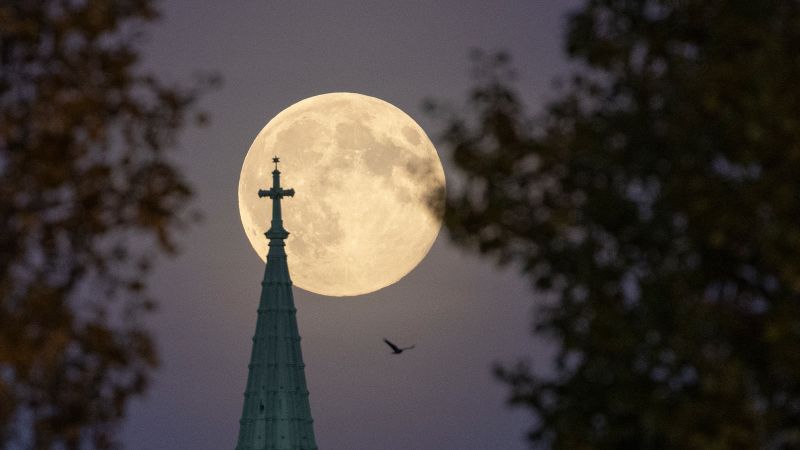
If you need a reason to gaze at the night sky this week, November’s full supermoon will put on a brilliant celestial spectacle. The full moon will reach maximum illumination tomorrow at 9:54 a.m. ET, according to EarthSky. While that peak occurs during daylight hours in the United States, the lunar orb will still appear full tonight, as well as Tuesday and Wednesday nights, said Noah Petro, head of NASA’s Planetary Geology, Geophysics and Geochemistry Laboratory at the Goddard Space Flight Center in Maryland. November’s full moon is known as the Beaver Moon, a nod to the time of year when the industrious dam-building mammals prepare for winter. The event will be the first of three consecutive supermoons. “The moon’s orbit is a little elliptical; it’s not a perfect circle. So sometimes the moon is a little bit closer to the Earth, and when that happens, it will appear larger in the sky as a result,” said Kevin Lewis, vice president and professor of earth and planetary sciences at Johns Hopkins University in Baltimore. November’s full moon will appear about 17% larger and 30% brighter than the smallest full moon of the year, Petro said. “People who regularly pay attention to full moons will notice the difference,” he added. Supermoons can occur consecutively because it takes about 27.5 days for the moon to return to its closest point to Earth and about 29.5 days to complete a full cycle of phases. These similar time frames allow the full moon to coincide with its closest approach to Earth for several months in a row, Lewis explained. No special equipment is needed to enjoy this month’s spectacular supermoon, but binoculars or a telescope can offer a closer look at its surface, revealing details like craters and vast, dark plains known as lunar seas, which were formed by ancient lava flows, according to NASA. For the best viewing experience, Petro recommends finding a dark area with a clear view of the sky, away from trees, tall buildings, and bright lights. On the days closest to maximum fullness, the moon will rise around sunset and remain visible throughout the night, setting around dawn. Look up shortly after sunset, when the moon will be low on the horizon and offer a particularly striking view, Lewis suggests. At that time, the orb may appear larger than it actually is due to an optical illusion known as the lunar illusion, according to NASA. Scientists aren’t entirely sure what causes the phenomenon, but it may have to do with how our brain processes visual information and compares the size of the moon to objects along the horizon, such as trees and rooftops. The moon’s gravitational pull also influences Earth’s ocean tides, and full moons contribute to larger high tides, Lewis said. He hopes this incredible display will prompt skywatchers to reflect on upcoming missions that aim to further explore the moon. “We’re still exploring our closest neighbor in the universe, so it’s especially exciting to look toward the moon now,” Lewis said. Future missions could provide new images of the lunar surface and potentially return humans to the Moon in the coming years, he said. With the holiday season approaching, Petro also encourages people to take a break from the end-of-year rush, bundle up, and spend a few moments appreciating our celestial companion in orbit. December’s full moon, the last of 2026, will also be the largest and brightest supermoon of the year, according to The Old Farmer’s Almanac. Known as the cold moon, it will reach maximum illumination on December 23. The first full moon of 2027, also a supermoon and called the wolf moon, will follow on January 22. If you missed the peak of the Leonid meteor shower, there’s still time to spot a few more fireballs. The shower will remain active until November 30, according to the American Meteor Society. And for those eager to see more, two meteor showers will still peak before the end of 2026. Here are the dates skywatchers should remember: Geminids: December 13-14 Ursids: December 21-22 Cold Moon: December 23 Wolf Moon: January 22, 2027 Taylor Nicioli is a freelance journalist based in New York. Subscribe to CNN’s Wonder Theory science newsletter. Explore the universe with news about fascinating discoveries, scientific breakthroughs and more.