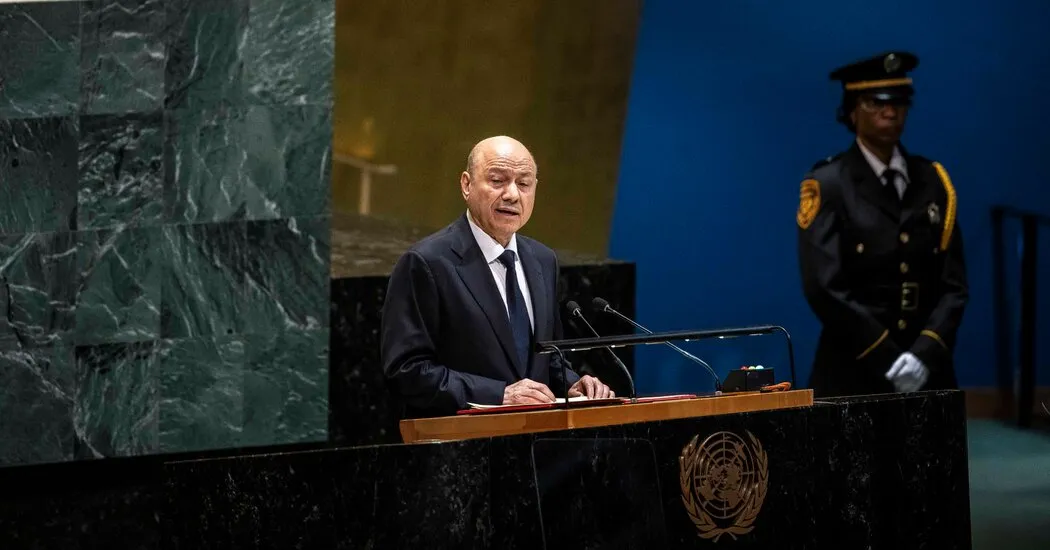
Yemen’s Saudi-backed government on Sunday announced a major military campaign against the Houthi militia, a key ally of Iran, plunging the Middle East further into war. In a televised speech, Rashad al-Alimi, leader of the internationally recognized and Saudi-backed government, said the government was trying to reclaim all the territory it had lost to the Houthis over the past 12 years. The government and the Houthis have been engaged in fierce battles in recent weeks, after Iran-allied militia seized control of the country’s Red Sea coast, increasing pressure on shipping lanes and energy markets unstable by the US-Israel war with Iran. The Houthis and Saudi Arabia, which supports the government financially and militarily, have also directly attacked each other. Al-Alimi’s announcement appeared to eliminate any hope that a truce would be reached. In his speech, he said the government’s military operations would continue “until the country is liberated.” The Houthis also say they are fighting to liberate Yemen and have dismissed government fighters as Saudi mercenaries. Yahya Saree, a Houthi military spokesman, said in a statement Sunday that the group’s fighters “will not stop carrying out more painful operations against the Saudi enemy.” The two sides have been fighting since 2014, when the Houthis seized the Yemeni capital, Sanaa, ousting the government. Saudi Arabia led a bombing campaign to try to restore the government, contributing to the deaths of hundreds of thousands of people from violence, famine, and disease. The Houthis eventually created a de facto state in northern Yemen. A truce in 2022 brought a fragile peace. But the conflict reignited this year, after the United States and Israel attacked Iran in February. The Saudi government has not publicly acknowledged any role in the new offensive announced by al-Alimi and did not respond to a request for comment. The Houthis have accused Saudi Arabia of launching hundreds of airstrikes on their territory in recent weeks, and any major ground operation by the Yemeni government would likely include the Saudis, according to analysts. “We cannot help but express our deep gratitude to our loyal brothers in the kingdom of Saudi Arabia,” al-Alimi said, adding that the Saudi government had “supported Yemen during its most difficult times.” Much of the Yemeni government operates from Riyadh, the Saudi capital. It was not immediately clear what role the United States or other Saudi allies might play in the government’s counteroffensive. Britain recently announced it would provide limited refueling support to Saudi warplanes, while U.S. officials have provided intelligence and targeting support to Saudi Arabia to counter the Houthis in recent months. The latest cycle of violence began in July, after the Houthis accused Saudi Arabia of bombing the Sana’a airport. The Houthis responded by launching drone and ballistic missile attacks inside Saudi Arabia, while also declaring a blockade on Saudi shipping in the Red Sea. As the conflict has escalated, it has dragged Yemen deeper into the broader war between the United States and Iran. With shipping through the Strait of Hormuz disrupted for months, Saudi Arabia had become more reliant on oil export routes through the Red Sea. Last month, the Houthis seized territory along the Bab al-Mandab Strait, a crucial maritime chokepoint. In recent weeks, the militia expanded its territory. On Sunday, it moved closer to encircling Taiz, one of Yemen’s largest cities. Houthi forces also captured Al-Turbah, a government-controlled town south of Taiz that lies on the main highway linking the city to Aden, the temporary seat of Yemen’s government, according to two Yemeni officials who requested anonymity to discuss sensitive military deployments. The takeover gave the Houthis control of a crucial supply route and leaves Taiz increasingly isolated from the government-controlled south. The city lies at a strategic crossroads between Yemen’s Houthi-controlled north, the government-controlled south and the Red Sea coast, making it a crucial prize for both sides. “We remain anxious and scared, fearing that the Houthis may enter the city,” said Ala’a, a Taiz resident who asked that only his first name be used because of possible retaliation. “It’s the first time I’ve seen my neighbors’ children still awake at 3 a.m. because of the bombing.” Yemen has been devastated by more than a decade of war and the latest escalation has only worsened its humanitarian crisis. More than 800 people have been killed since fighting broke out last month, according to the World Health Organization, while the World Food Program says more than 150,000 people have been displaced. On Saturday, the Houthis claimed that a missile and drone attack had caused fires at a facility owned by Aramco, the Saudi state-controlled energy company, in Riyadh. Videos verified by The New York Times showed a fire at an oil refinery in the city belonging to the company. Maj. Gen. Turki al-Maliki, spokesman for the Saudi-led coalition, rejected the Houthis’ account in comments to the Saudi-owned newspaper Asharq Al-Awsat, calling the group’s claim that it attacked Riyadh “misleading.” Houthi-run media reported that Saudi Arabia had carried out a new attack on Sanaa, the Yemeni capital. Saudi officials had no comment. Shuaib Almosawa and Dylan Collins contributed reporting.