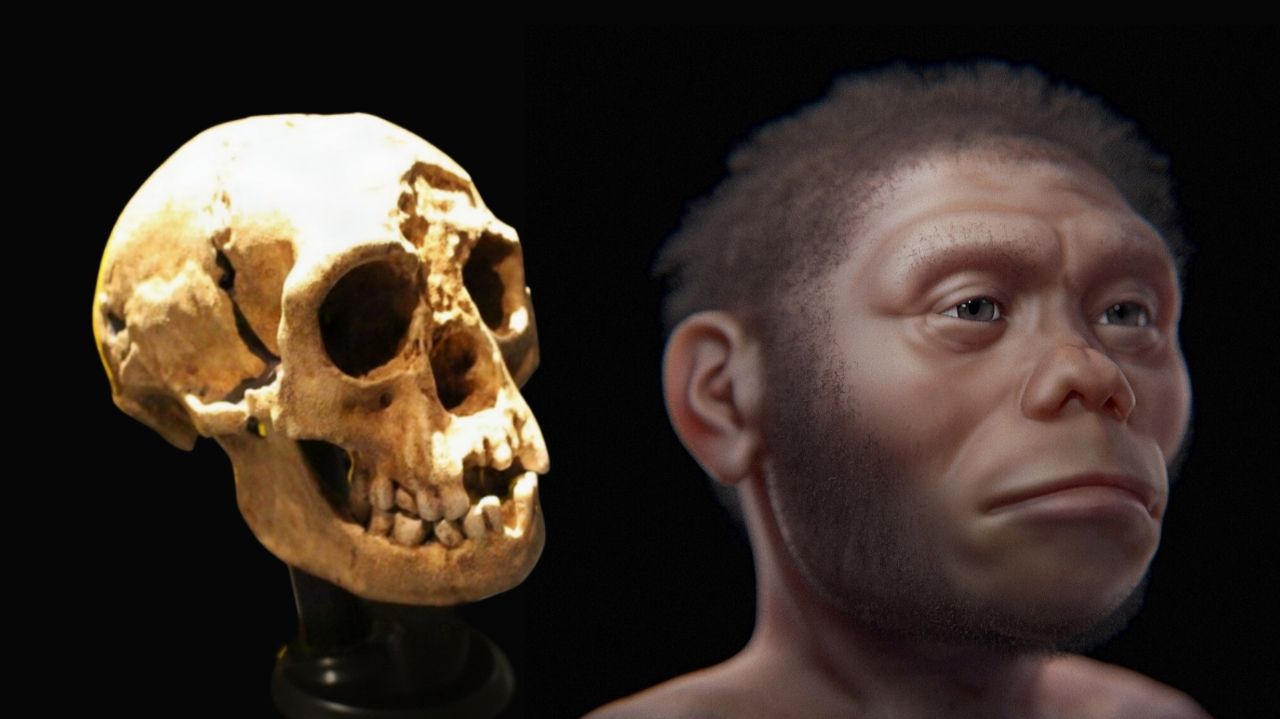
The pelvis of Homo floresiensis was more human-like than previous studies suggested, according to a new study of the species’ hip bones. The discovery adds details about how these small human relatives walked and deepens the debate about their origins. The skull of a female Homo floresiensis at the Natural History Museum in London (left) and a facial approximation of Homo floresiensis (right). Credit: Emőke Dénes and Cicero Moraes, CC BY-SA 4.0 Homo floresiensis, often called the “hobbit,” lived on the Indonesian island of Flores. Researchers first described the species in 2003 from remains found in Liang Bua Cave. The adults were about 3.5 feet or 1 meter tall. The study focuses on LB 1, an adult female whose remains date back to between 100,000 and 60,000 years ago. Its skeleton has a mix of features related to modern humans and much older human relatives. Those traits have made it difficult to pinpoint the species’ place in human evolution. For the study, the researchers examined micro-CT scans of the LB 1 pelvis. They compared its shape to pelvises from living humans and African apes, along with 26 fossil hominid pelvises. The LB1 fossil of Homo floresiensis at the Royal Belgian Institute of Natural Sciences in Brussels. Credit: Ghedoghedo, CC BY-SA 4.0 The team measured gait-related characteristics, including ilium angle and inferior ilium length. They also created a new way to measure iliac expansion, which describes how far the upper hip bones extend outward from the body. Iliac expansion has attracted much attention in studies of Homo floresiensis. A broad flare is most common in australopithecines, including Australopithecus afarensis, the species known from the Lucy fossil. This shape is related to a less efficient upright gait than the pattern seen in modern humans. Previous studies had achieved mixed results because researchers used different ways of measuring iliac expansion. The new measurement gave the team a more consistent basis for comparing LB 1 with other early humans, apes, and australopithecines. The results placed almost all measured characteristics of LB 1 within the range observed in Homo sapiens. Only the length of the ischium remained outside the modern human range. Looking at the pelvis as a whole, LB 1 showed closer ties to Pleistocene Homo groups than to australopithecines or African apes. The pelvis also shared characteristics with Homo erectus and other early members of Homo. This suggests that Homo floresiensis had a form of upright walking closer to other human species than previous work had proposed. Reconstruction of the head of a Homo floresiensis individual, as displayed at the Smithsonian’s Natural History Museum. Credit: Karen Neoh, via flickr; CC BY 2.0 Hobbits still didn’t walk exactly like people today. Its pelvic shape suggests a slower form of bipedal movement. They were not built for quick travel or long-distance hiking, and it is still possible to use some trees. The result fits with the unusual mix seen in the rest of the skeleton. Some bones in the hand look more like those of australopithecines, while the shoulders and upper arms show more human-like features. The new pelvic evidence adds another human characteristic to this unusual body plan. The biggest question about Homo floresiensis remains its origin. Two main ideas remain. It is argued that Homo floresiensis descended from groups of Homo erectus that arrived on Flores, followed by a period of insular dwarfism. The other proposes descent from a small-bodied population of an earlier Pleistocene species of Homo. The new pelvic study does not choose between these ideas. The work shows how much early human skeletons varied, making hobbit ancestry difficult to trace from bones alone. Future work on ancient DNA or proteins could provide new evidence about the species’ past. For now, the human-looking pelvis offers a clearer picture of how these tiny humans moved, while their evolutionary history remains open. Publication: Lewton, KL, Hammond, AS, Alamsyah, N., Noerwidi, S., Sutikna, T., Skinner, MM, Tocheri, MW (2026). Comparative morphometric analysis of the pelvis of LB 1 (Homo floresiensis). American Journal of Biological Anthropology. doi:10.1002/ajpa.70339