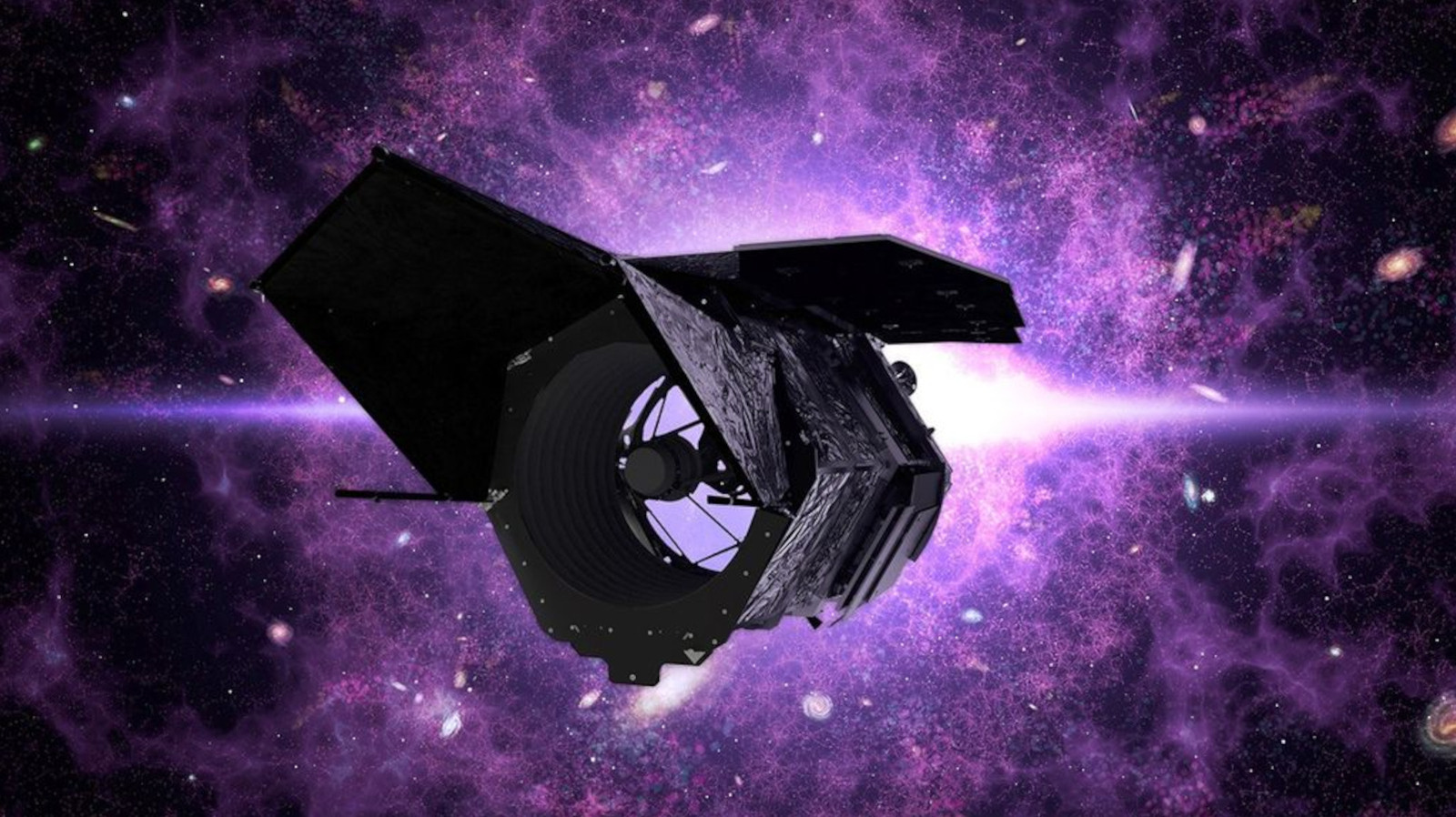
NASA’s Nancy Grace Roman Space Telescope is currently en route to its refueling station, 930,000 miles from the planet on which it was built. Once there, this triumph of engineering will explore our universe with innovative technology far beyond what has come before. However, when you arrive, you will discover that you are not alone. That’s because the James Webb Space Telescope is already there, and it’s also an engineering triumph, already exploring our universe with groundbreaking technology far beyond what came before it. So why does NASA bother putting two space telescopes in the same place in space? Isn’t that a little redundant? What exactly sets these two apart from each other? The answer has to do with how their respective cameras are designed, which in turn means they have very different capabilities and missions. In short, Roman has a very wide field of view, allowing him to capture large areas of the sky at once. In contrast, the Webb has a much narrower field of view and much higher resolution, meaning it can take incredibly detailed photos of distant objects. Think of it as the difference between looking around (Roman) and looking very closely at something (Webb). That makes Webb great for detailed studies of things scientists already know, but his narrow vision makes him bad at discovering new things. Roman will study the entire sky and is expected to find billions of stars never seen before. In fact, if Roman finds something new and exciting, do you know who NASA will send to check it out? Webb. Mirrors vs. Detectors As any terrestrial photographer will know, the photo a camera can take comes down to two main components: the mirrors (lenses) and the detectors. Mirrors are what really capture the faint, distant lights of distant stars; The more light you capture, the better the image resolution will be. This is Webb’s specialty: its main mirror is composed of 18 hexagonal segments combined into a roughly circular shape, reaching 21.3 feet in diameter. It is the largest mirror ever placed in space. This one is so sensitive that it needs to stay cool at -364 degrees Fahrenheit, because otherwise the tiny infrared light from the heat of the segments would interfere with the incoming light. This amazing mirror is connected to several different scientific instruments, but as an example, the near-infrared NIRCam features eight 2,048 x 2,048 pixel sensors with a field of view of 260 x 130 arcseconds. Ultimately, this gives Webb incredible detail (due to all the light captured) in a very narrow field of view. Roman turns all that around. Its mirror, which is just a giant segment, is only 7.9 feet in diameter. It is exactly the same as Hubble’s, although it only weighs a quarter as much. So compared to Webb, Roman captures much less light, which means much less detail. This also means it can get hotter, at -288 F. Roman’s muscles are in his detectors: his Wide Field Instrument (WFI) has 18 sensors of 4,096 x 4,096 pixels each with a field of view of 2,700 x 1,280 arcseconds. In other words, you’re taking much larger photos in a much wider field of view, but in less light (resolution) than Webb. Roman’s strong point is getting rid of light. Of course, part of getting the photo right is getting rid of unwanted light. Both Roman and Webb will live and work at Earth’s Lagrange Point 2, or L2, for exactly this reason. This is a point in space where the centrifugal forces of the space telescopes orbit will be exactly counteracted by the combined gravitational forces of the Earth and Sun behind it. That has two advantages: The telescopes can remain “in position” with comparatively little fuel expenditure, and they are as far away from the Sun’s glare as possible. Still, both telescopes have intensive shielding to keep out solar glare. What sets Roman apart is that he also has a way of blocking the light of the stars he observes. This may seem really counterintuitive, but the integrated coronagraph instrument is a marvel built for precisely this purpose. Using a series of masks and prisms, the coronagraph can essentially reduce the light from an observed star. Because? To see the planets that surround it in greater detail, of course. To do this, the coronagraph mirrors are flexible or “deformable.” It can even remodel itself with enough precision to compensate for an error the width of a strand of DNA. So once Roman reaches his destination, late this year or early next year, he is expected to find not only new stars, but also new planets in great detail. What if you find something really interesting? NASA can then send Webb to take a very detailed look. Roman and Webb are partners in the most advanced astronomical work ever done.