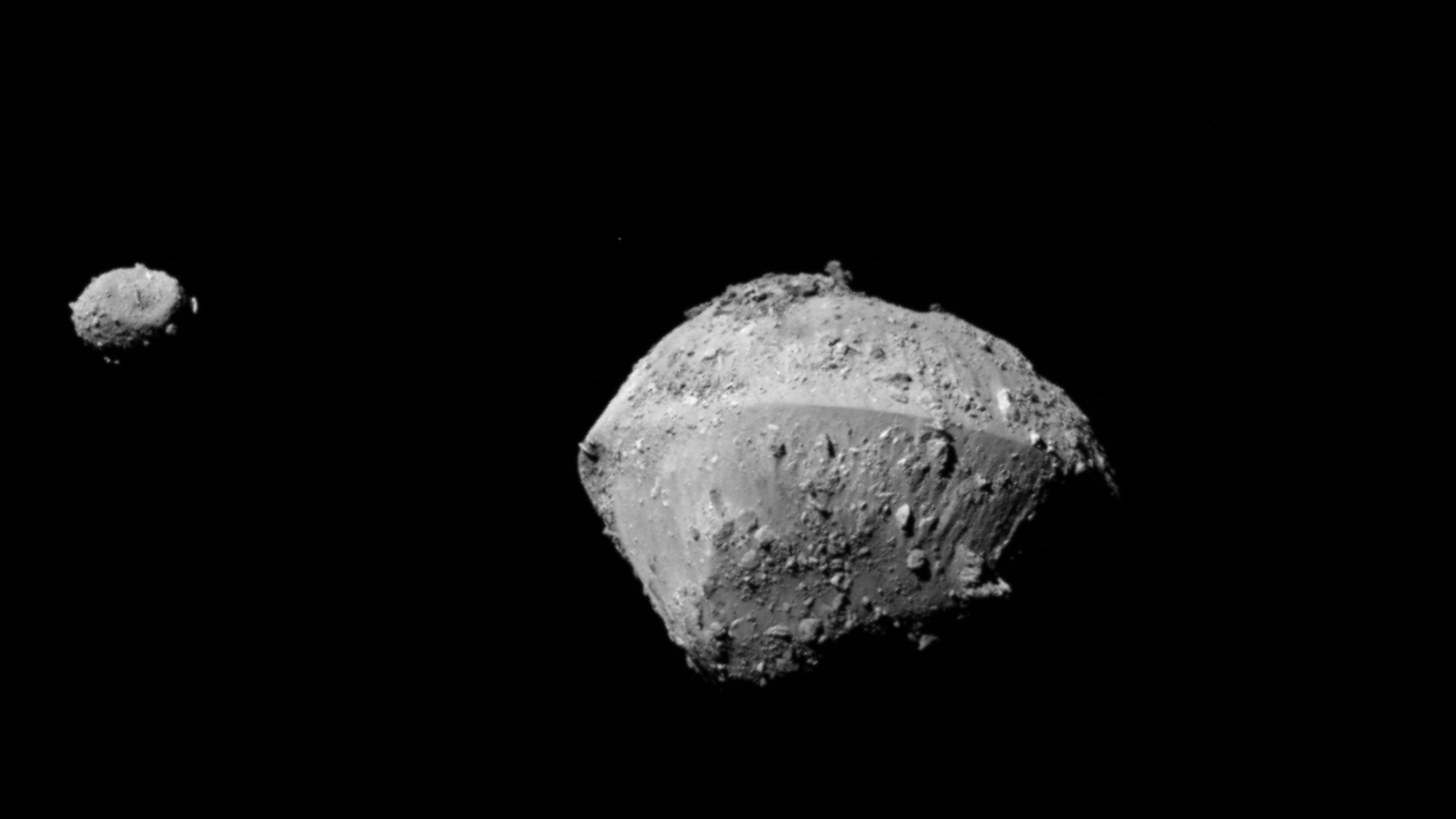
Follow Us Add us as a preferred source on Google Newsletter Subscribe to our newsletter NASA’s Earth Defense DART mission ripped a stadium-sized hole in a distant asteroid, and we’ve seen it up close for the first time thanks to the Hera spacecraft. NASA’s DART (Double Asteroid Redirection Test) mission made history on September 26, 2022, when it crashed into Dimorphos, the small moon of the much larger asteroid Didymos. The mission tested whether such an impact could be used to deflect an asteroid on a collision course with Earth. Scientists have known for some time that this diversion attempt was successful; The system’s orbit around the sun was lengthened by 33 minutes, but the European Space Agency’s (ESA) Hera mission launched in October 2024 to travel 194 million kilometers (120 million miles) to the Didymos system to observe the effect of the DART impact in greater detail. Now, the spacecraft has revealed that DART flattened one face of Dimorphos into a stadium-sized crater and spun it chaotically. The impact also appears to have destroyed hundreds of previously unknown rocks that now surround the binary asteroids. “Scientists debated whether Dimorphos had undergone an impact crater, changed its shape or remained the same,” Hera principal investigator Patrick Michel, research director at the Côte d’Azur Observatory, said in a statement. “To our surprise, the answer turns out to be all three at once! The face hit by DART has flattened into an impact crater the size of a sports stadium, stretching across the entire width of the asteroid.” You may like An important step for Earth’s defenseMichael Kueppers, ESA’s Hera mission scientist, detailed some of the changes to the small impacted moon seen by the spacecraft: “As Hera returned more images, it became clear that the DART impact had left Dimorphos spinning wildly in its orbit.” Another big surprise is that Hera is showing that asteroids are surrounded by hundreds of orbiting rocks, just a few meters in size.” Dimorphos Hera found that the rock fields covering regions of the unimpacted moon look exactly as they did when DART imaged it in 2022. (Left) Didymos system seen by DART in 2022 (Right): The same system seen by Hera in 2026 (Image credit: ESA/NASA) Hera is not done with Didymos and its moon. The ESA spacecraft is currently in a rectangular orbit around the binary asteroid system. This will allow Hera to continue observing Didymos and Dimorphos. will deploy two display box-sized CubeSats, which will move even closer to the asteroids. The Juventas CubeSat will use low-frequency radar to probe the interior of Dimorphos. Together, Hera and its CubeSats will more precisely determine the. mass of Dimorphos, which, when combined with information about the system’s orbital change, will be crucial in planning missions to deflect threatening asteroids. An infrared view of Didymos seen by Hera (Image credit: ESA)Hera observations were revealed on Wednesday (Nov. 25) in the dinosaur hall of the Nature Museum in Berlin, Germany. That location is no coincidence: it is a stark reminder of why this planetary defense mission is so important, especially if the Humanity does not want to follow the path of the dinosaurs, whose rule on Earth ended when an asteroid fell from the sky. “Sixty-six million years ago, an asteroid impact changed the course of life on Earth. Today, for the first time in history, humanity is validating how to prevent a similar event from happening again,” explained Hera mission director Ian Carnelli. “NASA’s DART mission demonstrated that we can change the orbit of an asteroid. Hera is now revealing what happened to the asteroid itself. “By combining these two missions, humanity is taking a decisive step toward making asteroid deflection a reliable tool to protect our planet.”