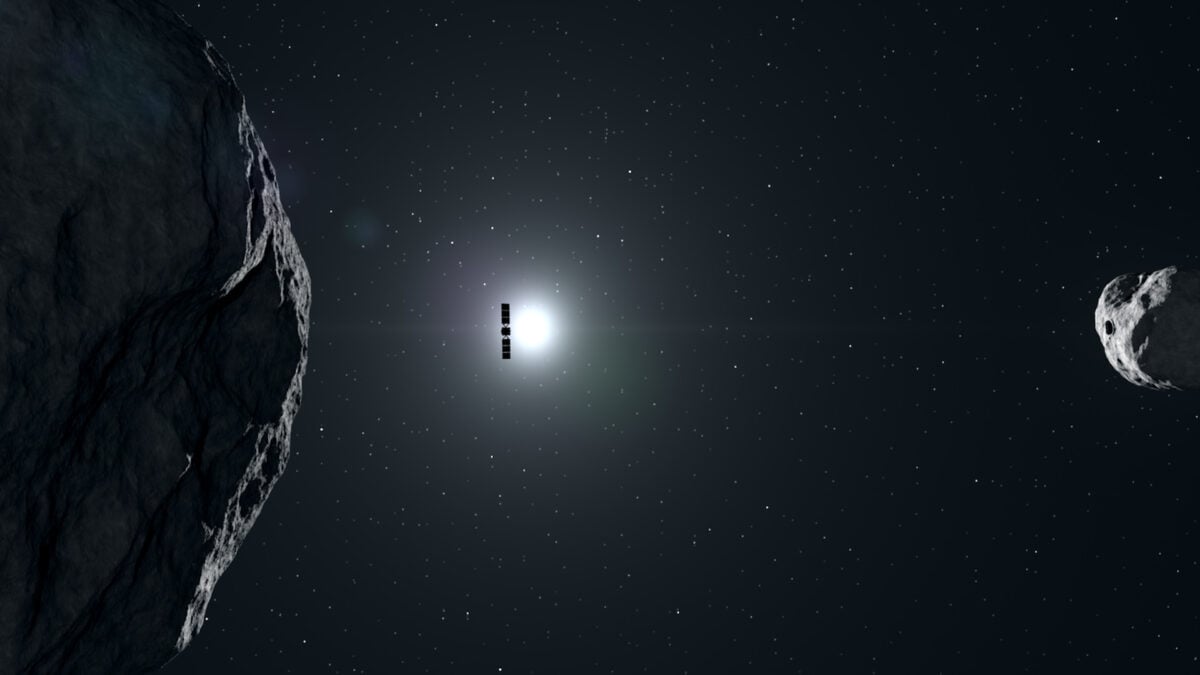
In September 2022, a NASA spacecraft violently crashed into a small asteroid as a test of planetary defense. Now, a new probe is ready to examine the remains by encountering the space rock for a closer look. The European Space Agency (ESA) launched its Hera mission on October 7, 2024, as a crucial follow-up to NASA’s DART (Double Asteroid Redirection Test), a first-of-its-kind attempt to redirect the orbit of an asteroid. The small, car-sized spacecraft recently performed a braking maneuver to slow down as it approaches the binary asteroid system before making its first close flyby in early November. Hera is set to conduct a detailed post-impact study with the goal of turning a unique space experiment into a well-understood planetary defense mechanism. The mission could also help scientists learn more about how asteroids form. Collision Ahead For the DART test, NASA sent a 607-kilogram spacecraft and crashed it into Dimorphos, a 170-meter-wide space rock that orbits its larger, 800-meter-wide companion, Didymos. Ground observations revealed that after the collision, Dimorphos’ orbital period around Didymos was shortened from 11 hours and 55 minutes to 11 hours and 23 minutes. The mission was considered a success and demonstrated that a spacecraft could deliberately alter the motion of an asteroid. But successfully hitting an asteroid and understanding exactly what caused that impact are two different things. To understand the full consequences of the impact, scientists needed more detailed research. That’s where Hera comes in, armed with a suite of scientific instruments to survey the asteroid after the collision and investigate whether DART’s success can become a reliable strategy to protect Earth. Enter, Hera’s ground-based observations are estimated to have a 10% residual uncertainty in their measurements, and models of the impact have not yet been able to calculate the mass and composition of Dimorphos, according to ESA. Once she reaches Dimorphos, Hera will not only investigate the crime scene, but will also measure the asteroid’s mass as well as its displaced orbit in a much more precise manner. Hera will also carry out the most detailed study of a binary asteroid system, which represents about 15% of all known asteroids, but none have been closely studied before. Earlier this month, Hera saw her target for the first time. The spacecraft imaged the Didymos binary asteroid system from a distance of approximately 146,954 miles (236,500 kilometers) away. On October 15, Hera performed a braking maneuver to fine-tune its trajectory toward the pair of space rocks and fired its thrusters to come close to matching the speed of the asteroids. In early November, the spacecraft will approach within 30 kilometers (20 miles) of the asteroids and begin collecting data. Hera will continue to approach the asteroid system before deploying a pair of shoebox-sized cubesats, called Milani and Juventas, in January 2027. Milani is tasked with identifying the composition of materials in and around Dimorphos, while Juventas will use radar to peer into the asteroid’s interior. After a two-year journey through space, Hera is expected to spend at least six months surveying the Didymos asteroid system, examining the aftermath of NASA’s DART impact, and collecting data to advance planetary defense.