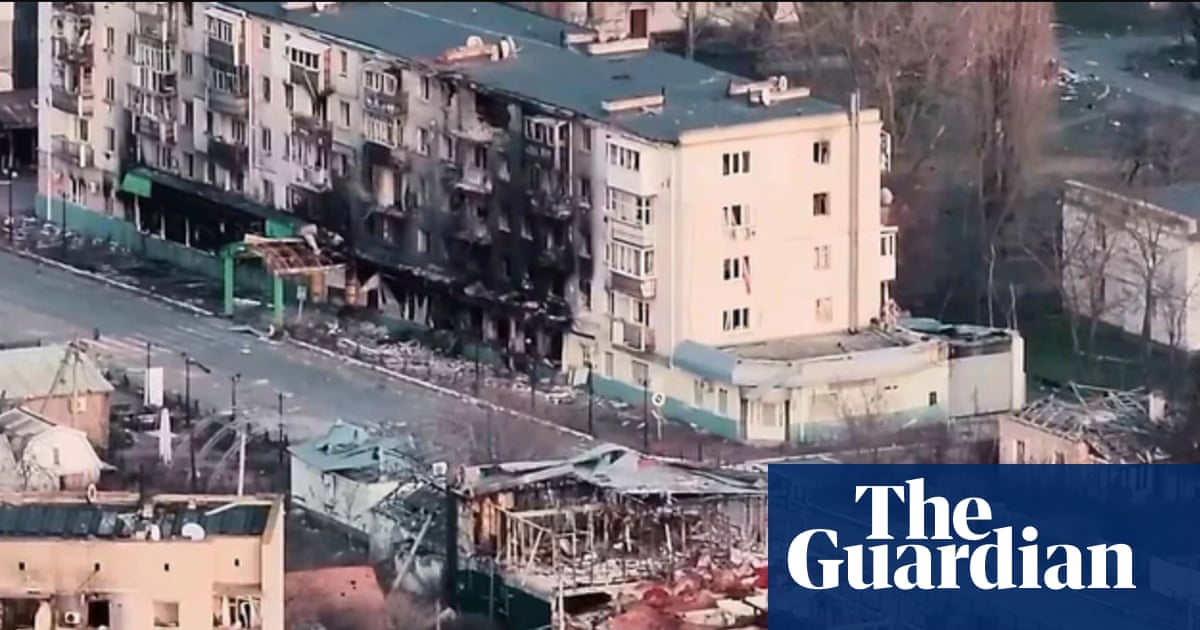
The telephone message sent from Russian-occupied Oleshky was grimly matter-of-fact: Food had finally run out for the approximately 2,000 civilians, including 50 children, remaining in the city and its surrounding villages. “We are in Oleshky. [and] we can’t go out. “We are starving… Right now I have absolutely nothing to eat,” read the message from a woman in the besieged city waiting to be evacuated by occupying forces. Before the war he weighed 110 kilos (17th); Now he weighs only 67 kilos, he writes. “At first I was happy [to lose some weight]but now I realize that I will die without a proper protein-rich diet. It’s very difficult. The house where we stayed last winter was also destroyed and burned down. Just like our own home… We are still alive.” Oleshky, across the Dnieper River from the southern city of Kherson, has become “hell on earth,” according to Ukrainians familiar with conditions there. This weekend, military authorities in Kherson carried out a large-scale airdrop of food, water and emergency medical supplies into the city and surrounding areas, using large drones, after Russia reportedly again rejected a ceasefire to evacuate civilians. The military governor’s office in Kherson said an operation had begun about four tons of food for 100 locations, but it was unclear how many the Russian military had intercepted. Ukrainian Foreign Minister Andrii Sybiha raised the situation in Oleshky at the UN general assembly in New York on Friday. obstacle.” He said in a speech during the general assembly: “Russia deliberately makes life there impossible. They are being starved.”Russian occupation of UkraineKremlin spokesman Dmitry Peskov this month acknowledged the “critical situation” in Oleshky, but accused Ukrainian forces of blocking humanitarian supplies destined for its residents. Compounding the problem for civilians is the fact that Ukraine’s very successful summer drone campaign against Russian supply lines has caused shortages for the invading forces’ frontline troops, who in turn steal the little food that Ukrainian civilians have managed to save. In messages shared with The Guardian, residents said they had only one meal a day: soup without potatoes, made with zucchini grown in what were once the garden beds of the city’s apartment buildings, sometimes with the addition of foraged purslane, an edible herb. “We are running out of everything,” one resident said in early summer. “In August the situation will be critical for us. And when autumn comes, we will definitely die. I’m already dying. I’m getting weaker every day.” On September 1, a food convoy headed to the city was attacked. Moscow blamed the Ukrainian military for the attack, while kyiv blamed Russian troops. Ukrainian officials say attempts to drop food by drone have served little purpose: supplies are confiscated by Russian soldiers and in at least one case the recipient was arrested. Commenting on the airdrop over the weekend, Kherson’s military governor, Oleksandr Prokudin described it as the largest operation of its kind so far. “The food was delivered directly to 100 distribution points. And now I would like to address the Russians,” he said. “Civilians have absolutely nothing to do with the Ukrainian armed forces. Because of the conditions you have created in Oleshky, people simply have no choice but to take food with them. Do not deprive people of the opportunity to survive and avoid hunger. “Russia, as an occupying power, is obliged to provide people with food, medicine and adequate conditions of health care and hygiene. If its own resources are insufficient, the occupying authorities must give their consent to humanitarian operations by international organizations and other States. Instead, we are seeing the opposite.” people trying to bring food and medicine. They also block all initiatives and agreements related to the evacuation of people from Oleshky.” War-damaged buildings in Oleshky. Photograph: 34th Ukrainian Marine Brigade According to Tetiana Hasanenko, a Ukrainian official who serves from the western side of the Dnipro as head of the Oleshky military administration, problems began in earnest at the end of last year when access to the city from the Russian side for Ukrainian civilians became increasingly difficult. “The density of the minefields has become very high,” he told The Guardian. “Starting in December, food deliveries became much less frequent because vehicles were hitting mines and being attacked by drones. In winter, the food supply had already become very difficult. “And it has already been very hard. There is no other infrastructure, no electricity, therefore no ATMs or cash. Oleshky does not work. Before the war, people grew food in their gardens. Not only did they have enough for themselves, but they sold it to Crimea and the city of Kherson. Now they can’t even grow it themselves.” Hasanenko described an incident in which a 74-year-old man was excavating a basement that had flooded with mud after Russia blew up the Kakhovka dam in 2023, searching for stored food. Refusing to allow the soldiers into the basement he was excavating, he was killed by the soldiers. “Some people have been digging these basements for canned vegetables, pickled vegetables and canned meat that people were storing. “For the winter,” he said. Despite the horrific conditions in the city, Ukrainian officials believe the occupation forces are delaying the evacuation of remaining civilians to discourage a Ukrainian counterattack. Hasanenko said: “The Russians fear that an offensive [against Oleshky] It will start from the city of Kherson and they simply keep the people, the civilians, as human shields.” He added: “It is an ancient city. It has existed for almost a thousand years, and in all this time, people have never lived in such horrible conditions, in such a hell as they do now. There are bodies not only in the basement of the hospital, but throughout the city. They are lying there because the body cannot be lifted. The drones fly constantly and then the dogs eat the corpses.” In one text message, another resident said simply: “All supplies are running out.” Another message: “A week ago, the orcs [a Ukrainian term of abuse to describe Russian soldiers] He went into people’s yards and dug up all the potatoes, onions and garlic. “They took away all the food supplies from the old women. When one of the grandmothers started screaming, they responded that ‘soon to live in heaven’ people like them should subsist only on water.”