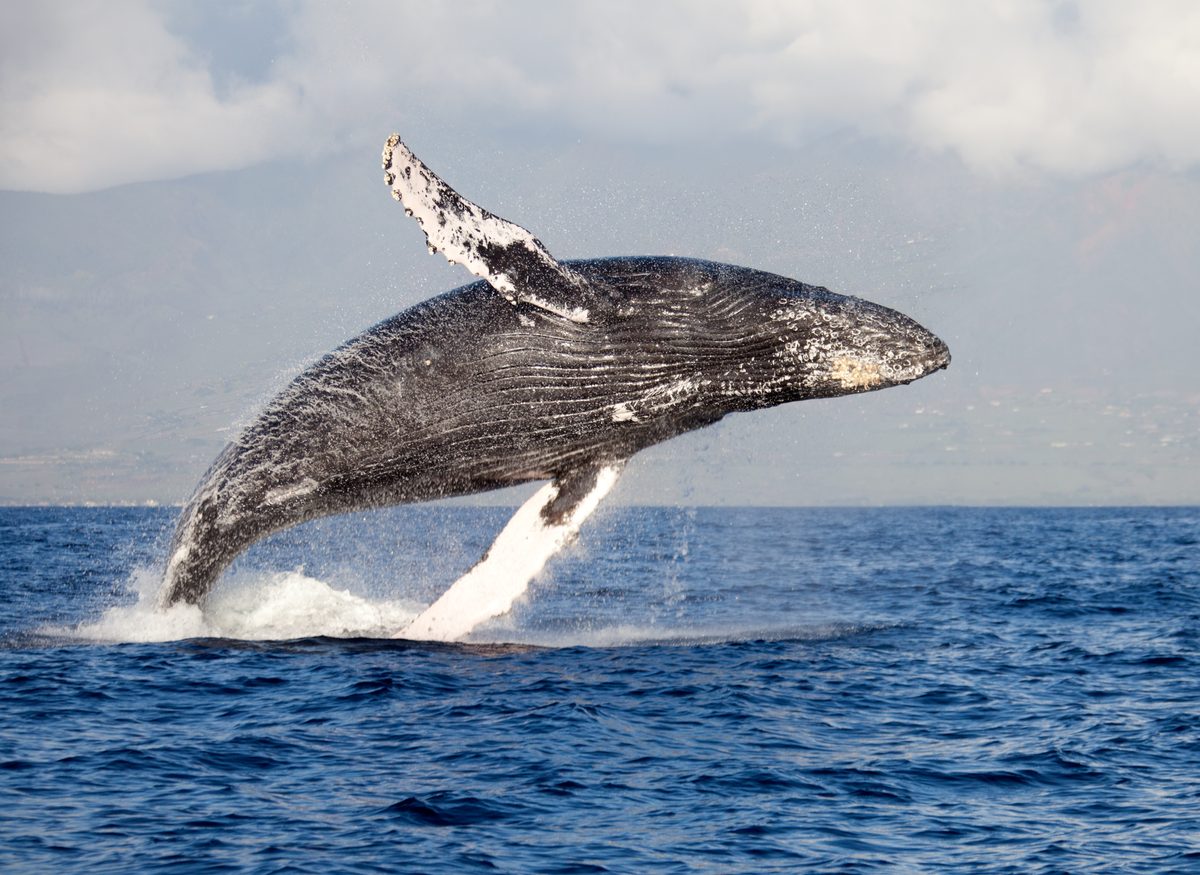
Humpback whales have long been admired for their intelligence, and their behavior with other marine creatures has been widely observed and documented. In particular, the whales’ habit of coming together to blow bubbles and form a ring around a school of small fish to “corral” them and facilitate their feeding. This hunting collaboration has led to interesting speculation about the nature of communication between team members. In 2021, a team of scientists at the SETI Institute conducted what was called a “conversation” with a single humpback named Twain. This involved playing whale songs through an underwater speaker to which Twain responded with similar calls. Later, in a 2024 study by the same group, whale calls made during bubble feeding events—originally intended as random and purposeless, other than, perhaps, as a way to keep in touch with other pod members—were assumed to have more specific goals. Certain calls appeared to be a way for the whales to give instructions or make specific comments to the group. But these studies did not address humpback whales’ voluntary interactions with humans, rather than contact designed by the researchers, or their use of blowing bubbles, rather than as a hunting strategy. A 2025 study by SETI and University of California scientists, published in Marine Mammal Science, addressed both aspects of whale behavior, documenting that humpback whales produced large rings of bubbles during friendly encounters with humans that appear to be an attempt to send messages. The overall goal of the SETI Institute is to understand the origins and prevalence of life and intelligence in the universe, so these interactions sparked great interest. Non-verbal communications, as well as attempts to speak, wherever they occur, are considered key to improving our understanding of all forms of life. This applies to non-human species currently on Earth, as well as any sentient beings that may be encountered in the future, if space exploration brings us into contact with life forms on other planets. “Humpback whales live in complex societies, are acoustically diverse, use bubble tools, and help other species that are harassed by predators,” says co-lead author Dr. Fred Sharpe. “Now, similar to a candidate signal, we show that they are blowing rings of bubbles in our direction in an apparent attempt to playfully interact, observe our response, and/or engage in some form of communication.” Candidate signal is the name given to interesting radio waves that can be detected from the depths of space and have been the subject of much analysis as to their origin and meaning. The team compared what they see as these communication attempts by the whales, and the efforts researchers are making to understand the messages from their bubbles, with the work being done to interpret interplanetary radio signals. The study analyzed 12 episodes of bubble ring production involving 39 rings made by 11 individual whales. “We have located a dozen whales from populations around the world, most of which have voluntarily approached boats and swimmers by blowing bubbles during these episodes of curious behavior,” said co-lead author Jodi Frediani, a marine life photographer. The Whale-SETI team aims to use the results of their research to develop filters that will help analyze cosmic signals for signs of extraterrestrial life. They hope that with continued observation and the help of AI they will be able to accurately interpret the verbal and non-verbal communications of whales and other animals in the future. These learnings and techniques could then be applied to communications coming from outside our world. Listen to the sounds of the pod of whales blowing bubbles.