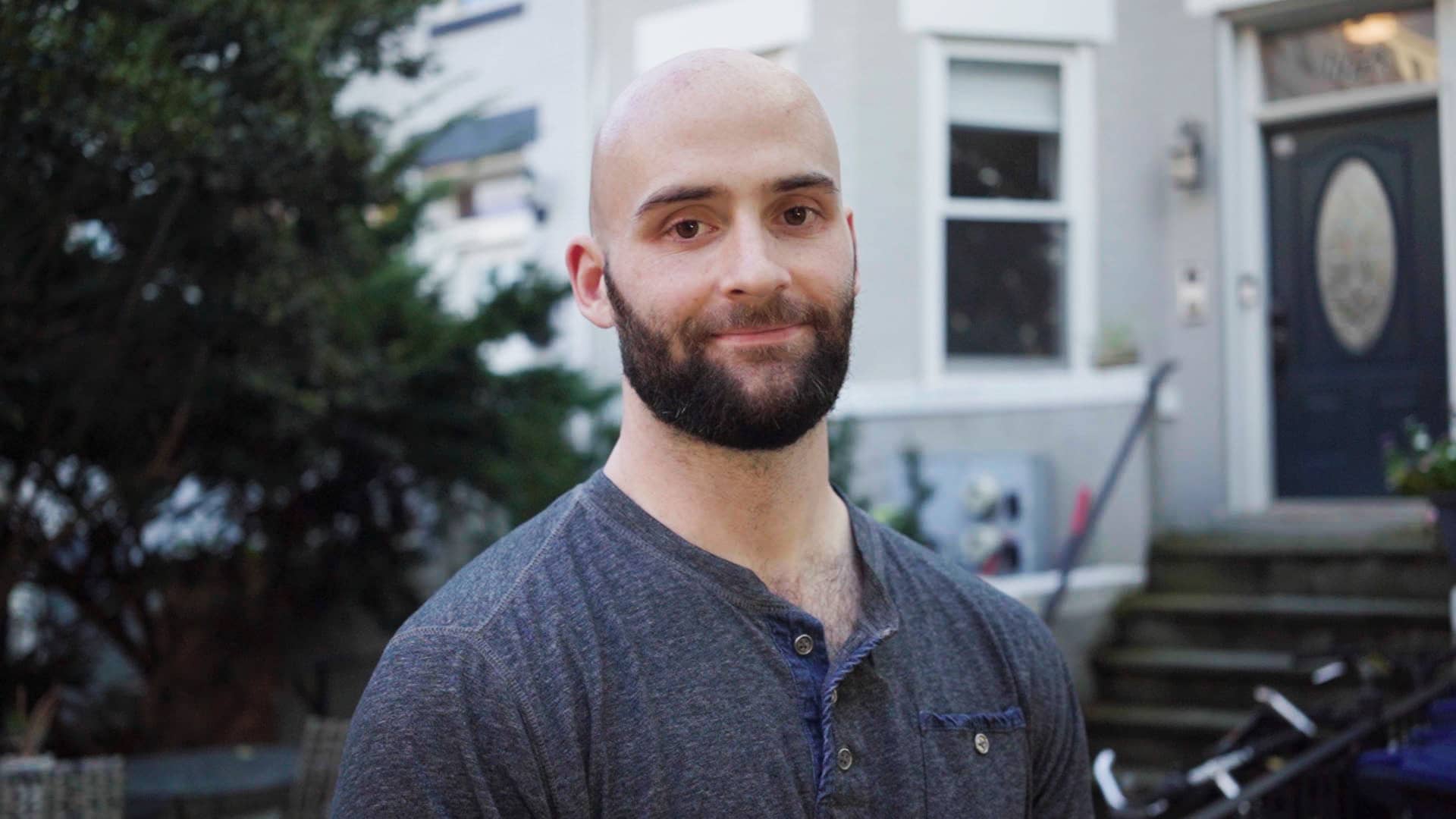
This story is part of CNBC’s Make It’s Millennial Money series, which details how people around the world earn, spend and save their money. At 26, Google AI security analyst and YouTuber Charles Broomfield is on track to earn around $323,000 this year, but he lives on less than minimum wage. For the past several years, Broomfield has kept his annual spending on basic living expenses below $20,000, less than the roughly $23,700 for full-time work. The worker would earn the minimum wage, average in the 50 states. He does this by living with roommates in Washington, DC, walking or biking instead of driving, eating for free at work, and rarely spending beyond his basic needs. Even when he splurges on something fun, he keeps things modest; in August, that meant a baseball game and a single $7 beer. “I guess another thing that probably makes me a little unique is that I don’t really feel joy when I buy things,” he says. “I feel like I have what I need.” Charles Broomfield in Washington, DC Matthew Ritenour | CNBC Make ItThere is a goal behind all that savings. Broomfield has sought financial independence since college and now hopes to reach her goal of $750,000 in investments over the next year, well ahead of her original goal of doing so before age 30. As his income has increased, his lifestyle has remained largely the same, he says. Here’s how Broomfield keeps his expenses so low and what he plans to do once he no longer needs the paycheck. Saving for Financial Freedom Broomfield grew up in Colorado Springs, Colorado, as the son of two military members. veterans. He and his siblings had to save half of everything they earned growing up. They could spend the other half or earn interest from their parents by saving that money too. By his teens, Broomfield had become a disciplined saver. At the time, he dreamed of using his cash to purchase some of the familiar attributes of wealth. “I wanted a Lamborghini and I wanted a nice penthouse,” he says. “I only wanted them because I thought other people wanted them.” At age 17, Broomfield discovered Mr. Money Mustache, a personal finance blog written by a former software engineer who retired at age 30. The blog advocates living frugally and investing much of your income to build a portfolio large enough to support you through withdrawals, without needing a paycheck. He introduced Broomfield to the financial independence, retire early (or FIRE) movement and gave all that saving a new purpose. Charles Broomfield in his room in a Washington, DC apartment he shares with four roommates. Matthew Ritenour | CNBC Make It”All I had to do was live very frugally and I could actually achieve financial freedom by the time I was 30 and do whatever really made me happy in life,” he says. The idea stayed with him. After graduating from Knox College in 2022, Broomfield moved to Northern Virginia for a job that paid more than $100,000 a year and set a goal of reaching $750,000 in investments by age 30, spending less than $25,000 a year. He also decided to start at $0. Broomfield had about $50,000 in savings when he graduated, and his parents had covered the portion of his college tuition that scholarships didn’t pay for. He wanted his total FIRE to reflect only what he earned after college. ‘Excited’ About Extreme Frugality In his first year out of college, Broomfield was “super excited” about achieving financial freedom, he says. “It’s almost the only thing I thought about, because I was developing all these new habits and making real money for the first time in my life,” he says. That enthusiasm sometimes took him to extremes. He even considered living in a van parked in his employer’s garage to avoid paying rent. “I did the math, and sure enough, every year I spent living in a van instead of paying rent would allow me to retire about a month faster,” he says. “It’s just [didn’t] “It seems like it’s really worth going to that extreme.” Charles Broomfield at the grocery store. Matthew Ritenour | CNBC Make ItBut Broomfield still found satisfaction in squeezing every dollar out of his budget. She once biked two miles to a grocery store to save $1 on toothpaste instead of buying it at the Whole Foods next to her apartment. “Many people feel their gains by buying things for themselves,” says Broomfield. “Looking back, Broomfield acknowledges that some of his early efforts to save money made little difference in how quickly he could achieve financial independence. “I never expect anyone else to do exactly what I’m doing,” he says. “I know I’m a lot geekier about this than most people, and I’m particularly well-positioned to be able to live this kind of life.” How he lives on less than $20,000 a year. $1,477 in August, excluding savings, investments and tuition payments from her graduate school. Here’s a breakdown of where her money went that month, including those extra payments: Zoom In Icon Arrows Pointing Outward Christina Locopo CNBC Make It Savings and investments: $17,931 in 401(k) and brokerage account contributions Rent and utilities: $1,098 including electric, gas and water Student debt payment: $700 Gym membership: $229Discretionary: $59Transportation: $48 for Uber ridesFood: $28 spent on groceries or eating out Insurance: $15 for dental services, renters About 90% of Broomfield’s income went into savings and investments in August, a fairly typical month for him, he says. He put about $7,931 into his 401(k) and another $10,000 into a. They went into a 0% interest employer tuition payment plan with a former employer, leaving him with a remaining balance of $16,800 in August. Housing is Broomfield’s biggest expense, although by keeping costs down by sharing an apartment with four roommates in a neighborhood where one-bedroom apartments commonly rent for more than $2,000, the arrangement saves him about $1,000 a month. splurge is a membership to a martial arts gym. He pays $229 a month to train as a kickboxer, although he could train for free at Google’s office gym. Broomfield considers it a “youth’s sport” and doesn’t want to put off competing until he reaches financial independence. It’s also a way to socialize with other amateur fighters who share his interest. Charles Broomfield trains in kickboxing. Google covers his daily commute on Metro, which helps keep his transportation costs down. He tries to meet friends near Metro stations, and when he visits his grandfather in Virginia, he takes public transportation as far as he can before using Uber for the last leg of the trip. Before joining Google, Broomfield typically spent about $200 a month on food. Now that he eats most of his meals at work, his average grocery bill was $28 a month. especially low because he had leftover ingredients from July. He also cooks less at home these days, relying more on batch cooking, including pressure cooker chili that makes nine servings for about $2 each. His income has tripled, but his expenses have not. $323,000 in 2026, more than triple the roughly $100,000 he earned in his first year out of college. His compensation rose to about $120,000 during his first three years, then jumped to $200,000 when he joined Amazon Web Services in 2025. After a brief stint at Capital One, he moved to Google this year. By keeping his expenses low, investing most of what he earns and taking advantage of a. stock market trending higher, he has accumulated about $650,000 in investments since graduating from college. Broomfield also makes money from his YouTube channel, which has expanded to offer personal finance and career advice. About $48,000 of his projected income this year will come from the channel and a related career coaching business. Even as his income has increased, Broomfield has stuck with roommates, public transportation, and the same modest spending habits. I’ve separated how happy I am from how much money I spend,” he says. “I really don’t think I’d be significantly happier if I spent a lot more money.” store.Matthew Ritenour | CNBC Make ItMuch of the money he doesn’t spend goes directly into investments. He maxes out tax-advantaged accounts, including his 401(k) and HSA, and has sometimes contributed 100% of his salary to his 401(k) at the beginning of the year to reach the annual limit as quickly as possible. possible. Broomfield keeps his investment strategy simple, favoring broad-market index funds. I just don’t have time to research and understand the risk and potential returns of those individual stocks,” he says. “And research shows that most people who try to pick individual stocks don’t end up doing any better than if they simply invested in the stock market as a whole.” Avoid cryptocurrencies for a similar reason. Broomfield says he doesn’t understand what gives them value and doesn’t want to put money into investments he doesn’t understand. At its current pace, Broomfield expects to reach its $750,000 investment goal over the next year. What’s Next After Financial Independence When Broomfield discovered the FIRE movement at age 17, he worried about being stuck in what he imagined was a “grinding” 9-to-5 office job until he was 65. He saw financial independence as a way to stop working altogether. But while financial independence would give him enough money to live without a paycheck, Broomfield no longer sees early retirement as his goal. Maybe this is a little ironic, but I actually think I’ll keep working,” he says. His YouTube business already makes enough on most months to cover his expenses without a full-time job. With that income and his growing investments, Broomfield hopes to eventually build a business of his own, potentially in AI security. “Having full ownership and full acceptance of something that’s mine. I find that really exciting,” he says. Charles Broomfield at home. Matthew Ritenour | CNBC Make It Whatever he decides to do, Broomfield sees financial independence as a way to keep his options open. He bases his savings goal on the so-called “4% rule,” a retirement guideline that suggests withdrawing 4% of your investments in the first year and then adjusting the withdrawals for inflation. For Broomfield, that would mean about $30,000 a year out of a $750,000 portfolio. That’s enough to cover his current expenses, although he acknowledges that could change if he eventually starts a family. “There’s a good chance I don’t want to live the way I do forever. That’s one of the reasons I do it now. I’m young. I’m healthy. I’m single,” he says. “I totally understand that someone with a family probably doesn’t want to live with a bunch of roommates.” But the money Broomfield has already saved gives him more freedom to choose where and how much he works without feeling tied to a paycheck. “Having the peace of mind that I’ll be okay, even if I can’t find a job quickly or even if I get laid off tomorrow, has been a huge breath of fresh air for me,” she says. Take control of your money with CNBC Select CNBC Select is editorially independent and may earn commission from affiliate partners through links.