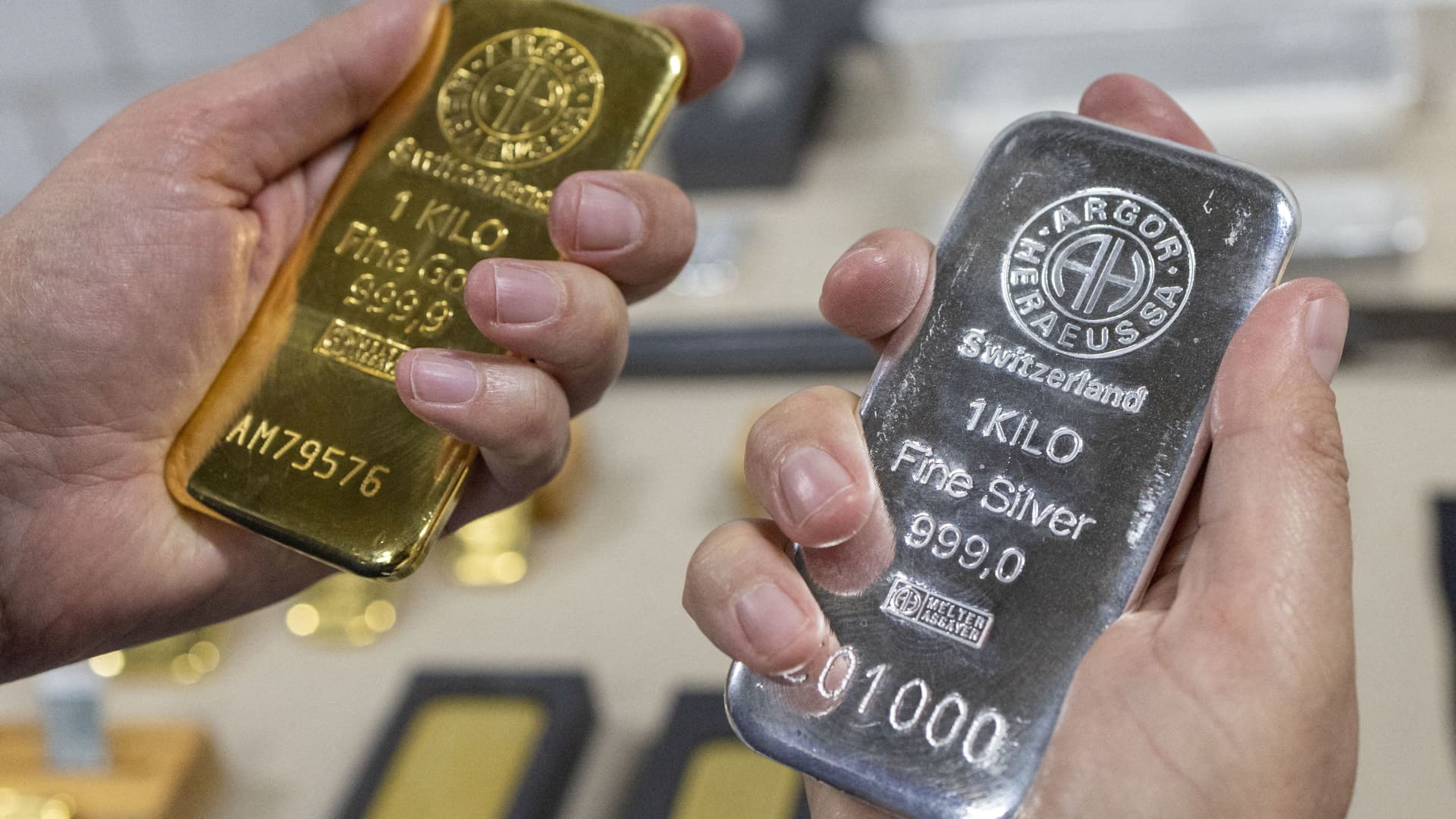
Robin Kolvenbach, CEO of Argor-Heraeus, holds a kilo of silver and gold bars at the plant of the Argor-Heraeus refinery and bullion manufacturer in Mendrisio, Switzerland, on July 13, 2022. Denis Balibouse | ReutersPrecious metals posted strong gains on Tuesday morning, while the value of the dollar fell, following the US midterm elections. Spot gold rose 2.97% to $4,044.90 an ounce at 4:32 a.m. ET, while spot silver jumped 4.27% to trade at $51.90 an ounce. Stock Chart Icon Stock Chart Icon Gold Spot Price First-month gold futures added 2.94% to trade at $4,056.40, while silver futures rose 4.54% to $52.01. Other metals posting notable gains Wednesday morning included platinum, which jumped 3.38% to trade at $1,463.95, and palladium, which rose 5.57% to $985.50 The moves came as vote counting continued in the midterm elections, with Democrats projected to have won control of the House and several governors’ offices to have also turned blue. U.S. stock futures fell across the board when the results came out, while Treasury yields also fell. Oil prices rose marginally, while the US dollar index lost about 0.3%. Rhona O’Connell, head of market analysis for EMEA and Asia at StoneX, said in a note on Tuesday that if Democrats were to gain dual control of Congress, gold should find support as rates and the dollar would likely come under pressure. He said this would lead to “fiscal brinkmanship and institutional frictions, both leading to uncertainty,” adding that “the Iran war and a weaker dollar would compete with [the] impact of [a] The Fed’s hawkish stance.” “Less fiscal stimulus argues for lower long-term yields and a weaker dollar, offset by debt limit premiums on bills and a Fed leaning toward another hike,” he said. Broader market volatility, but momentum has faltered this year, with inflation rising, bond yields rising and more aggressive central banks pulling support for metals. Gold is down more than 7% so far. “The challenge for precious metals is that geopolitical uncertainty does not automatically translate into safe-haven demand when investors are also worried about tight monetary policy,” he said. “They also face liquidation risk during sharp stock sell-offs, when investors sell profitable or liquid positions to raise cash.”