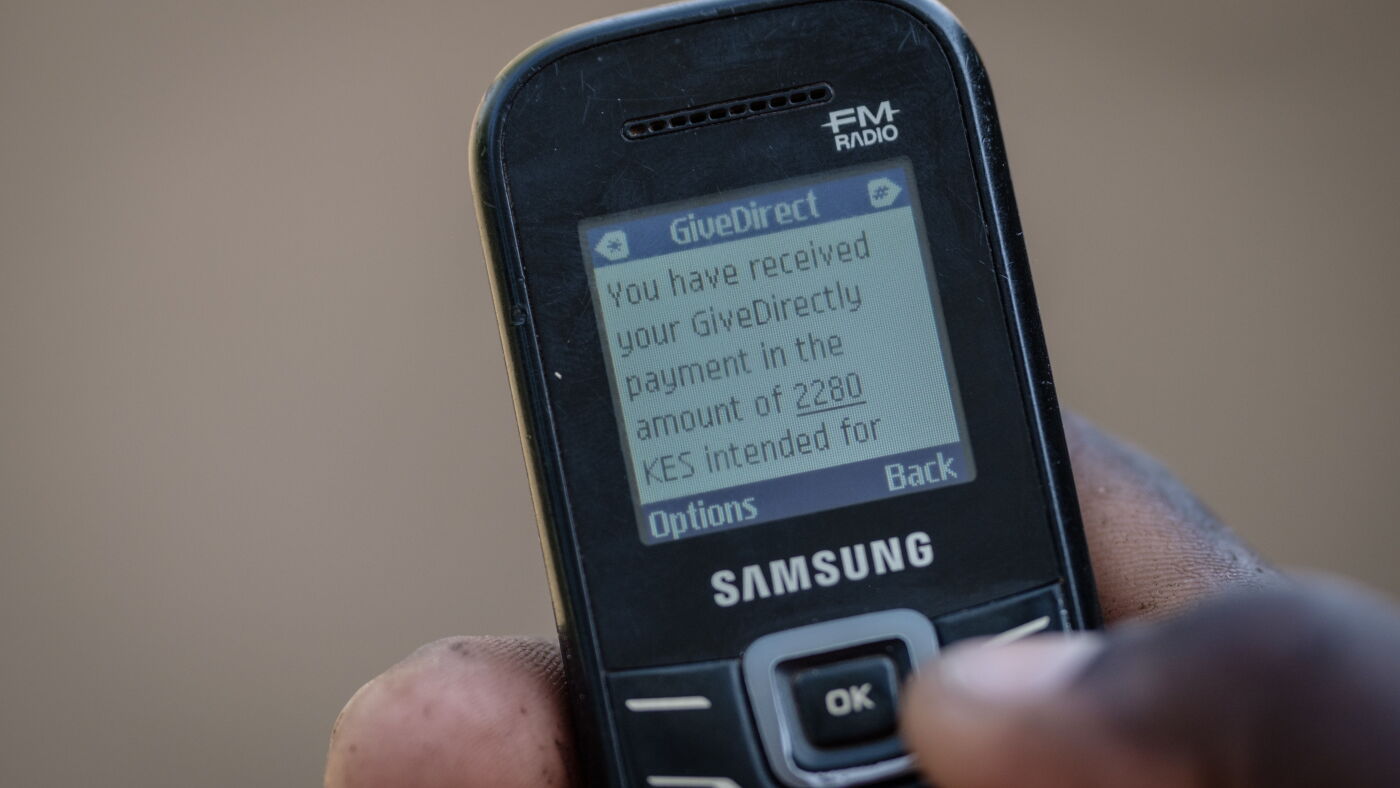
Cash transfers, intended to lift families out of poverty, are delivered via mobile phones. Yasuyoshi Chiba/AFP/via Getty Images hide caption toggle caption Yasuyoshi Chiba/AFP/via Getty Images Since the early 2000s, countries have tried to lift people out of poverty with a simple program: giving them cash. The idea is that a lump sum will help the poorest of the poor buy food, pay school fees, or start a business (such as raising livestock) to earn more money. Study after study has shown that these cash transfers are a reliable way to help families in extreme poverty build a source of income and meet their own basic needs. The West African nation of Liberia is one of the countries that has had success with cash transfers. The average amount the government gives to a needy household per year is $250, which is very significant. The money goes to a household member to manage for the entire family. And it is usually a woman. “One of our key design components is that we target women in the home,” says Aurelius Butler, Liberia’s national social protection coordinator. Liberia, which is among the 10 poorest countries in the world, has a high rate of gender inequality. Women face harassment and discrimination and lack opportunities in the workplace. In many families, the male head of the household typically controls the funds, Butler says, and may not give his partners the money to cover basic needs for themselves and their family, such as soap or food. By focusing on women in the cash aid program, Butler says the goal is to give them some financial control. Some men were not happy with that setup. “Many men reported feeling left out,” Butler says. A different kind of “cash transfer” So Liberia came up with a new approach. With funding from the World Bank, the Liberian government and the nonprofit GiveDirectly designed a new cash transfer experiment: giving both partners equal money and equal say over how to spend it. According to Sarika Gupta, a senior economist at the World Bank and one of the lead researchers on a study on this project, there were two goals: helping families generate more income and reducing domestic tension in a country where nearly 35% of women say they face intimate partner violence, higher than the global average of 27%. The results of the study were published in July. In 2022, more than 2,300 households in Maryland and Bomi counties in Liberia received $750 in four installments, more than double the amount typically awarded to a household in cash assistance programs, as both partners received an equal payment. To encourage partners to share decision-making, the researchers added an element of joint financial planning for half of those families. “The way joint financial planning works is that we sit down with the couple for about 45 minutes and ask them to detail their plan,” Butler says. “Is it to fix something inside the house? Is it maybe just to buy food, or is it to invest in education, planting or building a business?” Since the literacy rate in rural areas is low, the researchers also created posters for each family to document their plans. “It just had a photo of a happy family together, and then there were empty boxes for them to list their top four spending priorities for the cash transfer that was coming,” says Gupta. Couples also received a stack of stickers to indicate what they wanted if they couldn’t write things down: a stack of books meant education, a stethoscope and syringe meant medical care. “And the sign stays with the couple, and they can put it on the wall so they can see it. It’s like a constant reminder of what they’ve committed to,” says Gupta. Gupta and other researchers followed the households for a year after receiving the cash. The results showed that planning works. “Households that received planning were actually even better off financially than households that received just the cash transfer,” says Gupta. One of the participants is Christian, who only provided his name for the show. She works on a farm and her husband collects latex from trees to make rubber. In the joint planning session they agreed on spending priorities: education, food and home repairs. Christian used his cash to pay his five children’s school fees, buy rice and pay off debts. Her husband bought solar bulbs and cement to repair the leaking roof. There was another component to the study. The researchers looked at any past history of intimate partner violence in the participating couples, interviewed them before handing over the cash, and then checked in a year later to see if there had been any problems after receiving the cash. A surprising consequence The researchers were surprised by what they found. For most couples, no incidents were reported. But that wasn’t the case for couples who were determined to be at high risk for violence due to previous incidents. Although there was an increase in income from the cash transfer, there was also “an increase in intimate partner violence,” but only among those who had received the planning session, says Gupta. “It’s pretty clear that this is something to do with the change in which couples decide together [that led to the increase in violence]” says Amber Peterman, an impact evaluation specialist at UNICEF who was not involved in the research. The hypothesis Peterman and Gupta share is that conflict may have occurred if one of the partners deviated from a plan to which they both openly committed. “Any time one partner or another deviates from that plan, the other person can report them,” says Gupta. “And so there could be those kinds of disadvantages in planning,” especially in conflict-prone homes. Planning may also have changed the power dynamic from men to women, possibly spurring intimate partner violence, says Gupta: “This could happen directly, if planning gave women more say over how funds are spent, or indirectly, if planning triggered economic changes that gave women more power,” says Peterman. [of planning] He actually did a lot of good around the house. [financial] level, so I think the question is, how could it be modified?” he says. The researchers hope to do it again, provided they can get the funding, and with changes that could help avoid conflicts. For stories about life in our changing world, subscribe to NPR’s Global Health newsletter.