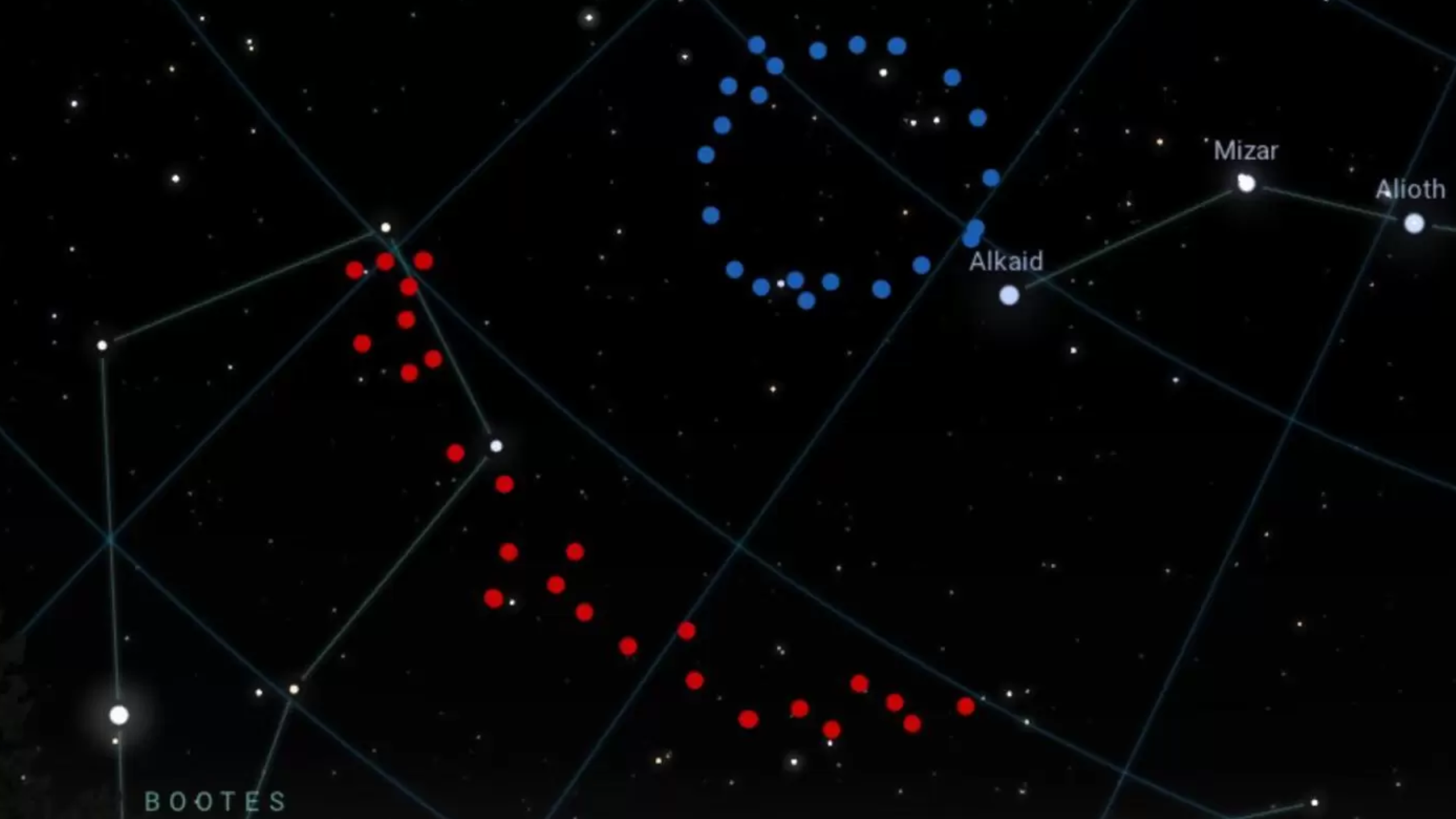
A massive structure detected in the distant Universe is challenging our understanding of how the Universe evolved. In 2024, astronomers found a giant, nearly perfect ring of galaxies about 1.3 billion light years in diameter. Yes, you read that right. BILLION light years. It does not match any known structure or formation mechanism. Astronomer Alexia Lopez of the University of Central Lancashire led the discovery, which was presented at the 243rd meeting of the American Astronomical Society in 2024 and published in the Journal of Cosmology and Astroparticle Physics. The signal was captured by light that has traveled for 6.9 billion years to reach us. it could mean that we need to modify the Standard Model of cosmology. The following video has a summary: It is the second giant structure discovered by López and his colleagues. The first, called the Giant Arch, is actually in the same part of the sky, the same distance from us. When the discovery of the arch was announced in 2021, it baffled astronomers. The Great Ring only deepens the mystery. The Great Ring (blue) and the Giant Arch (red). (University of Central Lancashire/Stellarium) “Neither of these two ultralarge structures is easy to explain in our current understanding of the Universe,” Lopez said in January 2024. “And their ultralarge sizes, distinctive shapes and cosmological proximity must surely tell us something important, but what exactly?” The most immediate link appears to be with something called Baryon Acoustic Oscillation (BAO). These are giant circular arrangements of galaxies found throughout space. BAOs are actually spheres, the fossils of acoustic waves that propagated through the early Universe and then froze when space became so diffuse that acoustic waves could no longer travel. The Great Ring is unlikely to be a BAO. All BAOs have a fixed size of about a billion light years in diameter. And close inspection of the Great Ring shows that it looks more like a corkscrew shape that is aligned in such a way that it looks like a ring. A galaxy graph, showing the Great Ring, approximately centered at 0 on the x-axis. (University of Central Lancashire) Which leaves the question unanswered: What the hell is it? And what does it mean for the cosmological principle, which states that, in all directions, any given portion of space should look more or less the same as all other areas of space? “We expect matter to be uniformly distributed everywhere in space when we view the Universe on a large scale, so there should be no noticeable irregularities above a certain size,” López explained. “Cosmologists estimate that the current theoretical size limit for the structures is 1.2 billion light years, however both structures are much larger: the Giant Arch is almost three times larger and the circumference of the Great Ring is comparable to the length of the Giant Arch.”But size is only one of the problems. The other is what it means for cosmology, the study of the evolution of the Universe. The current model fits better with what we observe, but some features are difficult to explain within its framework. “We didn’t think structures of this scale were possible.” – astronomer Alexia López Other models have been proposed to address these characteristics. According to one such model, Roger Penrose’s conformal cyclic cosmology, in which the Universe goes through endless Big Bang expansion cycles, ring structures are expected. However, it is worth noting that conformal cyclic cosmology has its own important problems. frameborder=”0″ enable=”accelerometer; autoplay; writing on clipboard; encrypted media; gyroscope; picture in picture; web-share” referrerpolicy=”strict-origin-when-cross-origin” enablefullscreen> Another possibility is that the structures are a type of topological defect in the fabric of space-time known as cosmic strings. They are thought to be like proton wrinkles that arose in the early Universe when space-time was stretched and then frozen in place. We haven’t found much physical evidence for cosmic strings, but the theoretical evidence is quite promising. For the “At the moment, no one knows for sure what the Great Ring and the Giant Arc might just be random arrangements of galaxies spinning across the sky, although the likelihood of that happening seems pretty small. The findings are reported in the Journal of Cosmology and Astroparticle Physics. This article was fact-checked by Rebecca Dyer and edited by Rebecca Dyer. While we take pride in our process, we are only human. If you spot an error, please let us know.