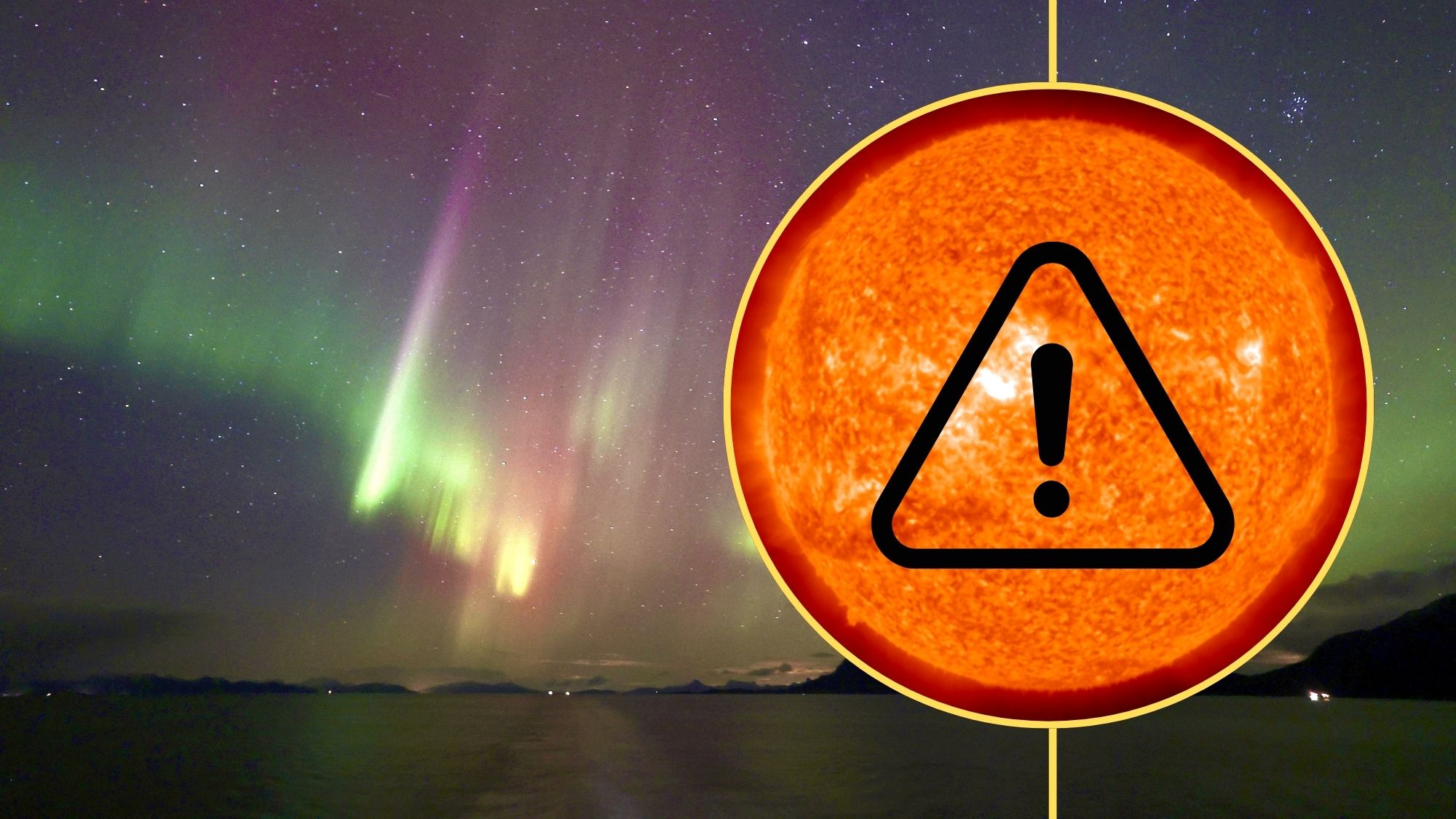
The Sun unleashed a powerful flare early on October 6, launching a coronal mass ejection (CME) toward Earth, and could give a boost to the northern lights later this week. NOAA’s Space Weather Prediction Center (SWPC) has issued a moderate geomagnetic storm (G2) watch for October 9, when the CME is expected to reach Earth. The eruption accompanied a class M1.4 solar flare originating from sunspot region AR4549, which is currently located near the center of the Earth-facing side of the sun. Forecasters at the Solar Influence Data Analysis Center (SIDC) in Belgium estimate that the CME is traveling at around 560 km/s. Current models place the arrival of the CME in the early hours of October 9 (UTC), although there is still uncertainty about the exact timing. You might like The UK Met Office is currently predicting an arrival around midnight EDT (0400 GMT), give or take 6 hours. So don’t set the alarm just yet: CME arrival forecasts can change by several hours as the eruption approaches. NOAA’s WSA-ENLIL model shows the October 6 CME propagating through the solar system toward Earth. The model indicates that the leading edge could reach Earth around 05:00 UTC (1 am EDT) on October 9. (Image credit: NOAA SWPC) Space weather forecasters are busy analyzing coronagraph observations and models to determine the CME’s trajectory and velocity, and updating its possible time of arrival on Earth. Then we’ll have a much better idea of what this eruption could mean for the northern lights. If a substantial part of the CME heads toward Earth, it could trigger a geomagnetic storm and send auroras to lower latitudes than usual. How impressive the display could be will also largely depend on the magnetic orientation of the CME when it reaches Earth. What could this mean for the northern lights? Solar flare M1.4 eruption from sunspot region AR4549 on October 6, 2026. (Image credit: NOAA Space Weather Prediction Center/GOES-19) NOAA SWPC currently expects minor (G1) to moderate (G2) geomagnetic storm conditions on October 9, with a G2 Watch now in effect. What to read next Geomagnetic storms are classified on a scale of 1 to 5, from G1 (minor) to G5 (extreme). G2 conditions correspond to Kp 6, and auroras have previously been seen as far south as New York and Idaho during storms of this strength. G1 (minor) to G2 (moderate) geomagnetic storms are likely to occur on October 9 with the arrival of a CME associated with an M1.4 flare from Active Region 4549 on October 6. (Image credit: NOAA Space Weather Prediction Center) This doesn’t mean the Northern Lights are guaranteed to reach these states, nor does it mean they won’t spread further south. The extent of the show will depend on how the incoming CME interacts with Earth’s magnetic field. Even a CME aimed at Earth does not guarantee an impressive geomagnetic storm and subsequent aurora shows. Much will depend on the strength and orientation of the magnetic field carried by the CME when it reaches Earth, particularly whether it has a southward component that can efficiently couple with Earth’s magnetosphere. For now, aurora hunters should closely monitor the forecasts for October 9. When might the northern lights be visible? NOAA’s latest 3-day forecast shows: G1 conditions between 11 pm and 2 am EDT on October 8-9 (03:00-06:00 GMT) Possible G2 peak between 5 am and 8 am EDT (0900 and 1200 GMT) on October 9. These times are estimates and could change as the CME approaches. Aurora forecast for the Northern Hemisphere, courtesy of the UK Met Office. More solar activity could be on the way. After the eruption we are currently following closely. Two prominent sunspot regions, AR4549 and AR4545, are currently facing Earth and have shown increasing flare activity. Any additional eruptions from these regions over the next few days could affect Earth. Meanwhile, coronal holes spinning along the Earth-facing side of the Sun are expected to send more streams of fast solar wind in our direction, and another enhanced period of geomagnetic activity is forecast around October 11. In other words, make sure the camera batteries are charged, the aurora alerts are on, and the coffee pot is full. Editor’s note: This story was updated at 4 a.m. EDT (0800 GMT) on Oct. 7 to include NOAA’s space weather forecast Center’s G2 Geomagnetic Storm Warning (Moderate) for Oct. 9. We will continue to update this story as new forecasts become available.