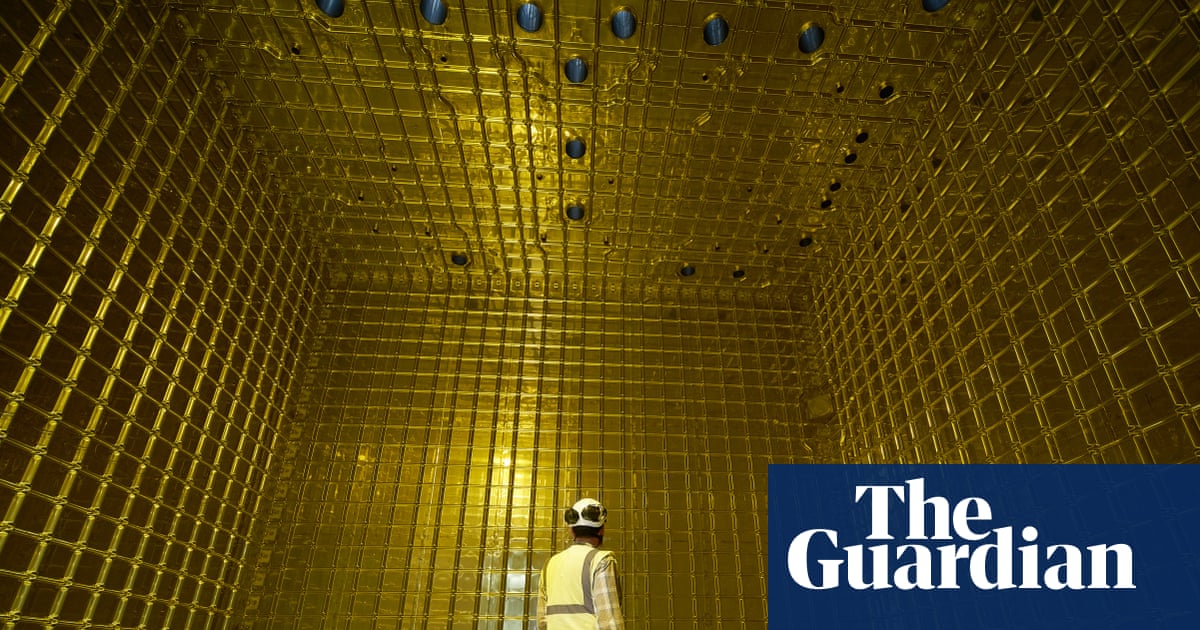
For more than a century, the mining town of Lead in the Black Hills of South Dakota attracted workers with a taste for gold. Now, a landmark experiment being built at the former mine is attracting scientists in search of more intriguing riches: answers to the deepest mysteries of the universe. Construction of the Deep Underground Neutrino Experiment (Dune) at the former Homestake mine will begin Monday. Engineers will begin assembling four giant detectors inside caverns carved into rocks a mile underground. Once turned on, the detectors will spark and blink silently as ghostly particles called neutrinos pass through them. Some will arrive from the sun and distant supernovae, others in an intense beam sent through 800 miles (1,300 km) of rock from a government laboratory near Chicago, Illinois. Project members visit the old mine, where construction will soon begin. Photo: Landin Burke, Destyn Humann/FermilabObserving neutrinos could uncover entirely new science and shed light on cosmic spectacles such as the death of stars and the birth of black holes. Scientists are particularly hoping to solve one of nature’s most enduring puzzles: why everything around us is made of matter and not its “evil twin,” antimatter. In other words, why we, and why anything, is here. Dune graphic “It’s a super exciting time to be working on this,” said Dr. Kate Shaw, experimental particle physicist on Dune at the University of Sussex. “Neutrinos still don’t make sense and could open a door to new physics.” Neutrinos are the most abundant particles of matter in the universe, outnumbered only by photons, the massless particles of light that illuminate the universe. They occur in natural nuclear reactions, such as those that power the Sun, in radioactive decay, and in particle accelerators. Even by physicists’ standards, neutrinos are weirdos. Uncharged particles barely interact with other matter: about a trillion pass unnoticed through your body every second. Neutrinos come in three varieties, all with tiny but different masses. Interestingly, they change from one variety to another, a process called oscillation, as they travel. “It’s very strange behavior,” Shaw said. “It’s like I throw an apple at you and it turns into a banana.” Lead has a history with these peculiar particles. In the 1960s, physicist Ray Davis followed miners down the shaft and built a detector with a 100,000-gallon tank filled with dry cleaning fluid. Protected so deep underground, the detector became the first to record neutrinos from the sun when they collided with chlorine atoms in the fluid and converted them to argon. The mine closed in 2001 and was transformed, through visionary foresight, into a dedicated underground laboratory, the Sanford Underground Research Facility (Surf). It is already home to the Lux-Zeplin (LZ) experiment, which last month reported the first potential detection of dark matter. The main detector of the Lux-Zeplin dark matter experiment in a surface laboratory before its installation underground. Photograph: Matthew Kapust/Sanford Underground Research Facility/Reuters “We’ve gone from mining the Earth to helping scientists explore the universe,” said Lead city manager Robin Lucero, whose family has lived locally for generations. “We are incredibly proud and lucky that Dune is happening here, and Surf, which has other experiments like LZ. Having world-class science brings new opportunities, new people and new possibilities for our local businesses and especially our young people.” Unlike Davis’ device, Dune’s experiment is huge. Made from more than 4,000 tonnes of steel, the detectors will be up to five stories high and contain a total of 70,000 tonnes of liquid argon that must be cooled to -200°C. Assembly of the detectors should take almost three years. Fill them with liquid argon, another year. “This is a high-performance engineering operation” and a partnership with skilled local workforce, said Professor David Newbold, of the UK Science and Technology Facilities Council and a spokesman for Dune. “It’s like building a ship underground.” The UK is the largest international partner in the US-led experiment and is manufacturing core detector components, critical computing for reconstructing events in the detectors and the graphite target needed to generate neutrinos at Femilab, a particle physics facility in Illinois. The LBNF-Dune underground site. Photo: Landin Burke, Destyn Humann/FermilabOnce operational, Dune will study an intense beam of neutrinos sent from Fermilab through 800 miles of Earth’s crust and mantle. Most neutrinos shoot straight, but every now and then one hits an argon atom, creating a flash of light and a pulse of electrical charge. Their analysis will reveal intimate details about the mysterious particles. A big question surrounds the masses of different neutrinos. Which is lighter and which is heavier? The answer could reveal new fundamental forces of nature. And in an attempt to answer the matter versus antimatter question, Dune will look for subtle differences between neutrinos and their antimatter twins, antineutrinos. Beyond the particle beams sent from Fermilab, Dune will also study neutrinos arriving from space, carrying with it new information about stellar explosions and the formation of black holes. High energy neutrinos from deep space. But detection is far from the end of the story. “This really is going to be a golden era,” Newbold said. “There’s a lot more of that to come.”