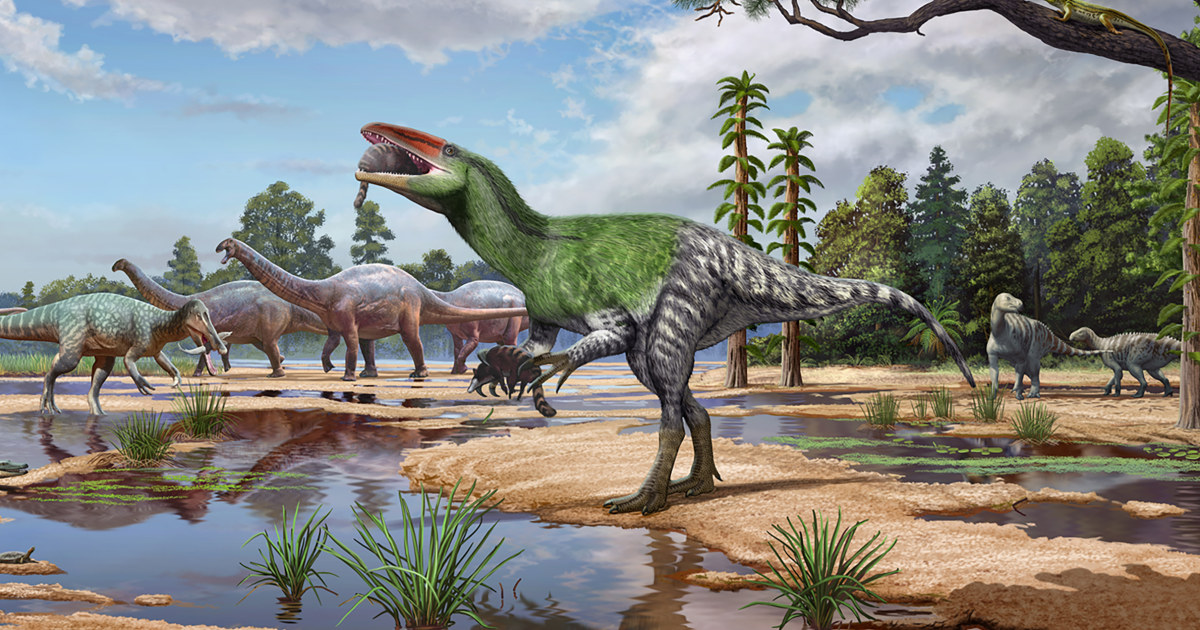
The partial skull of a tiger-sized predator that roamed what is now the Isle of Wight off the southern coast of England about 120 million years ago is giving scientists a better understanding of an enigmatic group of carnivorous dinosaurs known for chasing down prey and tearing it apart with enormous claws. The researchers said the fossil belongs to a species they called Invictibellatrix amberina, one of the first members of the lineage of carnivorous dinosaurs from the Cretaceous period called megaraptorans. Invictibellatrix contributes to the knowledge of skull anatomy among early megaraptors and, being the first known in Europe, helps show how the group spread around the world. Invictibellatrix is one of the smallest megaraptors. Based on fossils of closely related megaraptors, researchers estimated that Invictibellatrix was about 16 feet long and the weight of a large tiger. Its body may have been covered in filament-like feathers, they said. Megaraptorans were part of a group called theropods that includes all carnivorous dinosaurs. “Megaraptorans are very unique among theropods because they have relatively small and thin heads, but they had long, strong arms with huge claws, as well as very light skeletons,” said Cassius Morrison, a postdoctoral researcher at the University of Leeds in England and lead author of the study. study published in the journal Royal Society Open Science. “These characteristics imply that megaraptorans were agile hunters capable of chasing prey and using their large arms and claws to catch and disembowel them using their claws,” Morrison said. The largest known megaraptoran, named Maip, was about 33 feet long and inhabited Patagonia during the twilight of the age of dinosaurs, about 50 million years after Invictibellatrix lived. Megaraptors such as Invictibellatrix may have hunted smaller prey such as mammals, smaller reptiles, and baby dinosaurs. The largest megaraptorans may have targeted larger herbivorous dinosaurs, such as duck-billed hadrosaurs and long-necked sauropods, although probably not the largest ones. Megaraptorans hunted in the opposite way to massive predators like Tyrannosaurus rex. Tyrannosaurus used its large, robust head, enormous teeth, and incredible bite force to kill its prey, but it had weak arms of little use in hunting. Invictibellatrix was not the main predator on the Isle of Wight, with larger theropods around, along with several herbivorous dinosaurs, and may have played a role similar to that of a modern-day hyena. There is debate among dinosaur paleontologists about where megaraptorans fit on the theropod family tree. Despite differences in how they were built and hunted, one hypothesis is that megaraptors were closely related to tyrannosaurs, the group that included Tyrannosaurus and others that dominated the landscapes of North America and Asia later in the Cretaceous. Invictibellatrix means “undefeated warrior.” Morrison noted that after humble beginnings, megaraptors became apex predators in South America, Australia and Antarctica, becoming “the ruling queens,” while tyrannosaurs became “tyrant kings” in North America and Asia. Scientists are trying to unravel the evolutionary history of megaraptors. One leading hypothesis is that megaraptors originated in Asia before migrating through Europe to Africa and then South America, thriving until the dinosaurs were doomed by an asteroid impact 66 million years ago. This hypothesis lacked fossil evidence because megaraptors had not been known in Europe until now. “These findings help uncover the evolution of one of the most mysterious groups of theropods,” said Charlie Scherer, a PhD student and co-author of the study from University College London. The Invictibellatrix fossil, a fragmented brain box, was discovered about a century ago and acquired by the Natural History Museum in London in 1924. “Since then, it sat in one of the drawers in the collection and no one noticed. ‘Until a couple of years ago,’ Scherer said. While Tyrannosaurus may be more imposing than Invictibellatrix, researchers noted that if a person were somehow transported back in time, as in the recent film “The End of Oak Street”, Invictibellatrix could present a greater danger. “A smaller theropod like Invictibellatrix would probably have been a much bigger threat to a human than something like T. rex because we would probably be too small for T. rex “But we would be the perfect size for something smaller like Invictibellatrix, as we weigh about a third to a quarter of its weight, which would make us a nice filling meal and more than just a snack. Additionally, Invictibellatrix would have the agility and maneuverability to chase and catch a human.”