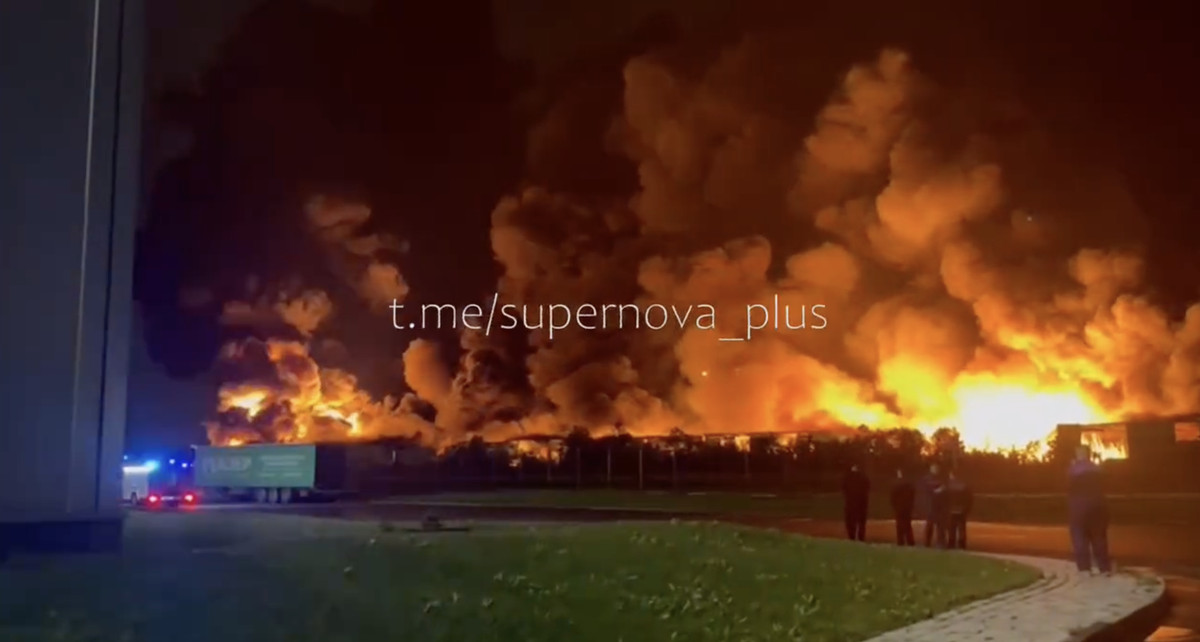
Massive fires broke out at two major Russian logistics and industrial facilities early Sunday, August 23, including a drone attack on a logistics center belonging to e-commerce giant Ozon. In the city of Orenburg, a drone attack targeted the “Orenbuzhye” special economic zone. Mayor Albert Yumadilov stated that several unmanned aerial vehicles (UAVs) were intercepted over the industrial zone, but falling debris caused a fire at the Ozon logistics complex. JOIN US ON TELEGRAM Follow our war coverage at @Kyivpost_official. Russia’s Emergency Situations Ministry reportedly extinguished the fire shortly after. According to the Astra Telegram channel, after the strike, Ozon management announced the evacuation of more than 300 employees from the logistics center. The company temporarily suspended all warehouse deliveries and concealed products stored in its market store premises. The Orenburg Ozon center represents a significant investment for the company. The first phase of the complex, covering 40,000 square meters (430,556 square feet), opened in August 2024 following investments exceeding 4 billion rubles ($43 million). An expansion planned for spring 2025 aimed to double its size, allowing the facility to store more than 31 million products and process up to 915,000 orders daily. At the same time, a large fire broke out in Kolpino, a suburb of St. Petersburg, on the Izhora industrial estate. The fire destroyed a “Logistera” warehouse. Russian EMERCOM assigned the fire a level 4 complexity rating, reporting that the affected area spanned 82,000 square meters (882,640 square feet). Other topics of interest Give me shelter! Serhiy Kolyada’s ironic view of the latest international events. The Izhora industrial zone is a major center for Russian heavy industry, housing metallurgical, metallurgical and heavy machinery companies, as well as production facilities linked to the energy and nuclear sectors. While local authorities in St. Petersburg did not declare any drone or missile threats overnight, OSINT analysts from the Astra Telegram channel noted that the burning warehouse was located just 350 meters from another Ozon warehouse. Previous attacks on Russian military and logistics facilities The fires in Orenburg and St. Petersburg follow a coordinated wave of attacks on Russian military and logistics infrastructure the previous day. On August 22, drones attacked the Novokuibyshevsk oil refinery in the Samara region, causing a fire at the Rosneft facility, which processes approximately 8.8 million tons of oil per year. At the same time, reports indicated another strike at a 75,000-square-meter (807,293-square-foot) Ozon logistics center in Samara. In the Krasnodar region, drone attacks targeted the Yeysk seaport, where independent media reported visible smoke and a possible ship fire. The extension of strikes to Ozon facilities follows a sustained month-long campaign in Ukraine targeting the logistics infrastructure of its main competitor, Wildberries. Since mid-July, at least 22 Wildberries warehouses have been affected, representing the loss of around 43% of the company’s total storage capacity and an estimated $918 million in assets destroyed in a single attack in Koledino on August 16. In addition to attacks on commercial logistics, Ukraine continues to attack Russian military aviation and drone infrastructure. President Volodymyr Zelensky confirmed on August 22 that Ukrainian forces destroyed a Russian Su-24M aircraft and four pieces of aviation equipment at the Saky airfield in occupied Crimea. It also verified that the Ukrainian strikes successfully took out drone relay stations in Russia’s Bryansk region, which Russian forces had used to guide unmanned aerial vehicles into Ukrainian territory. Additionally, the General Staff of the Armed Forces of Ukraine published confirmed damage assessments of an August 20 attack on the Primorsko-Akhtarsk airfield in Russia’s Krasnodar region, verifying the destruction of a Russian “Niobi” radar station and 18 warehouses used to store unmanned aerial vehicles.