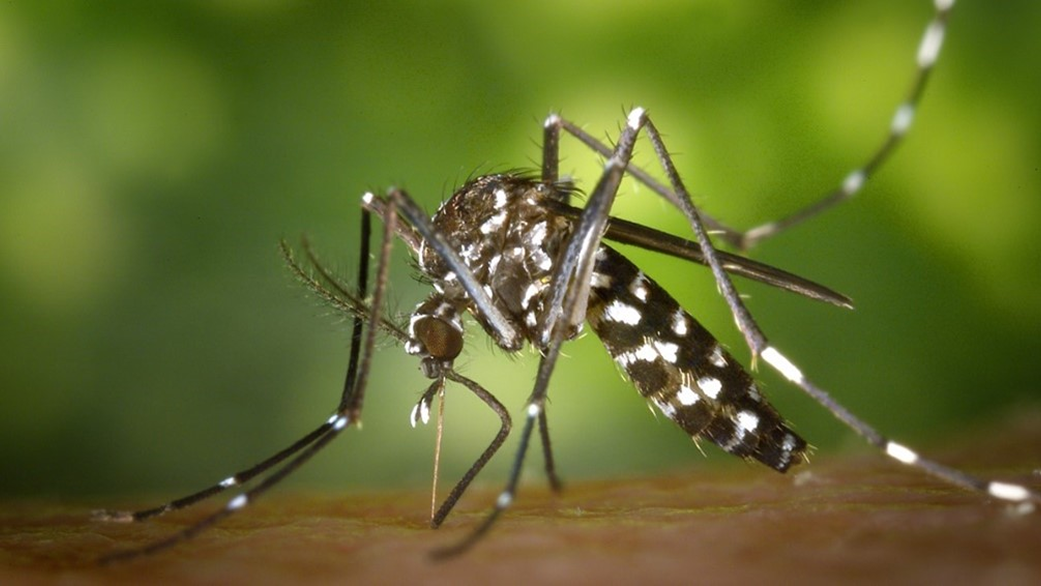
CHICAGO — Chicagoans have reported more mosquito bites this summer, and experts say a growing invasive species of the pest coupled with a summer of heavy rainfall are to blame.
The invasive Asian Tiger mosquito, or Aedes albopictus, has been spreading across the Chicago area over the past few years, experts say. They’ve become a nuisance in the city for their more painful bite. And unlike most mosquitoes, which are active at dusk or night, the Asian Tiger mosquito is a daytime feeder, biting ankles, legs and elbows primarily during the early morning and late afternoon.
“A growing concern we’ve seen over the past five years now is an increase of an invasive species of mosquitoes that specifically likes to feed on humans and during the daytime,” said Loyola University Chicago Public Health ciences Professor Justin Harbison, who is also a scientific advisor for a Cook County mosquito abatement district. “It’s a very voracious biter, and that one for sure does very well around people’s properties.”
Count of Asian Tiger mosquitoes in Cook County in 2019. Credit: Northwest Mosquito Abatement District
Count of Asian Tiger Mosquitoes in Cook County in 2025. Credit: Northwest Mosquito Abatement District
The Asian Tiger mosquito can breed in just a teaspoon of water, but it’s had much more than that to work with as Chicago has seen higher-than-average rainfall this summer. Midway Airport reported more than 20 inches of rainfall between June 1 and early August, while the Southwest Side airport typically sees about 13 inches of rain from June to late August.
Becky Smith, a professor of epidemiology at the University of Illinois at Urbana-Champaign, said the heavy rainfall has made the mosquitoes’ breeding easier by leaving more pockets of standing water — which the pests need to breed or lay eggs — in spaces that are normally dry. As an example, Smith said a colleague’s student found Asian Tiger mosquito larvae in a “very tiny” amount of water between the ridges of a plastic downspout extender.
Between the summer’s heavy rainfall events, seemingly innocuous places like birdbaths or saucers under potted plants can be breeding hotspots for the invasive mosquitoes, Harbison said.
“Certainly with these standing waters throughout Chicagoland, it’s definitely reasonable to think that there’s going to be places that are going to have higher numbers of mosquitoes,” Harbison said.
An Asian Tiger mosquito is identifiable by its jet-black body with a white stripe across the middle of its back. It’s been in the United States since 1985, brought in tire casings imported for recapping. The transport of tire casings has spread the insect to more than 20 states since.
Some good news: The primary concern they raise is annoyance, instead of disease spread, Harbison and Smith said. Asian Tiger mosquitoes are capable of transmitting yellow fever, dengue, Zika virus and chikungunya, none of which are present in Illinois.
“They’re more of a nuisance mosquito than a vector mosquito,” Smith said. “We’re very lucky on that, that we don’t have to worry about those viruses because that would be a serious concern with all the rainfall right now if we did have them.”
Harbison said there is some evidence that Asian Tiger mosquitoes may transmit West Nile virus, but they don’t seem to be near the capacity of other mosquito species, like Culex mosquitoes, Chicago’s most common mosquito that thrives in storm sewers. Public health officials are monitoring the mosquitoes and disease transmission, Harbison said.
How To Reduce Their Spread
Harbison said Chicagoans should look around their properties to drain, dump and get rid of standing water on a regular basis to reduce the chance of the Asian Tiger mosquitoes bothering themselves and their neighbors. Chicagoans can also report standing water to the city’s 311 system.
He said residents should protect their skin from bites by using insect repellents that are registered by the Environmental Protection Agency. Those have a graphic showing which insects they repel and for how long, he said.
Harbison added that mosquitoes aren’t very strong flyers, so putting on a box fan while sitting outside can also help keep the pests away.