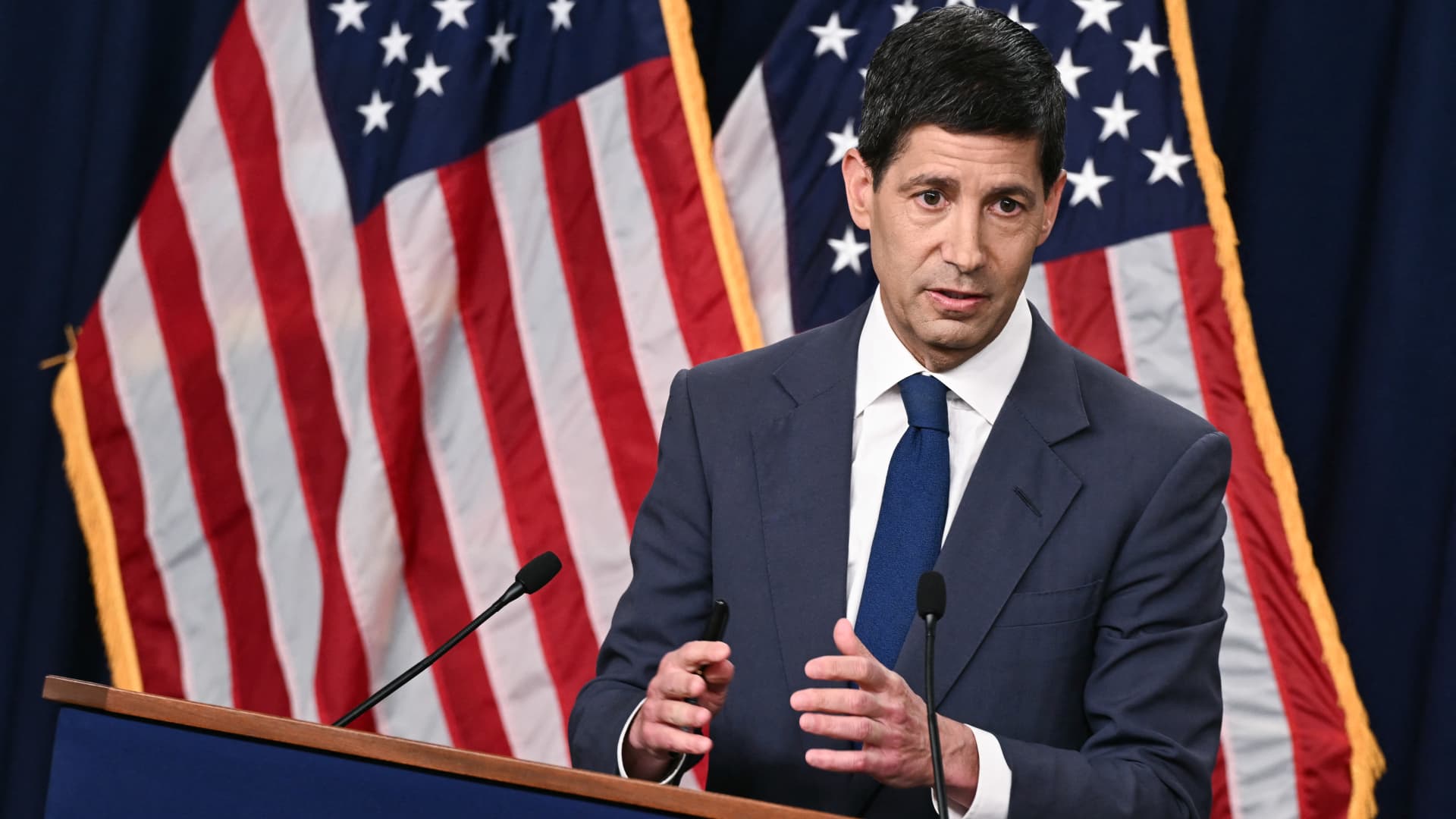
Federal Reserve Chairman Kevin Warsh expressed concern Friday about high inflation and hinted that interest rates may need to rise if more progress is not made to ease price pressures. Warsh’s comments, closely watched at the Federal Reserve’s annual symposium in Jackson Hole, Wyoming, avoided committing to forward guidance (or verbal signals about the Fed’s intentions) or the reaction function, the economic signals that would justify an adjustment in rates. However, he acknowledged that inflation is skyrocketing and said: “while this summer [inflation] “The readings were better than expected, they don’t tell me that the underlying trends have improved significantly.” “We must be sure that core inflation is moving towards our target, clearly and at sufficient speed. Otherwise, we have work to do. That is our job, our mandate and our obligation to sustain ourselves,” he added. Stock indexes rose after digesting the speech, delivered at 10 a.m. ET, while Treasury yields rose substantially. The policy-sensitive 2-year bond soared nearly 8 basis points, or 0.08 percentage point, to 4.31%, its highest level since late July. Read Kevin Warsh’s full speech at Jackson HoleTraders also raised the probability of a rate hike at the September policy meeting to 55.7%, or about 20 percentage points higher than a day ago, according to CME Group’s FedWatch. Warsh “opened the door to a Fed rate hike. There probably won’t be a hike in September, but there will be in October or December,” said Heather Long, chief economist at Navy Federal Credit Union. “Warsh explicitly said that this summer’s encouraging inflation readings do not indicate a ‘significant’ improvement in inflation. Bond markets reacted quickly by pricing in an increase.” Warsh noted that “market prices show confidence that we will achieve price stability. And I can assure you that they are right.” Aside from concerns about inflation, which he said should be the Fed’s main focus, Warsh largely expressed confidence in the economy, which he said “appears to have strengthened.” As he has previously, the president cited the benefits of artificial intelligence and said business and consumer spending has held up well. Although he acknowledged a slowdown in hiring, he attributed it to a flattening of the labor supply. Warsh also used the speech to outline his philosophy on policymaking, carefully avoiding any signposting. about what he believes needs to be done to achieve the Fed’s dual mandate of low inflation and full employment. “Today I am here committed to a discipline, not a decision,” Warsh said in prepared remarks to a group that includes his policymaking colleagues on the Federal Open Market Committee, as well as economists and members of the media. At the beginning of the speech, titled “In Our Time,” he joked, “You can call it an outline, you can call it a road map, but don’t call it future guidance,” a practice he said has “overstayed its welcome.” However, the broader message was to seek a change in approach to how the Federal Reserve views its role with the market and the public. It’s his 100th day in office: He’s started five working groups to look at a variety of Fed functions. An overarching theme has been making markets not dependent on every word that comes from policymakers. He called for a “calmer Fed, more decisive in its communications.” And our tools are powerful. We determine the path of short-term interest rates. And market participants will always try to anticipate what we will do next,” he said. “But we should not allow ourselves a regime in which market participants are primarily looking to the Federal Reserve for their next trades.” lack of future guidance, they have sought to have Warsh at least provide a reaction function on what would trigger a policy response. Even in that sense, he was reluctant to commit. “What if the new Fed chief commits, at the very least, to playing an explicit reaction function? Surely he should tell us the path of his interest rate, if, for example, the data were cold or hot,” he said, apparently acknowledging the criticism. He specifically asked if the Federal Reserve should provide a specific rule it would follow. However, Warsh stated that “our knowledge simply does not extend that far, at least not yet, and the factors most relevant to the proper conduct of monetary policy change over time.” “We will do this knowing that accuracy in economic forecasts remains only an aspiration. With so much rapid change in geopolitics, global supply chains and technology, it is prudent to be modest about what we can and cannot know,” he said. CNBC as your preferred source on Google and never miss a moment from the most trusted name in business news.