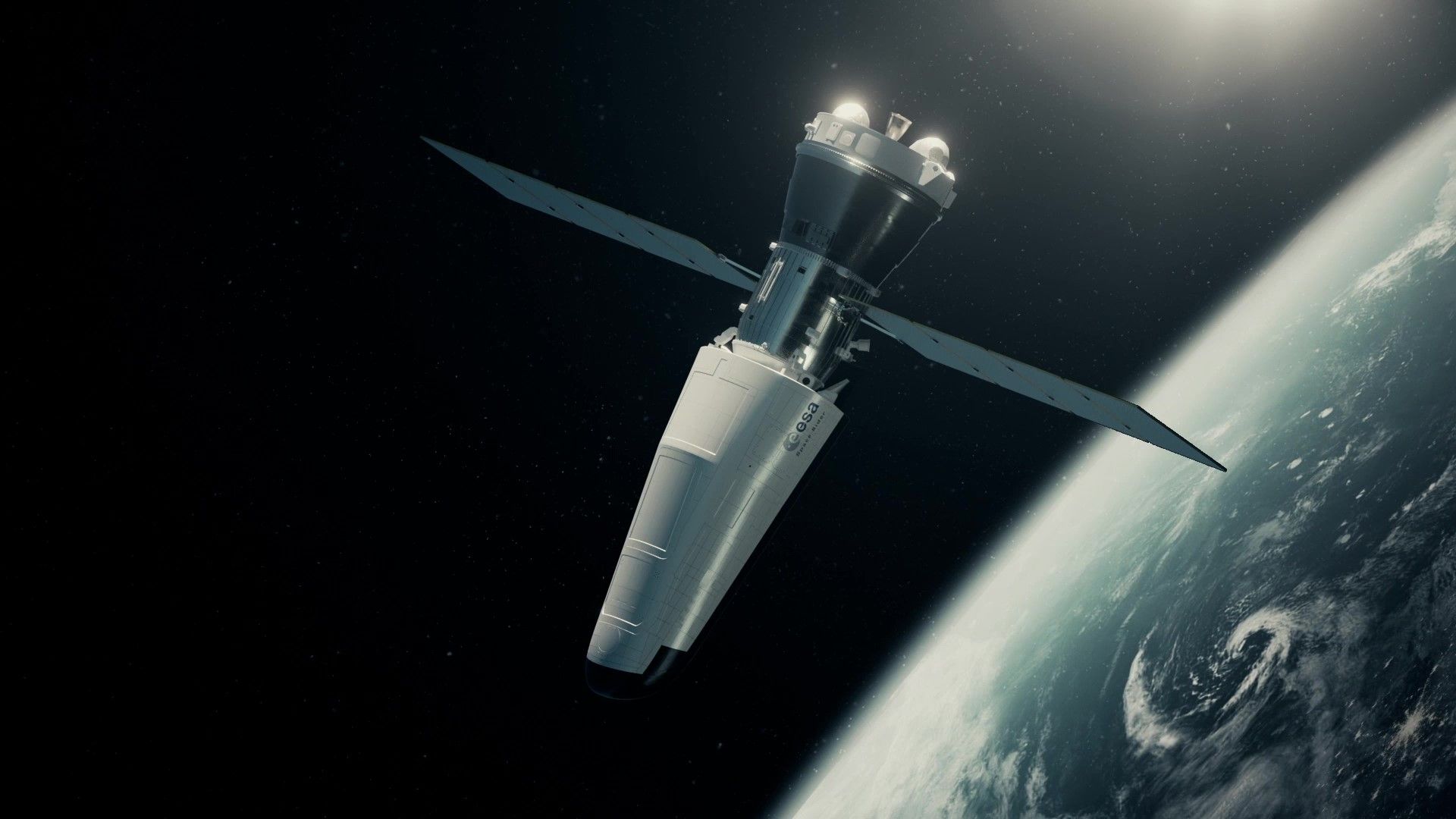
Follow us Add us as a preferred source on Google Newsletter Subscribe to our newsletter Europe has launched the prototype of its first reusable spacecraft. Or, rather, the prototype itself was dropped (on purpose), but the result of its fall was not what the engineers expected. The incident occurred during a drop test on October 6 of the European Space Agency’s (ESA) full-scale model Space Rider. The robotic vehicle’s initial parachute deployed successfully, but its main parachute detached during deployment, leaving the prototype unable to slow its descent before crashing to the ground, according to ESA officials. The cause of the failure remains under investigation. “Following several successful tests using representative vehicle masses, the final system-level drop test in October was not completed as planned due to an anomaly during the parafoil deployment sequence,” an ESA spokesperson confirmed in an email to Space.com. “An independent investigation is underway to determine its root cause and inform next steps.” Space Rider is being developed as Europe’s first reusable orbital spacecraft: an unmanned vehicle designed to carry scientific experiments into orbit for up to two months and then return them to Earth for analysis. However, its return method differs from that of any other spacecraft in operation today. Space Rider’s wingless lifting body design relies on a steerable parachute, or parafoil, to maneuver toward its landing area. This allows it to perform runway-style landings, unlike other less precise parachute-assisted recoveries in current practice. This month’s drop test was intended to demonstrate that capability, which is a critical requirement for Space Rider’s planned reusability after in-orbit missions, but the impact of its failure may not end up disrupting its final development schedule. According to Géraldine Naja, ESA’s director of space transportation, the vehicle’s other pending qualification tests do not prevent its launch. “We hope that this test will not damage, or let’s say lead us to modify, the remaining schedule and qualification activities,” Naja said during an ESA Council press conference on October 22. “In any case, the remaining qualification activities are not on the critical path of Space Rider development.” Naja described the incident as an unfortunate but important event. “We have done many successful tests before, but testing and validation are part of developing a space system,” he said. The missing vehicle was a full-scale test model assembled to evaluate Space Rider’s descent and landing systems. The minivan-sized mockup replicated the size and flight characteristics of its reentry module, with avionics to control its autonomous guidance and navigation systems, but the vehicle was far from a space-ready item. Render of the ESA Space Rider orbiter. (Image credit: European Space Agency) The Oct. 6 test took place at a military field on the Italian island of Sardinia, where the mockup was launched from a helicopter to an altitude of about 2 miles (3 kilometers). According to Naja, the vehicle’s initial parachute activated as expected and began to slow the Space Rider mockup’s descent before its larger, steerable parachute deployed. However, the parafoil detached during deployment, leaving the vehicle in free fall before impacting the ground. Subsequently, ESA recovered all of the ship’s components. This month’s event was the first drop test since a failed attempt in May, when a sensor detected a problem during preparations, leading engineers to cancel the test before the model was launched. After that, the Space Rider test range, operated by the Italian Ministry of Defense, was unavailable from June to September. Space Rider’s descent and landing qualification campaign began in 2025, with previous successes demonstrating its parafoil deployment and autonomous capabilities. Beyond its landing systems, Space Rider also underwent separate thermal protection testing earlier this year, exposing its thermal protection materials to temperatures of around 2,900 degrees Fahrenheit (1,600 degrees Celsius) in plasma wind tunnel tests. ESA is targeting Space Rider’s first orbital mission for the end of this decade.