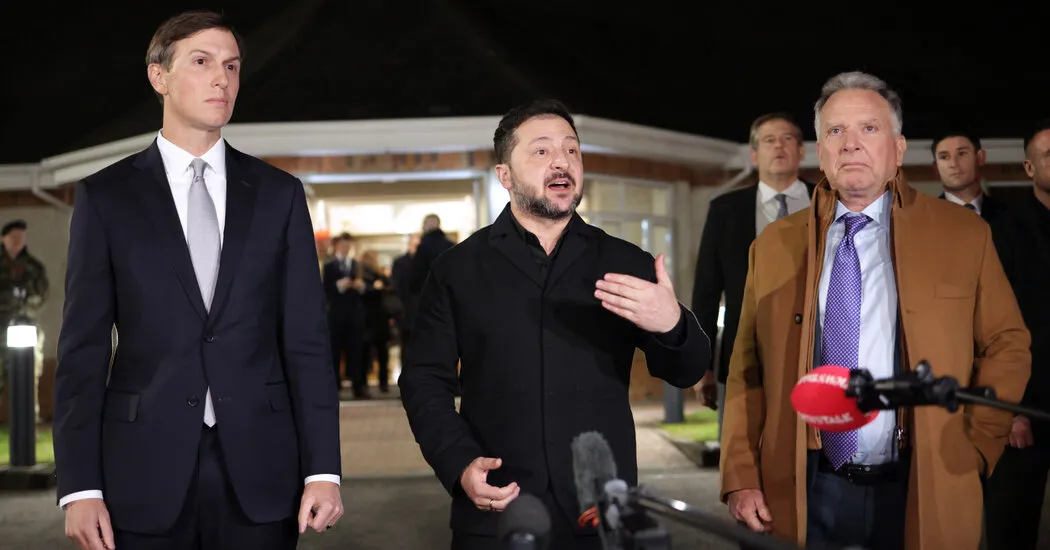
European leaders have waited for months on the sidelines of negotiations to end Russia’s war in Ukraine, looking for a seat at the table. Now they finally hope to get one, and they don’t know who should sit in it. “If Europe could identify one person to speak on its behalf, it would be a greater achievement than getting the Russians to include them in the negotiation,” Jared Kushner, President Trump’s son-in-law and one of his two envoys, said Thursday. Kushner’s inquiry reflected a harsh (and, for Europe, potentially embarrassing) reality that internal divisions could cost European officials time and influence. Kushner and fellow American negotiator Steve Witkoff pushed this week to add the Europeans to the talks after Russia insisted during discussions in the United Arab Emirates that postwar security in Europe be a negotiating topic. Russian negotiators made clear during talks with Ukraine and the United States that, as a condition of ending the war, they want Europe to change the way it protects itself. Russia has a history of pushing to reduce NATO operations near its border. European officials have rejected those suggestions, insisting that the continent, not the Kremlin, decides its own security. But Kushner and Witkoff expressed a willingness to broaden the scope of talks to try to break the impasse in discussions over the war. “I don’t want someone to talk about our European house, if they don’t live in that house,” Luc Frieden, Prime Minister of Luxembourg, said in an interview on Friday. Naming a lead negotiator would give Europe a voice in discussions about its own future, while failing to identify someone quickly could make the continent appear weak and fragmented. How the Ukraine war is resolved could reverberate across Europe for decades, either containing the threat of Russian expansionism or emboldening it. “Europe really needs to pay attention,” President Volodymyr Zelensky of Ukraine warned dozens of leaders from across the continent gathered in Dublin for a summit on Thursday. European Union leaders will debate who should represent them at a lunch in the Irish capital on Friday. Zelensky is pressing Europe to choose someone before the end of the month, possibly as soon as a meeting of Ukraine’s allies is held next Thursday in Germany. The issue became more pressing late Thursday. Kushner told reporters at an air base in Dublin after a meeting with the Kremlin that Russian officials had been asked about the possibility of having European negotiators at the table and were “willing to try it.” Zelensky, standing next to him, added that “next time, next meeting,” Europe will be on the “negotiating team.” Even with so much at stake, choosing a representative, or even a small group to speak on behalf of Europe, has become a herculean effort. The small nations of the European Union do not always trust that the large ones reflect their interests. Britain and Norway, which have financial and security interests, are not part of the union. Eastern nations bordering Russia doubt that Western nations understand the depth of the threat they face. Prime Minister Donald Tusk of Poland said Thursday: “Under no circumstances will we allow new security rules for this part of the world to be established over our heads, without Poland or Europe having a say.” European officials have already warned not to expect an immediate election, although nominations are coming in. Frieden, Luxembourg’s prime minister, has suggested that Costa should be the bloc’s representative. Prime Minister Andrej Babis of the Czech Republic ruled out a handful of names, including Mr. Tusk and Prime Minister Giorgia Meloni of Italy. Several leaders suggested that they were more likely to decide on a group than a single person. “It’s not necessarily one person, but there should be clear and coherent leadership from the European Union at that table,” Micheal Martin, the Irish leader, told reporters this week. One possibility could be a team of negotiators from Europe’s largest nation, Britain. and NATO, headed by Mr. Costa as a central figure. Mr. Costa himself alluded to a potential grouping. “Europe’s security cannot be discussed without a European voice at the table; that European voice needs to be a team effort between European nations, the European Union and NATO,” he said. Two European diplomats said one concern is that Mr. Costa may lack the international stature to impress the Russians and Americans. The diplomats spoke on condition of anonymity to describe private conversations. Costa has long argued that the European Union should be represented in the discussions because the bloc controls a large set of sanctions against Russia, which Moscow wants to reverse. Another factor is Ukraine’s possible EU membership, which kyiv wants as a security guarantee. To complicate matters, many European officials have even opposed starting talks with Russia before Moscow agrees to a ceasefire. When Costa’s office tried in June to reopen lines of communication with Russia, France and Germany criticized him for overreaching. These discussions could develop differently, the two European diplomats suggested, because the possibility of coming to the table now seems realistic and Europe’s security is clearly at stake. who will represent Europe,” Danish Prime Minister Mette Frederiksen said Thursday. “In democracies there will be debates, but I’m pretty sure we will find a way forward.” That doesn’t mean it won’t be tumultuous.