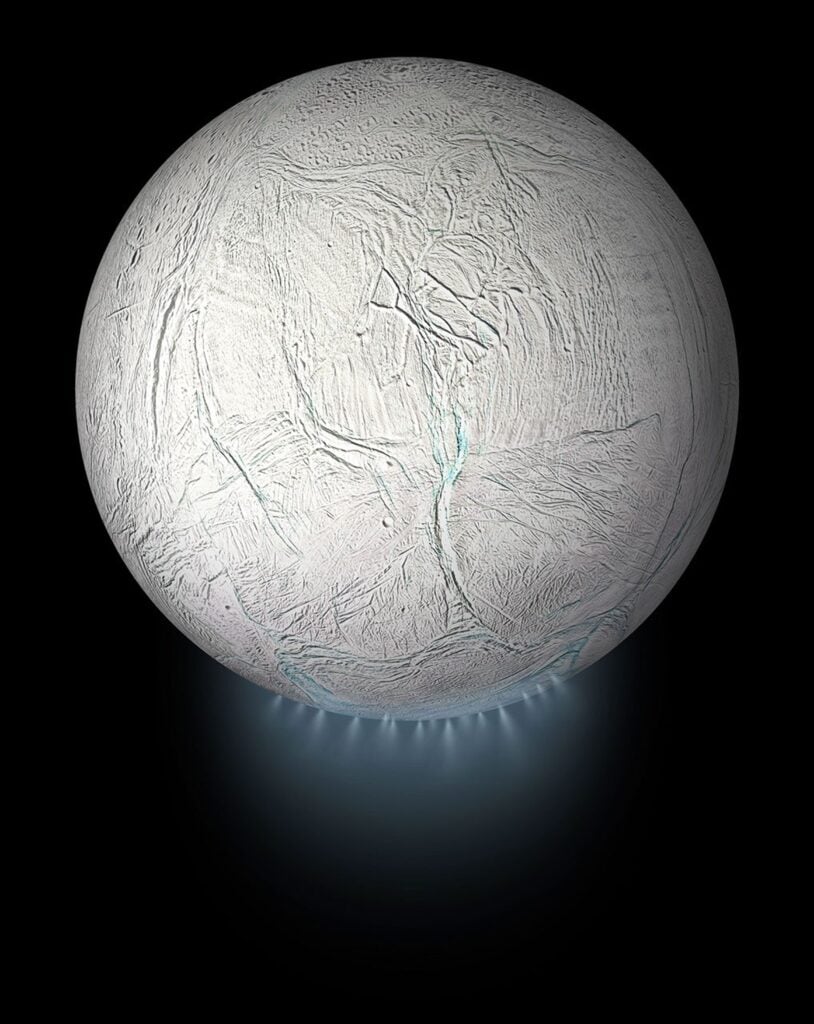
Enceladus offers astrobiology an unusually disciplined question. Saturn’s small icy moon has liquid water, contact between that water and rock, chemical energy, salts, phosphorus and a varied inventory of organic compounds. The models also show ways in which its hidden hydrothermal and oceanic circulation persists through geological time. Those findings make Enceladus plausibly habitable. They do not prove that it is inhabited. This is a synthesis of several Cassini analyses, interior models, and life detection studies, not a conclusion from a single experiment. The distinction is important because a credible failure to find life would require much more than sending an instrument through the spine and seeing no cells. A negative becomes scientifically powerful only when a mission can show that it sampled the right material, looked for several independent signs, and had a high probability of detecting plausible life if it were there. Cassini found a habitable system, not life Cassini changed the state of Enceladus by discovering jets emerging from warm fractures near its south pole and then flying through the combined plume. Gravity data and the slight physical wobble of the moon support the existence of a global liquid ocean beneath the ice. The salty grains connect at least some of the ejected material to water that has interacted with the rock rather than frost scraped just from the surface. The plume is an extraordinary natural distribution system. A spacecraft can collect material exported from an alien ocean without needing to land and drill through miles of ice. However, it is still an indirect sample. Water and particles must travel from the ocean, through a network of fractures and into the void. That trip can dilute material, sort particles by size or chemistry, and alter fragile molecules. Cassini was also designed before anyone knew that Enceladus had this column. Their mass spectrometers could identify gases and fragments of ice grains, but they were not a complete laboratory for establishing life. A helpful earlier Space Daily story on the justification for a significant negative result makes the central point: conditions compatible with life and evidence of life are separate categories. The water that meets the rock provides energy and chemistry. Some of the most important clues concern the rock core. Cassini found small silica particles whose formation is consistent with relatively warm water-rock reactions. During a close pass of the column in 2015, he also measured molecular hydrogen. A team led by J. Hunter Waite reported in a 2017 Science article that the most plausible source was ongoing hydrothermal chemistry. Hydrogen is relevant because it stores usable chemical energy. On Earth, some microorganisms combine hydrogen with carbon dioxide and produce methane, obtaining energy without sunlight. Enceladus supplies the reagents for that pathway. But water-rock reactions can generate hydrogen abiotically, and methane can also have non-biological origins. Detection establishes an available energy source, not an organism that consumes it. The distinction extends to organic compounds. In 2025, Nozair Khawaja and his colleagues reanalyzed grains collected directly from the plume during Cassini’s rapid E5 flyby. Their Nature Astronomy paper reported fragments consistent with several newly recognized classes of organic compounds, along with aromatic and oxygen-containing material seen before. Because the grains were freshly ejected, the chemistry probably came from inside Enceladus rather than forming over years in Saturn’s E ring. Organic still means containing carbon, not biological. Phosphorus strengthened the case for habitability. Phosphorus had been a possible weak point. Earth cells use it in genetic material, membranes and energy transfer chemistry, but some previous models suggested it might be scarce in an alkaline ocean surrounded by rock and ice. That concern weakened in 2023 when Frank Postberg and his colleagues identified sodium phosphates in nine salt-rich grains recorded by Cassini’s Cosmic Dust Analyzer. Their Nature study, supported by laboratory experiments and geochemical modeling, estimated that orthophosphate concentrations in the ocean water that forms the plume were at least 100 times greater than those in Earth’s oceans. The measurement was significant, but its scope must remain visible. Nine phosphate-containing grains do not represent the entire ocean, and transport through vents can concentrate or separate salts. An abundant nutrient also does not demonstrate that something uses it. Five of the six elements commonly summarized as essential for life on Earth have been identified in material derived from Enceladus. This is an impressive chemical inventory, not a biological census. A long-lasting ocean is a model outcome Life needs more than ingredients. It may require stable opportunities for reactions to accumulate, compartments to form, chemical gradients to persist, and selection to begin. This makes the lifespan of the ocean as important as its current composition. Enceladus radiates more heat than a small moon should easily withstand. One proposed solution places tidal dissipation within an unconsolidated and permeable rock core. In a 2017 Nature Astronomy model, Gaël Choblet and colleagues found that water circulating through a tidally heated core could create concentrated hot upwellings and sustain activity for tens of millions to billions of years. That result shows physical plausibility, not a measured birthday for today’s ocean. Other stories may include episodic warming, changes in Saturn’s lunar system, or a younger period of activity. Therefore, the defensible claim is “capable of lasting geological ages.” “Known to have remained unchanged for billions of years” is not. A future mission would need better measurements of heat flow, ice thickness, ocean circulation, and water and rock chemistry to narrow that story down. A negative result would have to earn its meaning. No analysis performed alone did not find any cells that could establish sterility. A biosphere may be sparse, restricted to hydrothermal regions, or poorly connected to vents. The cells could settle into the ocean, break up during the eruption, or miss the narrow collection area of an instrument. Large molecules can fragment when the grains hit a detector at many kilometers per second. Therefore, even an inhabited ocean could produce a seemingly empty sample. Mission designers address that problem by combining measurements that fail in different ways. A landmark scientific framework published in Astrobiology proposed looking for complementary signatures while measuring habitability, plume transport, and geochemical context. Possible evidence includes complex molecular distributions, isotopic patterns, cell-like structures, and chemical imbalances, but no ambiguous signal should lead to the conclusion. Sampling statistics are also important. A Planetary Science Journal model estimated false negative rates for capturing cells from a hypothetical methanogenic biosphere in Enceladus’s ocean. Its assumptions are necessarily uncertain, but the logic is general: a mission must indicate how much material it analyzed, what abundance it could detect, and how surely a null result excludes each plausible scenario. “Searching deeply” would not mean examining every liter of a global ocean. It would mean repeated sampling at different times and sources of the plume, more careful collection where possible, sensitive instruments, contamination controls and a declared detection threshold. It would also mean confirming that the collected grains faithfully represent oceanic material. Why Failure Could Become a Discovery Suppose the program found no cells, no persuasive biological molecular patterns, and no unexplained chemical imbalances, while confirming abundant water, usable energy, nutrients, and a sustained interaction between water and rock. The result would not prove that life had never existed anywhere in the ocean. However, it would set an empirical limit around how easily chemistry becomes biology. The Earth cannot provide that comparison on its own. Life appeared early in the surviving terrestrial record, but the planet retains no accessible control: Earth with the same raw materials and no biology. A well-characterized and apparently sterile Enceladus could serve as something closer to a natural control. It could show that habitability is common, while abiogenesis requires a rarer sequence of gradients, surfaces, cycles, time and chance. There are other interpretations. Life could use chemistry that our instruments were not designed to recognize. It could have arisen and died out, or remained confined beyond the reach of the column. Those possibilities are why a negative result would gradually become more informative, as mission sensitivity and environmental knowledge improve, rather than a dramatic non-detection. Enceladus remains one of the best places to find life beyond Earth. The same evidence that makes a positive result plausible is what could make a rigorous negative result consequential. Livability describes an opportunity. If repeated, well-calibrated searches found that the opportunity was never taken, astrobiology would have learned that a suitable house and a living occupant are separated by more than one list of ingredients.