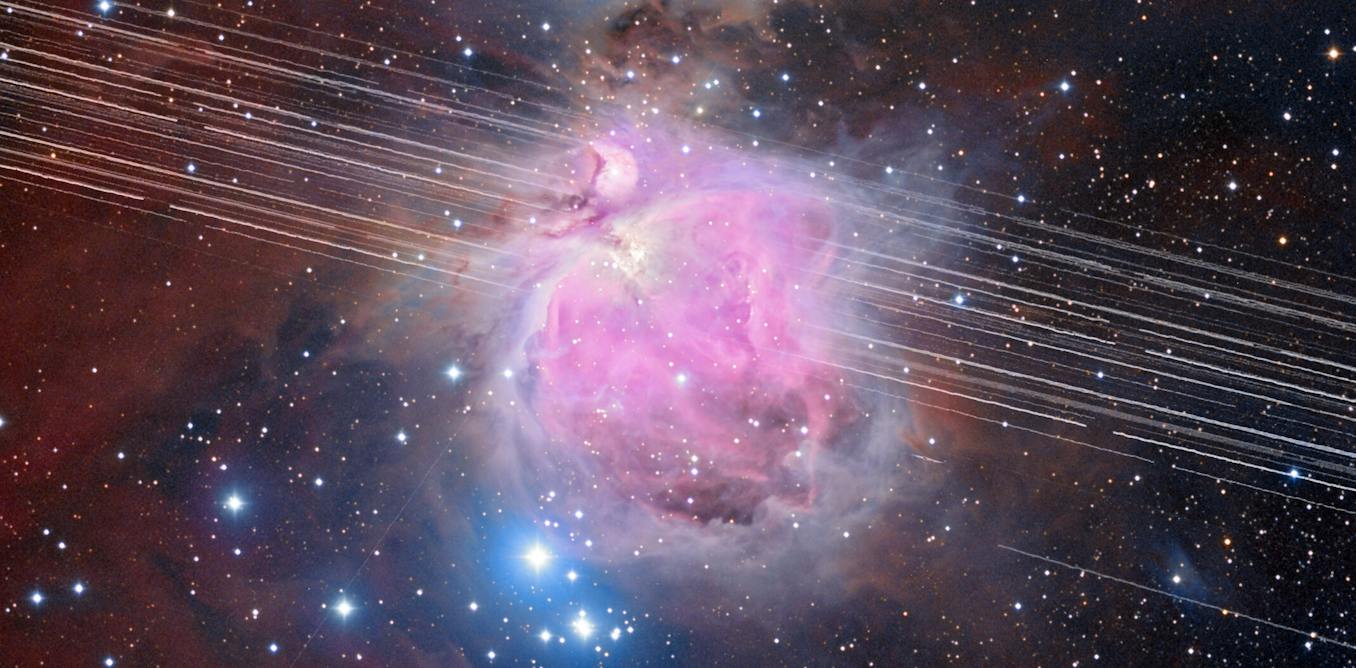
This week, on the eve of the Thanksgiving holiday, the US Federal Communications Commission approved SpaceX’s plan to launch one million “Starmind” artificial intelligence (AI) data center satellites. This decision reflects the convergence of a satellite boom, an AI bubble, and the Trump administration’s disregard for environmental regulation. If Starmind moves forward in full, the number of operational satellites will increase 50-fold. Space and our night skies will become much busier places. SpaceX’s goal is to shift the impact away from data centers on Earth, using one million solar-powered satellites to process AI data in space and transmit the results back to Earth. But what is the impact of a million satellites, both in space and on Earth? Why has the Federal Communications Commission made this decision? And will a million satellites really end up in orbit? Ups and downs We are currently in a satellite boom, and constellations of hundreds or thousands of satellites are a key feature. The Starlink Internet satellites (another SpaceX project) are the best-known example of such a constellation. Orbital rocket launches have increased to almost one a day, while the number of operational satellites is approaching 20,000. Starlink is currently the largest satellite constellation, but it is small compared to the proposed Starmind. SpaceX But Starmind represents something more. One million satellites. Putting so many satellites into orbit would be a huge task. If the satellites have a five-year lifespan (similar to Starlink satellites), then approximately 500 satellites would need to be launched each day. This also implies that approximately 500 satellites would eventually need to be removed each day. For satellites less than 2,000 kilometers above Earth, disposal usually means re-entry and combustion in the atmosphere. And this has consequences. When satellites burn up in the atmosphere, their materials react and are deposited in the upper atmosphere. We now have satellites that deposit much more aluminum, titanium, copper and lead into the atmosphere than the natural amounts of meteors. Aluminum is of particular concern as it can cause ozone destruction in the upper atmosphere. This could increase ultraviolet light on Earth and the risk of skin cancer. There is a lot of work Increasing the number of satellites by a factor of 50 will change our view of the sky. If you look up during the early evening hours, you will see the stars that your ancestors saw. But in a minute or two you will see a satellite. A point of light that moves silently from horizon to horizon. Satellites are already quite common and Starmind would make things worse. Our view of the night skies could fundamentally change. Each satellite would be 75 meters wide and at sunset they will be brighter than any star. And with a million satellites in orbit, there will be hundreds of Starmind satellites over the horizon, regardless of where you are. Orbital disorder carries real risks. Satellites travel at speeds of about seven kilometers per second and collisions produce clouds of debris that can lead to more collisions. One nightmare scenario is Kessler syndrome: a runaway cascade of debris that produces collisions that render low-Earth orbit useless. Of course, SpaceX is aware of the risks of orbital collisions and already mitigates this risk with Starlink by maneuvering satellites away from potential collisions. However, such maneuvers require operational satellites and it is inevitable that some satellites will fail. These uncontrolled satellites will represent a real danger. Regulator or promoter? The Federal Communications Commission has been a key regulator for American satellites. This has included the regulation of radio frequencies used by satellites for communications to and from Earth, the disposal of satellites at the end of their useful life, and environmental impacts. Under the Trump administration, however, the commission is taking a more flexible approach to regulating satellites. This does not include any consideration of environmental impact, which is reflected in the commission’s decision on Starmind. It says the commission “will not require additional environmental review under the National Environmental Policy Act.” […] for SpaceX’s Starmind system.” There are also some statements from the commission about Starmind that are, frankly, strange. For example, it claims that Starmind “promises to bring the human race closer to a Kardashev II civilization, one that can harness the full power of the sun.” This is science fiction nonsense. A Kardashev II civilization would need many trillions of square kilometers of technology in orbit around the Sun. Starmind is not a stepping stone to a vast “Dyson Sphere”: a hypothetical megastructure that would surround the Sun and capture its energy. But can it work? One of the reasons data centers are so unpopular on Earth is the use of precious resources, including water to cool hot computer processors. But of course, it is possible to regulate heat in space, and satellites do it all the time, but they are not typically spilling heat like data centers do. AI, but there had to be some downtime between calculations to remove the excess heat bubble, then the explosion can bring Starmind back to Earth.